A recent (re)post from the excellent Art of Manliness covered The Insanely Difficult Standards of Histories Hardest P.E. Program. Brett is not typically prone to hyperbole but compared with the current physical education provided students – which is a travesty! – the observation is correct. But he has written about the Spartans, so he knows that standards have been higher. As laudable and challenging as the La Sierra System was, it was no agoge!
In the Hoplites and Physical Limitations, I took Donlan and Thompson (1976) to task for thinking college athletes were a viable comparison to Athenian hoplites when evaluating if it were possible to run a mile in panapoly. I suspect it is the oldest truism that each generation thinks they had it hardest and that there is nothing but a continued decline in physicality and grit. I am inclined to agree that, on average, it is in fact true.
My primary context is from Aikido. To attract and retain students, and because the average instructor is aging, the level of intensity is markedly less than what I remember. I admit to being complicit: when I instruct, I do not demand (or provide) as much as I did a decade ago. I assuage my guilt by telling myself that physical conditioning isn’t the primary goal of learning a martial art (it isn’t). But it doesn’t help because I know that while it isn’t the primary goal, it is an important by-product. Athleticism is required for martial excellence.
Athleticism I define as integrated somatic awareness and skillful ability – you need to be kinesthetically engaged with your environment, be able to move your body appropriately to effect a physical goal, and have the endurance to sustain the activity.[1]
Our ancestors were more athletic because they were generalists by necessity. To survive and thrive in a world with tools of minimal mechanical advantage, muscular labor was everything. Therefore everyone performed manual labor, if only because walking was the primary means of conveyance. I have an Oura ring to nag me into activity and achieve my daily step goal.
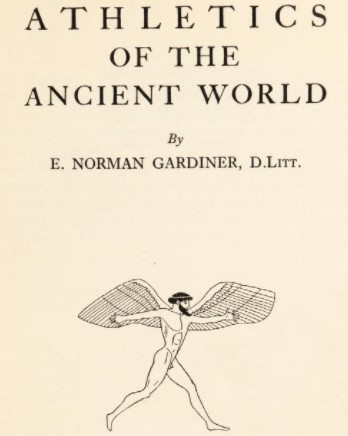
But there is hope. Despite near sloth-like activity levels when contrasted with the (even recent) past, the body is universally pliable. As some company slogan says, all we have to do is just do it! The means of physical conditioning and improvement have not materially changed since the dawn of recorded history. This is best shown in E. Norman Gardner’s (1930) survey, Athletics in the Ancient World.
I have mused about the origins and importance of Elite Competition, and Gardner’s introduction is a perfect summary, which I copy in full:

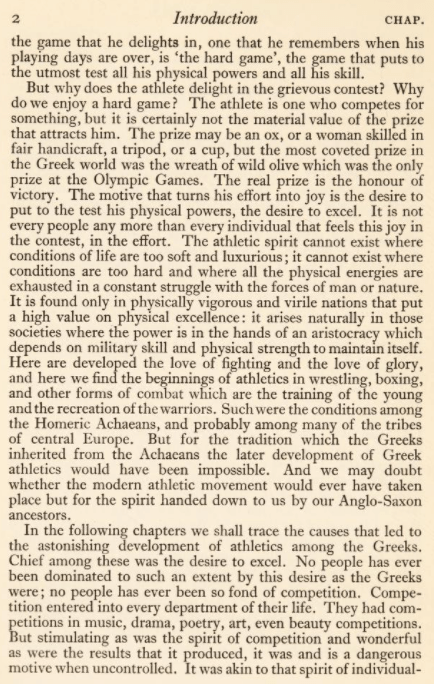
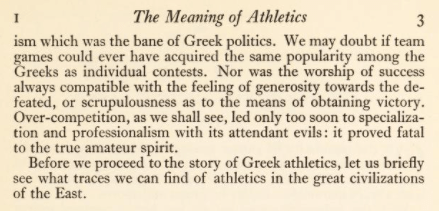
The ideals of excellence are often exemplified by the sports, the athletic contests that are played and form the basis of competition. The connections among athleticism, athletics and excellence competitively proven are ancient and remain irrefutable.
In book 8 of the Odyssey, Odysseus is hosted by the Phaeacians who compete in athletic contests. These competitions all go smoothly until one prince tries to get Odysseus to take part. He politely declines, but when that prince suggests that Odysseus looks like a businessman, not an athlete, Odysseus is goaded to action by this unbearable taunt. He discards his cloak and throws a discus much farther than any of the Phaeacians. (His impressive showing in the discus is somehow seen as proving that he is not a merchant.) An embarrassed silence follows, but the king heals the rift with lots of praise and presents.
But in these contests, all the activities are individual sports, sports that require no cooperation with others. And I now also have Gardner’s conclusion to justify my abject lack of interest in American team-sports like football and baseball: “We may doubt if team games could ever have acquired the same popularity among the Greeks as individual contests.” I am more Ancient Greek than American in that regard.
________________
[1] My definition of athleticism integrates skill because regardless of “natural” and “innate” ability, excellence requires training: strength, vigor and physical endurance are vital components to be cultivated, but in themselves do not constitute athleticism.
 Protective Arts