April 25, 2022. Two synchronous events: Elon Musk buys Twitter and Erdoğan sentences Osman Kavala to life imprisonment.
If we take Musk at his word, he purchased Twitter to expand free speech: “Free speech is the bedrock of a functioning democracy, and Twitter is the digital town square where matters vital to the future of humanity are debated.” There are skeptics, of course, who doubt Musk’s sincerity. Nevertheless, Musk will likely reinstate banned individuals (including Trump), allow editing of posts, and in general have less control over posted content. This would be a move in the correct direction. The market-place of ideas should and must be unfettered.
Human-rights activists who fear a rise in “hate speech” miss the deeper principle. Hate speech is deplorable, but in an open society it must be defeated by argument, not suppression. Censorship grants ugliness moral glamour and drives it underground, where resentment ferments without reply. The better argument, the life-giving sword, is the antidote.
Deborah Brown, of Human Rights Watch, while rightly wary of state surveillance, reveals the contradiction of modern activism when she insists, “Freedom of expression is not an absolute right, which is why Twitter needs to invest in keeping its most vulnerable users safe.” Think through that statement. Freedom of expression is absolute, limited only by the libertarian maxim: one’s liberty ends where another’s begins. Speech acts certainly have impact, and there is harmful speech (which sometimes rises to criminal behavior) but we cannot and must not create safe spaces. The world is not a safe place. What needs happen is to create resilient, intelligent, and independent humans. Humans who are smart enough to evaluate information critically, who think broadly, and who are robust and assertive enough to discern and fight against evil acts. “Safety,” in the way Brown means it, requires protection from offense, not coercion. That is not liberty; it is infantilization.
To keep a platform “safe” demands surveillance. To eliminate “hate speech” requires the creation of censors. And once censors exist, they require doctrine. The instinct to protect swiftly becomes the habit to police. A population made “safe” becomes a population relieved of agency.
What Brown and the other anointed forget is that we have real-world examples of what “safe spaces” look like under enlightened censors. Erdoğan provides one. So does every tyrant who imprisons a man for speaking the wrong truth.
The digital town square has replaced the physical one, but the tension is ancient. The printing press, the radio, the television broadcast. Each age has produced its own chorus of reformers insisting that control equals virtue. Yet presses have always been privately owned, town criers always paid by the crown.[1] The illusion of “public good” has merely shifted platforms. Freedom of the press remains an ideal; in practice it has always depended on private ownership and the courage to publish what offends.
Technological democratization has lowered the cost of speech but not the price of courage. The crowd still decides what it will hear. Peckinpah’s The Osterman Weekend captured the dynamic perfectly: Rutger Hauer’s weary anchorman reminds viewers that the medium is not the villain, the audience is. “It’s a simple movement,” he says. “Done with the hand and what’s left of your free will. My bet is you can’t do it.”[2]
Consumption is a choice. So is outrage.
When Musk promises to make Twitter a freer forum, we should hold him to it but not sanctify him for it. The real test is not whether the powerful allow speech, but whether the public still has the stamina to hear what it despises.
Free speech is dangerous, impolite, and indispensable. Safety is comfortable, docile, and the first refuge of those who fear responsibility. Choose one.
Virtūs et Honos
____________
[1] The town square has changed. No longer a geographic location where denizens meet and listen to speakers, the digital town square is a forum of ideas where people subscribe to content. Activists who fear that ownership of any given platform will have a “chilling” impact are both correct and historically naive. Not all speakers can elocute with equal charisma (q.v. Weber’s analysis and if you don’t want to read the original, >here< is the online course). Technological advances have lowered the cost of entry and made it much easier to distribute information, but the platforms are private companies. People who believe that Twitter, Facebook, whatever the company du jour, are a “public good,” or should be subject to regulation to ensure access, need to think more critically. (There is a very interesting thread by Twitter founder Jack Dorsey on the Musk/public good concept. Do note Dorsey’s very personally lucrative post-sale regret that one should own Twitter, but if it were to be someone, it’s Musk…)
[2] We have been here before – bemoaning the private control of the public forum. The Osterman Weekend is instructive.
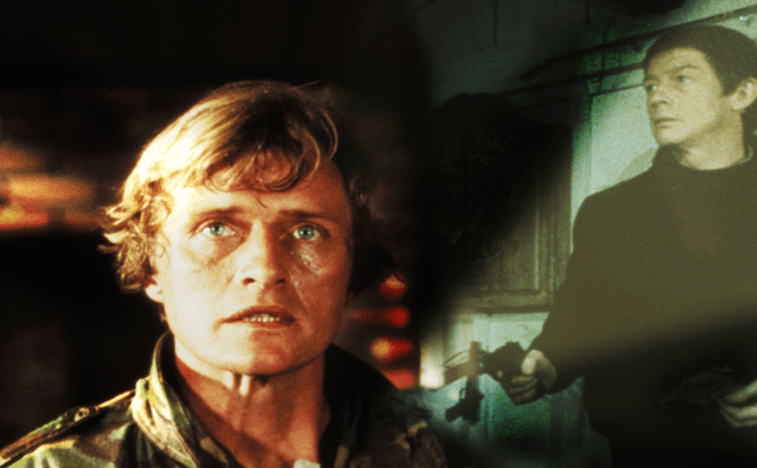
Based on the Ludlum novel of the same name, in the movie, CIA agent Lawrence Fassett convinces John Tanner, a famous television interviewer, to collaborate with him to unmask a Russian organization which counts some of Tanner’s old friends as members. I won’t divulge the plot because the movie is worth watching (Peckinpah’s last feature film). The movie is instructive because it is a pointed indictment of the power of television (then high-tech public forum). Tanner (Rutger Hauer) delivers the damning reminder:
What you’ve just witnessed is, in many ways, a life-sized video game. You saw a liar talk to a killer and you couldn’t tell them apart. But hey, it’s only television. As you may know, television programs are just the filler between attempts to steal your money. So if you want to save some, turn me off. It’s a simple movement, done with the hand and what is left of your free will. The moment is now. My bet is you can’t do it. But go ahead and try.
[beat]
Am I still on?
The culpability is with the viewer – consumption is a choice.
__________________
Update 4.28.22 – The Economist published its position on Musk’s acquisition >here< and I agree with its penultimate paragraph:
This newspaper shares Mr Musk’s free-speech convictions. Nobody has a monopoly on wisdom. Experts are sometimes wrong and blowhards sometimes right. Even in the internet age, the best response to a bad argument is a better one. Moderation on many platforms has become heavy-handed and arbitrarily enforced. If Mr Musk’s talent for shaking up industries can help cut the Gordian knot of online speech, everyone will benefit.
A pithy summary, but read the full article.
Update 11.18.22 – Thomas Zimmer on Musk’s libertarian-to-far-right transformation and his destruction of the public square.
Update 11.21.22 – Since Elon Musk took over Twitter, Republicans have been gaining followers and Democrats losing them. Why? I am confused by the behavioral changes given an ownership change. Selective algorithms or self-fulfilling prophecy based on user bias?
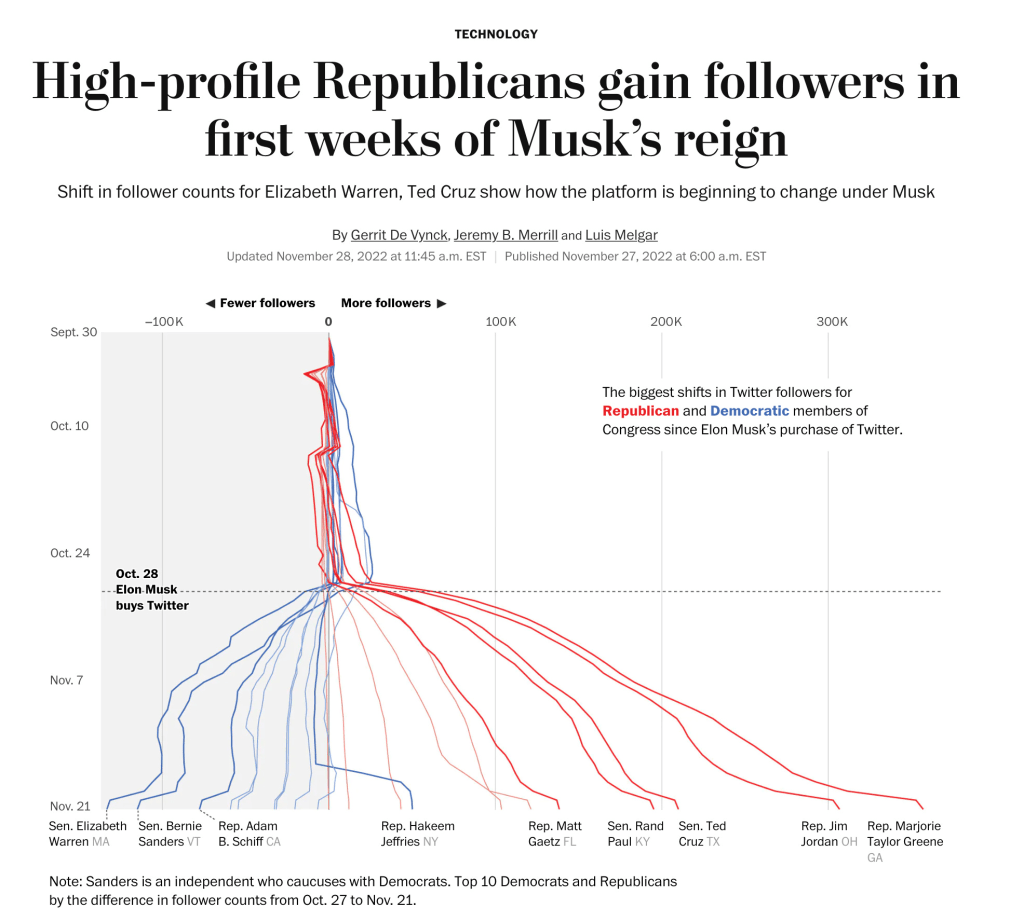
Of course, many will point to Musk’s Thanos-snap reduction of the Twitter work force by half as a cause.
 Protective Arts