I was unimpressed by Graeber’s Debt: The First 5,000 Years. Its conclusions were juvenile, a moralist’s wish to abolish the machinery that sustains civilization. Debt is not an aberration of justice; it is its ledger. The financial edifice may be flawed, but it is constructed and destroying it is not an option. Even sovereign adversaries, locked in open conflict, still meet their obligations.
In April 2022, as Russia shelled Ukrainian cities, it nonetheless tried to pay $649 million in dollar-denominated interest. The attempt failed because the payment was offered in rubles. Fortune summarized the absurdity:
Russia is moving closer to its first default on foreign debt in over a century, after a watchdog ruled that the country’s attempt to settle a $649 million dollar-denominated interest payment in rubles isn’t going to fly.
Fortune, April 21, 2022
Why was Moscow even bothering? Why not simply repudiate the debt?
Because even Putin knows that access to capital depends on reputation. To default deliberately is to exile oneself from the global market. In the bond world, trust is quantifiable; the penalty for its violation is exact. The current quibbling over whether payment in rubles counts as default is mere gamesmanship. The West froze Russia’s reserves and embargoed its exports; the gesture of payment was theater but telling theater.
As I argued in Economic Warfare, sanctions led by the United States are a denial-of-service attack on the Russian state. Credit agencies have withdrawn their ratings for Russian entities, effectively locking its firms out of capital markets. This is the power of the Iron Bank: access, or exile.
Watch the brinksmanship as it unfolds during the course of Russia’s war to see precisely how committed they are to escalating the conflict. If Putin repudiates all debt then beware, that is one step from hitting the launch button on the nukes.
The last major country to purposefully refuse to pay was Germany on the eve of WW2 despite years of negotiations to reduce the debt burden of the Treaty of Versailles (q.v. the 1924 Dawes Plan, the 1929 Young Plan, and the 1932 Lausanne).[1]
I suspect (and pray) that Russia’s finance ministry will continue to litigate and delay rather than repudiate. As long as Moscow is still “negotiating,” it implies rational actors remain inside the Kremlin. The oligarchs may be odious, but their instinct for solvency may restrain catastrophe. Even in its current isolation, Russia is unusually resilient: its debt-to-GDP ratio is among the lowest of any major economy.
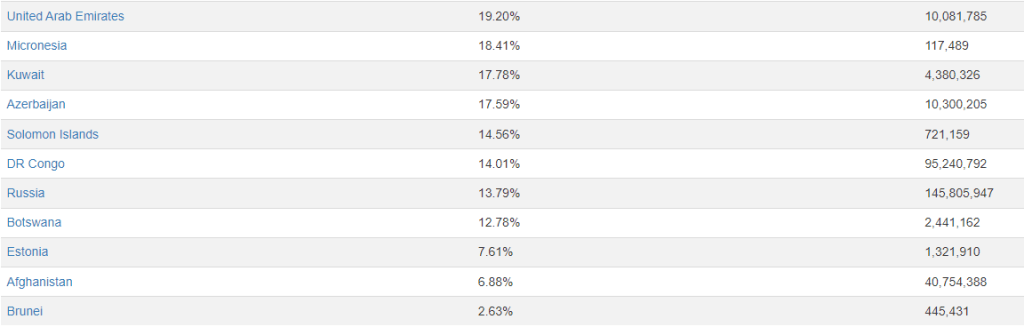
The only countries with lower debt to GDP ratios are either massive oil exporters, or such poor credit risks that no one lends to them (buys their sovereign debt). But Russia has kept itself insulated, not isolated.
This fact undermines Graeber’s central conceit. He condemned debt as impersonal because it quantifies obligation, but that impersonality is precisely what makes it civilizing. Debt is the mathematical form of trust, the proof that promises can survive politics. On the international scale, it is not merely an instrument of finance but of peace.
I hope that the oligarchs and financiers in Russia have the outsized political influence they have in the West. I pray that the debt-games being played in real time are earnest efforts to negotiate, because that indicates rational actors remain in Russia. If Putin truly is the sole autocrat then my fears will continue to amplify as we watch the proxy war escalate. The Western war machine is proving its dominance: it is our weapon systems deployed by brave Ukrainians destroying Russia’s equipment and by all reasonable accounts, Russia’s capabilities already are severely degraded. This humiliating loss will further antagonize an irrational actor. If Putin is unchecked by his financiers, then we all need fear the consequences of him losing the war.
If the financiers have any real power in Russia, then we have a path to a negotiated settlement (of debt and territory), which, odious as it will be, is the only rational resolution to avoid the potential of overt war with a nuclear capable country.[2]
Coda:
Debt, at its root, is the discipline of trust extended beyond the tribe, the proof that memory and morality can be quantified. A handshake is sacred among men who remember their word; among nations, the treasury bond performs that same function.
When a state pays its debts, even to an enemy, it acknowledges a truth deeper than politics; that order itself depends on continuity, that promises survive ideology. When it repudiates them, it declares that might alone is law. Debt is the measure of the civilized.
Graeber mistook the impersonality of obligation for alienation, but impersonality is precisely what allows enemies to negotiate peace instead of vengeance. It is the abstraction that civilizes power. To erase it is to return to tribute, conquest, and plunder.
In war, debt becomes the final test of restraint. When nations still honor their accounts amid ruin, they confess that some things must endure: the arithmetic of trust, the habit of good faith, the fragile fiction that keeps nations from becoming beasts.
______________________
UPDATES
5.13.22 Finland and Sweden to join NATO in response to Russia’s aggression, but Turkey is opposed (shocker!). The Russian economy will likely run a significant trade surplus despite sanctions.
5.7.22 Russia’s economy bounces back despite the direct attacks on its global financial capabilities – Russia also makes its foreign-debt payments.
6.16.22 Now Germany fails to meet its commitments? Et tu Scholz?
6.26.22 Germany – a good piece on why they are unreliable in the support of Ukraine.
6.27.22 Russia defaults on its debt – but the details are muddied and Russia contests its default. Despite the headline “historic” default, note that the Russians appear to be attempting to pay and have been hampered by international sanctions.
______________________
[1] It is important to note that on the 20th anniversary of German reunification (Oct 2, 2010), it made the final payment on its reparation debt incurred during WW1 – a symbolic act as much as an honoring of political treaties.
[2] Finland appears to have learned well from the Winter War (1939-1940) when the Soviets invaded and planned appropriately as technology progressed: Helsinki has more than 5,500 bunkers, with space for 900,000 people. Finland as a whole has shelter spaces for 4.4 million, in more than 54,000 separate locations. Nuclear-resistant shelter for over 78% of their entire population. Well prepared indeed!
 Protective Arts
One thought on “Financial Warfare Redux”