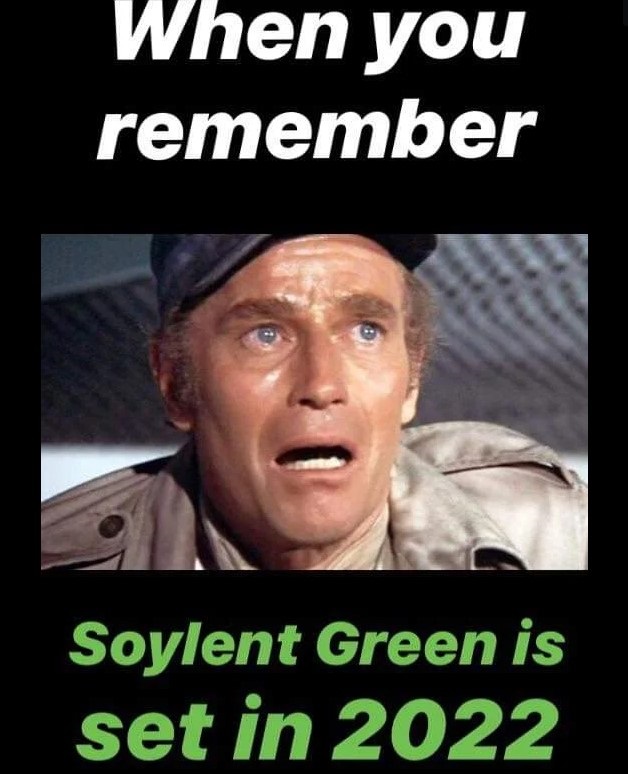
Soylent Green, based on a Harry Harrison novel [1], was released in 1973 and set in the distant future of 2022! This dystopian future is one ruined by overpopulation and ecological destruction.[2] The plot revolves around a murder investigation that leads to the discovery of a corporate report, “Soylent Oceanographic Survey Report, 2015–2019” that concludes the oceans are dying. Dead oceans cannot produce plankton, so how is the only remaining food source for an over-crowded world, Soylent Green, produced?

“Soylent Green is people,” the culminating scene in the movie, with Charlton Heston delivering the line.[3]
Dated as it is, I still recommend the movie. Charlton Heston’s mentor, Sol (played by an aged Edward G. Robinson)[4], who first learns the truth of Soylent Green is driven to assisted suicide (Oregon) and that scene is powerful.
Sol has volunteered for assisted suicide and the incentive is to experience an immersive video of the beauty of an Earth that no longer exists – a “natural” world untainted by mankind. The beauty is stunning for Frank Thorn (Heston) who is too young to have ever experienced the raw power of an unspoiled world. He is emotionally overwhelmed as he watches his friend die. For Sol, it is a return to the idealized past of his youth; a means to reward and comfort his passing. Virtual reality alleviating the anxiety of death.
My thoughts jumped to Soylent Green today because I read the synopsis of “The Effect of Reminiscence Therapy Using Virtual Reality on Apathy in Residential Aged Care: Multisite Nonrandomized Controlled Trial.” The 2021 paper, like many academic studies, was relatively dull and inconclusive, but it does indicate that people prefer VR immersive over flat screen technology and that there (may) be therapeutic uses for augmented reminiscence – a return to our favored past.
À la recherche du temps perdu, Proust [5] writes evocatively on reminiscence and help to answer the singular question: what does a life consist of?
I do not plan to do any deep dive into the literature, but I see that the VR platform is being used (and monetized) by professionals already (Amelia), despite that the benefits are not rigorously demonstrated.
Whatever the provable benefits, the technology is advancing rapidly and most actively by the military (as Mayor’s thesis predicts).
American drone pilots have been operating in a virtual environment to inflict real damage in remote areas for decades. The psychological impacts are telling, with drone pilots are at greater risk for adverse effects. Visualization is powerful, there are certain things once seen cannot be forgotten, and humans remember negative experiences more than positive ones.
One can only hope that eventually an immersive VR experience will be used to enhance our experiences as positively and as effectively as the holodeck in Star Trek.
________________________
[1] Make Room! Make Room! by Harry Harrison (1966) was set in 1999 and does not have the cannibalistic twist (in the book Soylent = “Soy + Len(tils)”) and thus is less dramatic and less compelling than the movie. Harrison’s concern was more simply focused on the growing population problem. Ah, we were all good Malthusians in the late 60s and 70s! Now it is purely ecological destruction we focus upon.
The Netflix series Altered Carbon is a brilliant amalgam of themes, a future where cloning and consciousness-uploading has allowed the ultra rich virtual immortality and plays with the themes of VR hotels, AI autonomy, all within the plot device of a detective story.
[2] Fortunately over population does not appear to be a significant concern (see Demography is Destiny) but the ecological future may be problematical. Another great movie that contends with overpopulation and alludes to plankton (Box!) as a primary food source is Logan’s Run (1976), with the amazing Jenny Agutter.
[3] “An Evolutionary Case for Cannibalism,” Slate Dec., 2010, is a great read.
[4] That death-scene was Robinson’s denouement, he died the year the film was released.
[5] How Proust Can Change Your Life, the 2000 made for TV movie based upon Alain de Bottom’s (1998) book of the same name.
_______________________
UPDATE – The Economist was late to the story
Released 50 years ago, “Soylent Green” is an eerie prophecy
It features Charlton Heston as a sweaty cop in the New York of 2022

Feb 2nd 2023
In his later years, Charlton Heston was known as the Reaganite president of the National Rifle Association. But as a younger actor he was a Democrat and a civil-rights activist. He starred in three dystopian science-fiction films, the messages of which are positively left-wing. They all warn of the catastrophic damage that humans can do to the environment.Listen to this story.
The first and best of these was “Planet of the Apes” (1968), which ended (spoiler alert) with the revelation that civilisation had been destroyed in a nuclear war. In “The Omega Man” (1971), civilisation had been wiped out again, this time by biological warfare. In “Soylent Green”—released 50 years ago, in 1973—civilisation is hanging on, but the situation is precarious.
Pollution and overpopulation have ravaged the natural world, resources are scarce and climate change has brought on “a heatwave all year long”. The unnerving part is that the story is set in 2022. It is impossible to watch the film today without weighing up how accurate its predictions turned out to be.
Loosely based on “Make Room! Make Room!”, a novel of 1966 by Harry Harrison, “Soylent Green” is a melancholy conspiracy thriller written by Stanley Greenberg and directed by Richard Fleischer. Heston stars as Robert Thorn, a hard-bitten police detective in New York who shares a cluttered flat with his sweet old assistant, played by Edward G. Robinson in his final role (he died before the film was released).
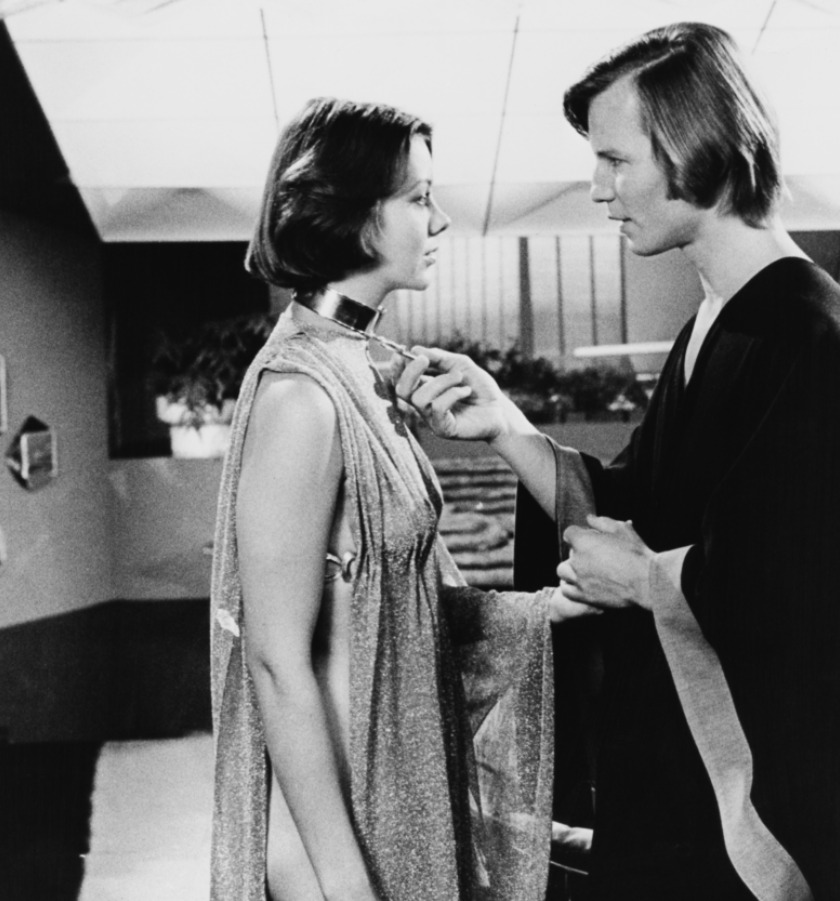
A murder investigation takes Thorn to a plutocrat’s spacious apartment in a fortress-like complex, where he encounters items that, in the world of the movie, are luxuries: soap, fresh apples and, most excitingly of all, air conditioning. “We’ll make it cold like winter used to be,” coos the apartment’s live-in courtesan (Leigh Taylor-Young). The inquiry also takes Thorn towards the truth about Soylent Green, a tasteless foodstuff. It is supposedly made from plankton, but, given that the oceans have been despoiled, it is not.
Considering it was set five decades in the future, “Soylent Green” is remarkably unfuturistic. There are no spaceships or laser guns, just miserable figures shuffling around a dingy brown metropolis. For most people around the world, city life in 2022 was nicer than it is in the film-makers’ imagination, the pandemic notwithstanding. But some elements are too close to reality for comfort: the enmeshing of politics and big business, the separation of rich and poor, and the clashes between the masses and the heavily armed riot police. The relentless, sticky heat may be familiar to modern viewers, too.
The film’s most daringly cynical touch is that New York’s citizens are resigned to the way things are. Nobody thinks that nature might one day recover. Nobody rebels against the corrupt system. Indeed, Thorn himself is happy to be a part of it, as long as he can supplement his income by accepting a few bribes and pilfering a few treats from crime scenes. In its own way, the complacency of the populace in “Soylent Green” is scarier than the mutants in “The Omega Man” and the tyrannical gorillas in “Planet of the Apes”.
 Protective Arts
One thought on “Soylent Green”