I was subjected to some Maoist-light re-education at work. Telling me all about my implicit biases and teaching me all about equity.[1] It came replete with some illustrations.
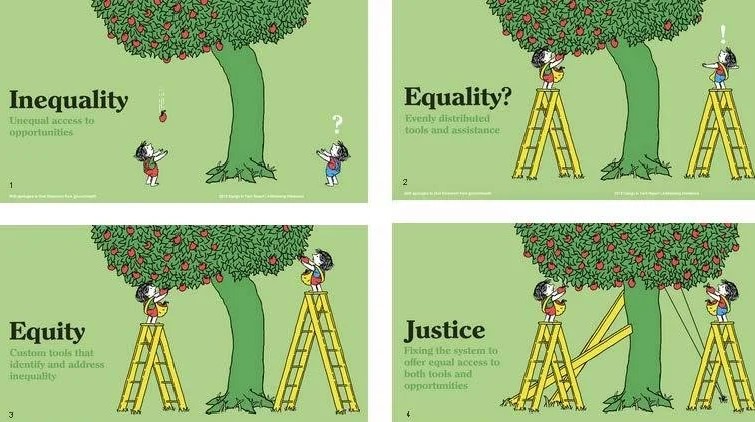
I loathe this image since it makes a direct visual reference to The Giving Tree – one of my favorite books from childhood. I wondered about copyright infringement, but set that aside and read the banal labels for each progressive image.
I find a deep irony in the appropriation of the book because I had read it numerous times and understood its true lessons.
Shel Silverstein shows a beautiful relationship between the tree and the boy who progresses through the natural order of aging with the resulting ever changing needs and wants: at first the boy plays on the tree, then uses the apples from the tree to make money, then the wood for a house, then a boat, and finally the stump upon which to rest as an old man. Silverstein was astute and precise in his presentation. Man interacts with nature as its husband (etymology), a care-taker who cultivates it for purposeful use, not abuse. Those re-educators were trying to pervert Silverstein’s message.
The re-worked graphic doesn’t show what it purports to; I see the true lessons:
Inequality is portrayed correctly: the gifts of nature are unequally distributed (a proper use of “distribution”).
Equality shows the leveling impact of human technology, which even if shared broadly, is not used with the same impact and efficacity: some individuals and groups will use technology to greater advantage.
Equity is shown as if there is a deus ex machina providing ladders of differing but exactly the right height for each person to have equal access to the fruit. Who is this external agent providing perfectly sized ladders? How did they know the need existed, how were they produced, paid for, and distributed? The actual lesson is that differences in original conditions dictate that individuals must exhibit initiative to solve for scarce resources.
Justice is appropriately shown as a perversion of nature – the tree is forced to conform to meet the needs of the individuals, who suddenly have equally sized ladders (where did the perfectly sized ladders go?). Even a less cynical interpretation requires that these competing individuals must have worked cooperatively to brace the one side of the tree and rachet the other. But the more subtle thinker would ask, if they are cooperating and not competing, then why didn’t they simply specialize their roles to maximize collective efficiency: one picks the apples from the ladder while the other gathers and processes them from the ground? Bending the tree to their circumstances was the least productive path (and did their “correction” of the natural world to meet the social goals reduce in lower yields because the crown no longer had maximal access to sunlight?).
The second image they presented was overtly classist and racist:
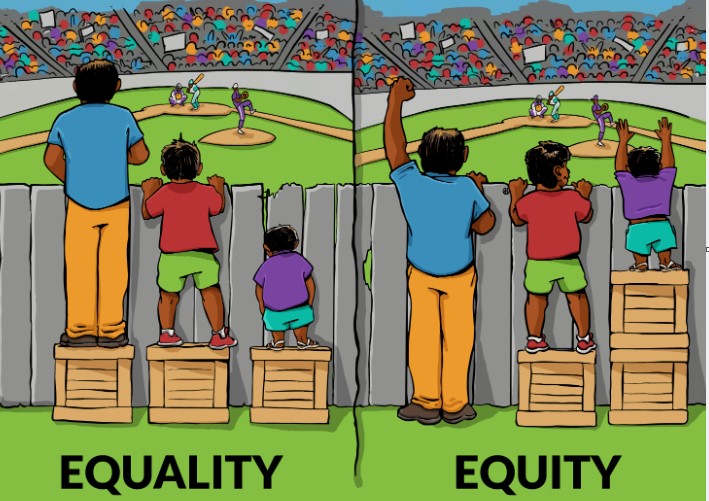
Again, the indoctrinationists were correct to use this image – but not for the reasons they thought! To moralizing idealists, the image illustrates that tired Marxist “to each according to their needs” nonsense. But look closer. The image shows the impact of age. The adult needs no box to see over the fence, the teenager needs but one box and the youth needs two – an equitable distribution of the three boxes. Let’s ignore who supplied the boxes, how they were produced, delivered, and focus on who decided to allocate them equitably. I assume the image is that of a family (albeit solely male – implicit patriarchy preferencing?) and therefore the “father” helped his sons. This would be the exactly correct response: a familial responsibility to maximize the discrete advantage for each member based on the available resources accumulated by the “bread winners.”
As a well-educated, white male representing all the evils of the oppressor class, I could say nothing lest I risk my employment status. But I raged inside at the moralizing propaganda and stupid explicit biases they made in their presentation (not to mention the false consciousness and just poor scholarship).[2] Just look at the graphic – the brown people are non-payers who watch the baseball game from beyond the home run fence. Why don’t they have tickets and sit in the bleachers? How racist is that image to presume an economic disparity based on race!
Discussions of “equality” and “equity” usually focus on income “distribution” and wealth outcomes. Especially in the United States, wealth is primarily “distributed” based on age cohorts.
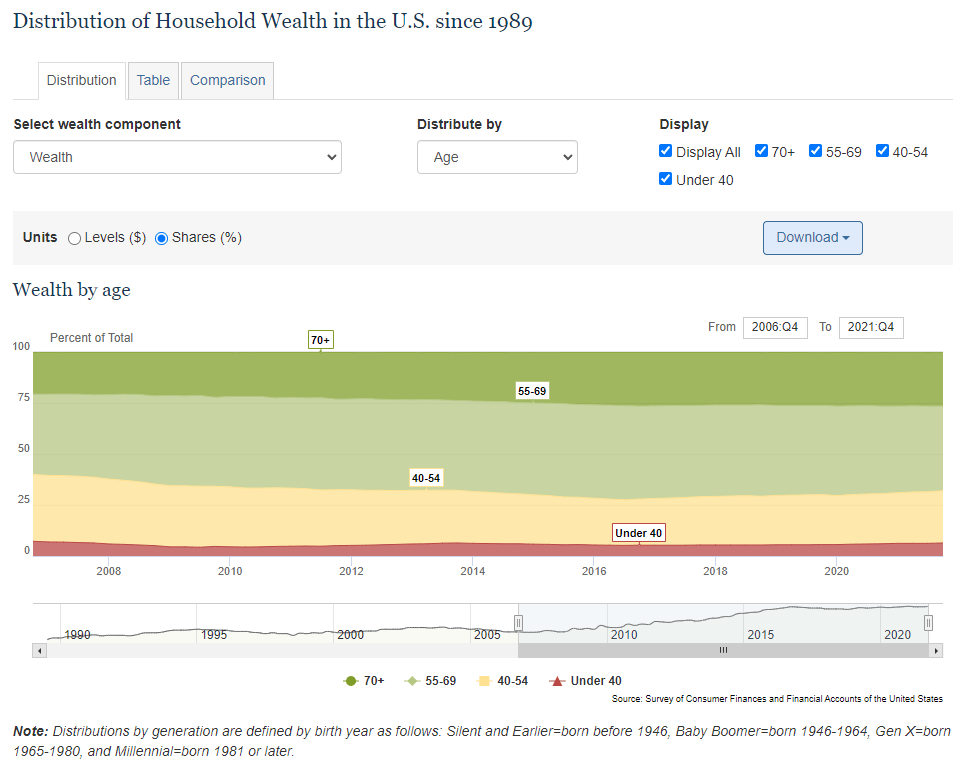
Wealth By Age Distribution is relatively constant across time and the variable component is the fact that individuals, people in aggregate, age. As people age they generally gain in experience and thereby become more valuable employees and therefore earn more to accumulate more assets. [Update: 3Q22 confirmation >here<] Thus older workers earn more and have had longer time to accumulate wealth. Hence the resulting “distribution” of both, which results from the act of earning and saving. There is good literature that shows an increase in inequality in America since 1949 (with exacerbated persistence along racial lines). The Pew Research Center summary on the increase since the 2008 Great Recession is also instructive.
The data may be incontrovertible, but the conclusions are not. The Pew report is balanced in its summary:
One reason for the concern is that people in the lower rungs of the economic ladder may experience diminished economic opportunity and mobility in the face of rising inequality, a phenomenon referred to as The Great Gatsby Curve. Others have highlighted inequality’s negative impact on the political influence of the disadvantaged, on geographic segregation by income, and on economic growth itself. The matter may not be entirely settled, however, as an opposing viewpoint suggests that income inequality does not harm economic opportunity.
The fact that income and wealth are unequally distributed, for some, appears to be a problem to be solved.
Thomas Piketty’s Capital in the Twenty-First Century galvanized academic debate about global inequality.[3] His more recent Capital and Ideology explores the economic and ideological interactions of conflicting social groups to conclude that the great driver of human progress over the centuries has been the struggle for equality and education and not, as often argued, the assertion of property rights or the pursuit of stability.
Hmmm…. not sure that is a conclusion I can agree with or the history of mankind supports. WW2 as a struggle for equality and education?
Piketty further concludes that the new era of extreme inequality that has “derailed progress” since the 1980s, is partly a reaction against communism, and our persistent ignorance, intellectual specialization, and our drift toward the dead-end politics of identity. On that last point, I do concur, but how can one seriously assert that the innovations resulting from intellectual specialization (smart phones, MRna, quantum computing, etc.,) have derailed progress. Unless one defines progress as moving toward some idealized state of social relations and not by material progress and the expansion of wealth and human health (broadly defined).
His solution is to improve each and every individual: we all need to be better educated so we can begin to envision a more balanced approach to economics and politics. Piketty argues for a “participatory” socialism, a system founded on an ideology of equality, social property, education, and the sharing of knowledge and power.
As a Frenchman, Piketty can be forgiven for not knowing American history. The very best argued and thoughtful arrangement of the social contract is the US Constitution. Simply look at its intellectual provenance and the subsequent public debate among the Federalists and Anti-Federalists (who are largely forgotten). These brilliant thinkers did not conclude that socialism was the answer. The answer is to preclude government (i.e., the coercive control of human interaction) from limiting social interactions and explicitly preserving the right of free association. Thus capitalism is a by-product of that freedom; as Milton Freedman showed capitalism alone isn’t sufficient for freedom, but rather its byproduct. The greatest thinkers with the best education understood human nature – demonstrated by historical evidence and tempered with Scottish philosophy – to conclude that limited government with a robust system of checks and balances to limit the tyranny of the minority over the majority (and vice versa) was best. The later forms of “enlightened” government gave the world the French Revolution and the ideological purges of Hitler, Stalin, Mao and other anointed reformers of human nature.
Why do idealists always forget to include human behavior in their analyses? Germans voted Hitler to power, Americans voted F.D.R. (and laterday Trump…). You get what you deserve.
Knowledge isn’t a panacea. In the age of the internet, we have already achieved the greatest distribution of knowledge – the internet is the library of Borges. We drown in knowledge – but that exacerbates the problem of inequality, it doesn’t solve it! An abundance of information and knowledge means that the ability to sift through it to find the practical use for such knowledge is the new imperative.
A story of my personal failure to emphasize the point. I purchased Xerox because of its patent history which I saw as a bulwark for its continued success. Xerox had the information and the knowledge but didn’t know how to capitalize on it. I should have simply followed the crowd into Apple and Microsoft – the companies that actually knew how to put knowledge to purposeful use. Knowledge isn’t sufficient.
“Knowledge is power” is true only if one knows the value of the information and furthermore has the cultural capital (Bourdieu) to exploit it. Perfect distribution of knowledge is eternal stasis, not a means of “progress.” Progress results from differentiation – being able to see and exploit differences. The best definition of intelligence is the ability to see and make connections among seemingly unrelated conditions. Human intelligence as praxis – the act of doing, not just of knowing.
As my Xerox purchase shows, I am an intermittent Platonist who thinks that “knowledge for its own sake” – the understanding of the eternal forms – is important. Then life kicks me as a harsh reminder that I am wrong and my net worth drops.
Idealists like Piketty ignore the immutable fact that wide variances in intelligence, initiative and desires will always result in wide divergences in income and wealth. Piketty recognizes this fact – to an extent. “What I propose is not full equality; there will still be a lot of inequality.” And what “practical” solution does he posit? An “inheritance for all.” The idea is to use a progressive tax on wealth in order to finance a capital transfer to every young adult at the age of 25. What is Piketty’s number? About $134,000 per person, which is about the level of median wealth today in France or in the U.S., and this transfer will help transform the ability of children from poor families or middle-class families to create their own firms. He believes such a transfer of wealth will transform the basic structure of power in society.
Hogwash! The instant the world knows that a settlement check is coming at age 25 would result in moral hazard of the most unprecedented scale. How do I know? I saw it amongst any number of my upper-middle-class classmates in high school. They were the beneficiaries of accumulated wealth and knew that they would not have to work. Their economic security did not spur initiative or innovation. Their access to excellent educations did not guarantee access to knowledge and power. I witnessed a stultifying effect. The lack of adversity resulted in diminished character and enervated initiative.
Milton Freedman destroyed Piketty’s argument (delivered earlier by the same collegiate idealism) years earlier:
Why is inequality in America not a rally-cry? Simple most Americans are comfortably well off and people vote their aspirations. The disparity within America may be pronounced, but I have a suspicion people may have an osmotic understanding that they are far better off just having been born American. We won the global lottery already. As the distribution graph shows, if you are in America, likely you ain’t poor regardless of your relative position within America itself. Any given American may have a diminishing percentage of the “pie of wealth” but that pie has grown so fast as to still improve the average household’s quality of life. Moreover the quality of the goods consumed is no longer dictated by their price: consumption isn’t as unequal as income distribution indicates. (Perhaps my frame of reference is too historical, but I would much rather be born poor in American that be Caesar – we control more raw power over our environment and have access to more creature comforts, see Dracula as Historian.)
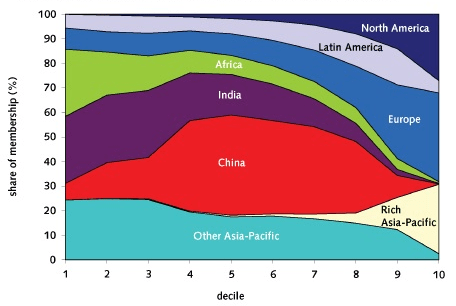
Furthermore, most Americans will also progress (usually upward) through the “distribution” of wealth as they age and continue to be productively employed. Therefore, any future class warfare will not be caused by economic disparity but (as always) by ideological differences.

_______________________
[1] The literature is not supportive of implicit bias training as a “corrective” measure.
The deleterious effects of stereotyping on individual and group outcomes have prompted a search for solutions. One approach has been to increase awareness of the prevalence of stereotyping in the hope of motivating individuals to resist natural inclinations. However, it could be that this strategy creates a norm for stereotyping, which paradoxically undermines desired effects.
Duguid, M. M., & Thomas-Hunt, M. C. (2015). Condoning stereotyping? How awareness of stereotyping prevalence impacts expression of stereotypes. Journal of Applied Psychology, 100(2), 343–359. https://doi.org/10.1037/a0037908
Keep telling me how racist I am and thus I will become if only to meet the stereotype. Pareto distribution (yet again) indicates most of the biases are held by the minority.
[2] False consciousness is a term minted by Marx. The positive formulation, class consciousness, refers to awareness by a social or economic class of their position and interests within the structure of the economic order and social system in which they live. In contrast, false consciousness is a perception of one’s relationships to social and economic systems of an individual nature, and a failure to see oneself as a part of a class with particular class interests relative to the economic order and social system.
[3] The Piketty theory – his economics merit review and thought, but his political conclusions are not meritorious. In summary, Piketty’s political theory suffers the same failure of idealism that Marx perpetuated:
“For as soon as the distribution of labour comes into being, each man has a particular, exclusive sphere of activity, which is forced upon him and from which he cannot escape. He is a hunter, a fisherman, a herdsman, or a critical critic, and must remain so if he does not want to lose his means of livelihood; while in communist society, where nobody has one exclusive sphere of activity but each can become accomplished in any branch he wishes, society regulates the general production and thus makes it possible for me to do one thing today and another tomorrow, to hunt in the morning, fish in the afternoon, rear cattle in the evening, criticise after dinner, just as I have a mind, without ever becoming hunter, fisherman, herdsman or critic.”
― Karl Marx, The German Ideology / Theses on Feuerbach / Introduction to the Critique of Political Economy
Sounds good on paper, but these freedoms first are not desired by everyone equally (as demonstrated by their behavior) and such freedom from specialization requires a high level of wealth. The best recent example of Marx’s dream is Gandhi – about whom Sarojini Naidu, president of the Indian National Congress, astutely quipped, “It costs a lot of money to keep this man in poverty.” The economic freedom implied in the Marxist dream is enormous and requires wealth incalculable (or a reversion to subsistence level living).
For me the most articulate deconstruction of Marx was delivered by Jordan Peterson, not because he is an economist, but because as a psychologist he better understands human nature.
________________
Update – Noah Smith on Piketty – with the conclusion that inequality is declining:
In other words, even if Piketty’s direst warnings were overdone — and even if the leftists who cited his research to warn of the coming collapse of capitalism were blowing hot air — there seems to have been a core of truth to what Piketty wrote. Ultimately, it was a combination of government action, a stock crash, tight labor markets, and deglobalization (if not yet major war) that curbed the upward trend of rising inequality — just as Piketty might have predicted.
The reasons for declining inequality are not however bettering the human condition. The cause was exigent events and negative forces – the leveling of the top, not a rise of the lower quartiles, so I am not impressed. If anything Piketty was calling for a Marxian revolution which would have had the same impact – pulling down the very top percentages which exacerbates the mathematical inequal distributions, but note that pulling down the top only smooths the curve (shortens the distribution tail) – the lower classes are not better off as a result – except perhaps in the malicious joy in knowing that the top tier now seems to have suffered a fall.
Update 1/18/24 – Vincent Geloso “Thomas Piketty’s Motte and Bailey” City Journal
 Protective Arts
One thought on “Equity and Thought Reform”