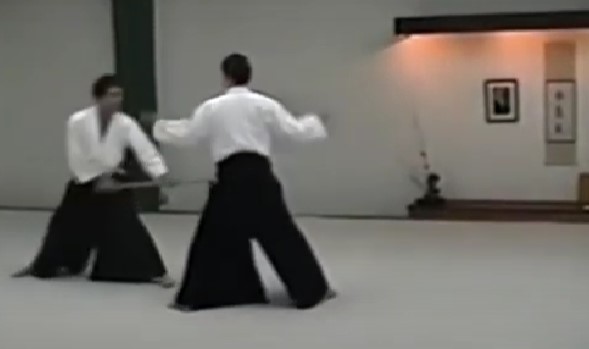
The jō 杖 (“wooden staff”) is a walking stick usually about four feet in length. It is unclear precisely how it became incorporated within Aikido. While some of the jō movements come from spear-fighting (yarijutsu 槍術), and others from staff-fighting (jō-jutsu 杖術 and bō-jutsu 棒術), many of them are most similar to the use of a bayonet (jūken-jutsu).
Jō tori is taking the jō from an armed opponent and perfectly reflects the use of a rifle with bayonet: uke’s attack is uniformly tsuki (thrusting with the point).
Mulligan sensei‘s demonstration illustrates the kihon set up and responses. The first part of the video is jō nage with Asako. The Jō tori with Alex Levens starts at 0:34.
Table summary of the five basic responses (techniques).
| TIME | RELATION | RESPONSE |
| 0:34 | outside | kokyu nage |
| 0:39 | inside | counter tsuki |
| 0:44 | outside | ikkyo |
| 0:49 | inside | ikkyo |
| 0:55 | outside | shiho nage ura |
| 1:02 | outside | shiho nage ura (repeat) |
| 1:08 | inside | shiho nage omote |
| 1:15 | outside | ikkyo (repeat) |
| 1:22 | outside | atemi – juji garami (cross over) |
We have covered all these responses in class. Note that Mulligan sensei does not demonstrate the inside variant of the last technique (juji garami).
Remember that jō nage is weapon retention and jō tori is weapon taking, but many of the movements are essentially the same.
In class we explored an expanded response matrix.
| RESPONSE | RELATION | COMMENTARY |
| kokyu nage (1st) | outside | atemi (shoken) – both hands knuckle up/nails down. Ura-tenkan movement – throw with jō perpendicular (bar bell) |
| kokyu nage (2nd) | outside | atemi (shoken) – both hands knuckle up/nails down. Ura-tenkan movement – throw with jō parallel (requires extending jō forward to impel uke) |
| koshi nage | inside | cognate to kokyu nage – atemi (tegakana to face) – both hands knuckle up/nails down. Tenkan movement (not demonstrated in class) |
| ikkyo | outside | front hand active first – step 90-degree back to avoid thrust – front hand knuckles up, second hand follows – stay outside line |
| ikkyo | inside | front hand active first – step 90-degree back to avoid thrust – front hand knuckles up, second hand follows – stay inside line |
| shiho nage | outside | start like kokyu nage – keep turning |
| shiho nage | inside | omote form |
| juji nage | inside | atemi tegatana – front hand nails up/knuckles down – back hand nails down – uke’s front hand is fulcrum – move to outside (front hand like soto kaiten) |
| juji nage | outside | atemi – front hand nails up/knuckles down – back hand nails down – uke’s front hand is fulcrum – move to inside |
| kokyu ho [1] | outside | three-beat: front hand strike, replace with back hand control of uke’s front hand, then nage’s front hand opens cross body while back hand levers jō opposite vector |
| irimi nage | inside | cognate to kokyu ho – front hand palm strike to chin – back hand rip jō opposite vector while advancing irimi |
| ude kime | outside | atemi (shoken) – front hand grabs nails up/knuckles down, then cams (rotates) over and cross-body irimi to lever uke’s elbow (best done as explosive entry) |
Because the jō is a lever make sure to use mechanical advantage! Make sure you know whose hand is acting as the fulcrum in every encounter (sometimes it is uke’s and other times it is nage’s hand).
General note on atemi
The inside line dictates a strike to uke’s highline with the tegatana (shyuto) or alternatively a palm strike.
The outside line exposes uke’s ribs and armpit, which requires a “standard” punch to the ribs or a middle knuckle (shoken) punch to the armpit.
[1] Parallels to other arts
Kokyu-ho is an “internal” breath throw in Aikido that teaches (and relies upon) abdominal muscles and hip rotation as its primary driver. In jō tori, the low-line (leg) should be used and the “life-giving” palm up presentation of the top (throwing) arm opens cross body. This is not the most martial presentation. Okinawan karate provides a more direct application from the Bubishi, with the shyuto: shyuto ashi harai. This use of shyuto no kamae is preserved in kushanku – with a bunkai as an augmented take down.

Use your front hand to parry opponent hand attack and seize it with your rear hand. Simultaneously strike the opponent’s face with your shyuto and sweep his leg with your thigh (Crane opens its wings).
 Protective Arts