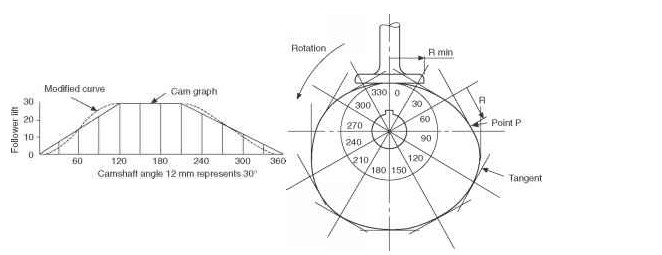
The banner image shows a cam with a flat follower. Cams are used to convert rotary to linear motion. As the cam rotates, the follower rises and falls:
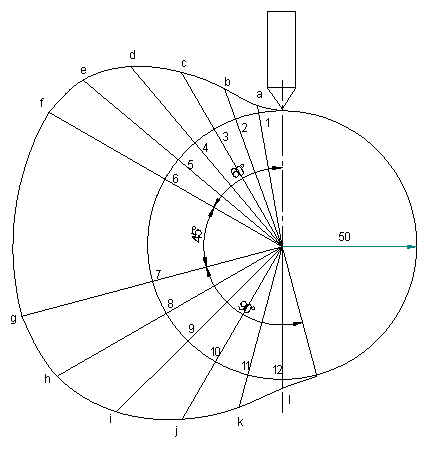
Abrupt changes in the cam’s velocity results in large accelerations and cause the follower to jerk or chatter. In operating machinery, that is not a good thing, but in a martial art context, that is precisely what we want to achieve: a destabilizing reaction in uke.
The easiest example is found in “blocking” actions. I use quotation marks to emphasize the simplistic use of the concept. Blocking is often understood to mean “stopping an action or absorbing a force.”
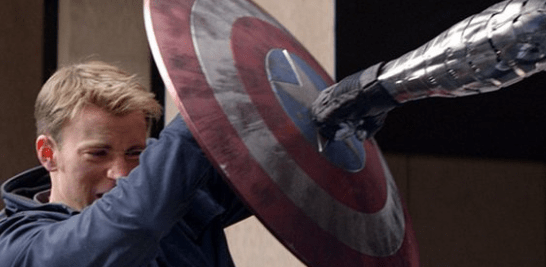
Absorbing a force directly is punishing because the force isn’t dissipated – the physics remains an inelastic collision. Captain America has a Vibranium shield as well as super-human strength and durability – the rest of us have to use technique and demonstrate a better understanding of physics when fending off violent attacks.
Consider the traditional blocks in karate – high / middle / low line:
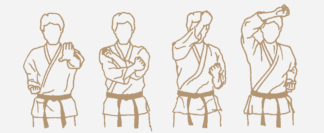
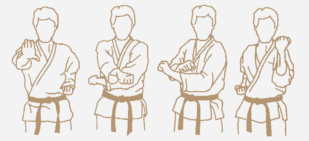
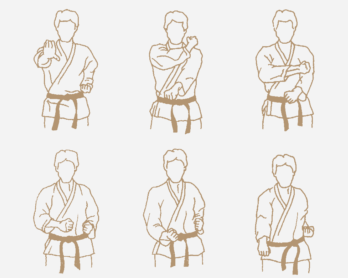
As the images show, the forearm is not used as a flat shield. Rather at the moment the attack is intercepted, nage rotates their forearm – camming it – to deflect and redirect the lineal attack. Properly understood, a block is never just a stopping action, but always incorporates a redirect of incoming energy. The redirect of the assailant’s energy is used to gain positional advantage.
Sifu David Harris demonstrated the concept back in 1993 at James Keating‘s dojo.
The drill and application should look familiar – do you see irimi nage? Because irimi nage often is presented from shomen uchi’s descending arc rather than jo dan tsuki’s line the similarity may not be immediately obvious. Once you recall that all lines can be points, and points can be lines, I hope the similarity will manifest. The key take away should be that the camming action off the initial contact creates the redirect, which affords the opportunity to execute the throw (technique).
I alluded to the importance of camming when I stated that ikkyo is makiotoshi. In that post I focused on the similarity in sword-play, but the action is more pronounced when using the jō (short staff).
With the jō every receiving contact should be executed with an outward camming action to help dissipate the energy from the collision. The returning action, makiotoshi, reverses that winding action so that the camming is inward (tension -> release). These actions are subtle but critically important (and are often not readily apparent and often not highlighted during presentations).
In a similar manner, the non-grabbed shoulder/arm used in kata or katatae-dori should also have an inward camming action rather than a simple draw-pull in order to create a complex (two vector) response to uke’s linear attack.
Lines are solved by circles.
______________________
Unless you are as proficient as Master Ken and can meet lines with lines.
 Protective Arts
2 thoughts on “CAMMING ACTION”