
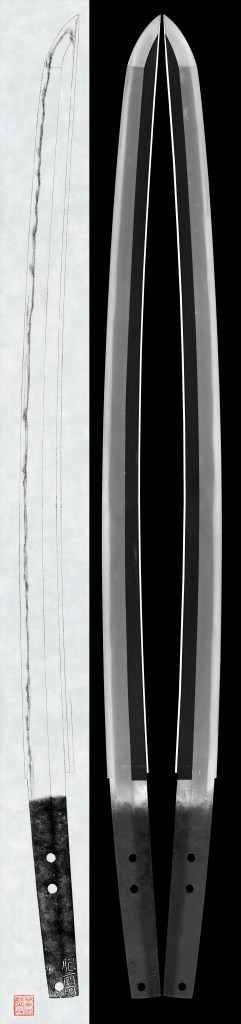
My first historical Japanese sword, forged by the first Hizen Kuni Kawachi Daijyo Fujiwara Masahiro, a swordsmith of the Nabeshima clan who created a unique hamon with the grandson of the first Tadayoshi. He changed his name to Masahiro November 2 in the 2nd year of Kanei (1624) and received Kawachi Daijyo in May of the same year. He died on February 5, 5th year of Kanbun (1665) at the age of 59.
Graded and judged by NBTHK as Hozon Token (worthy of preservation)
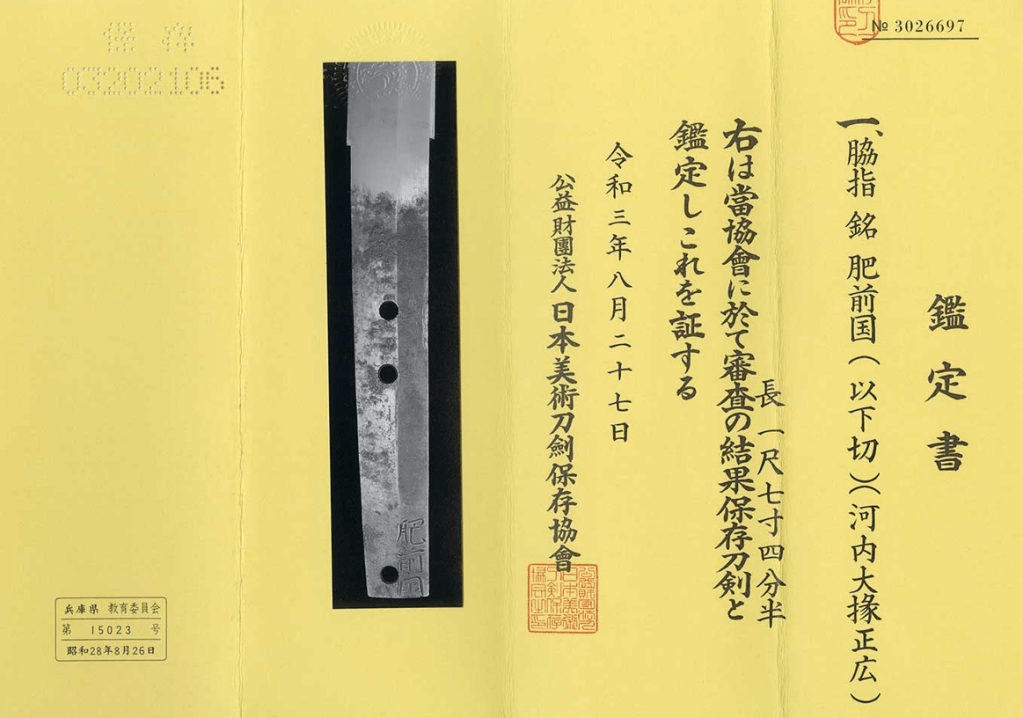
This sword is further ranked as Jyo Jyo Saku (above-superior made).
The blade was polished.
Habaki : Gold foiled single habaki
Blade length : 52.4 cm (20.62 inches)
Sori : 1.2cm (0.47inches)
Mekugi : 3
Width at the hamachi : 2.89cm (1.13inches)
Width at the kissaki : 2.1cm (0.82 inches)
Kasane : 0.5cm (0.19 inches)
The weight of the sword is 530 grams (1.17 lbs).
Era : Edo period Kanei to Kanbun era (mid 1600s)
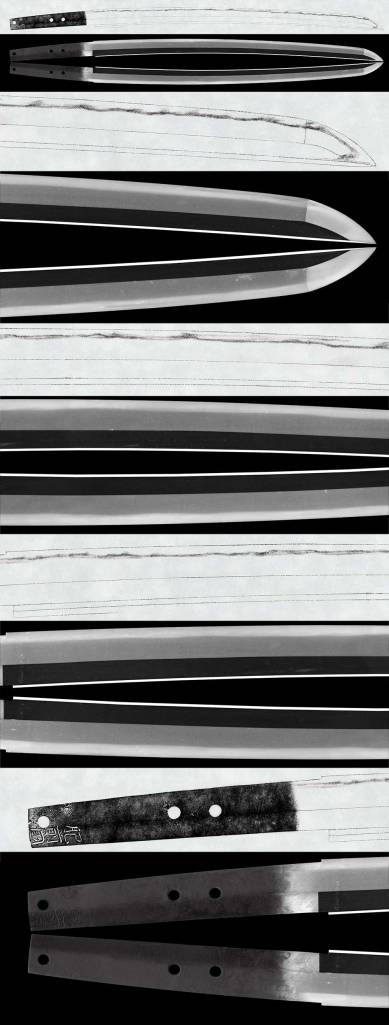
Shape: The blade is suriage (shortened) and left the signature Hizen Kuni (Kawachi Daijyo Masahiro)
Jigane : Koitame hada well-grained with jinie attach beautiful nice texture konuka hada (rice bran) which is called Hizen texture because it is unique to that province.
Hamon : Nie deki middle suguha with deep nioikuchi and soft feeling.
Bo-shi is deep nioikuchi round shape.
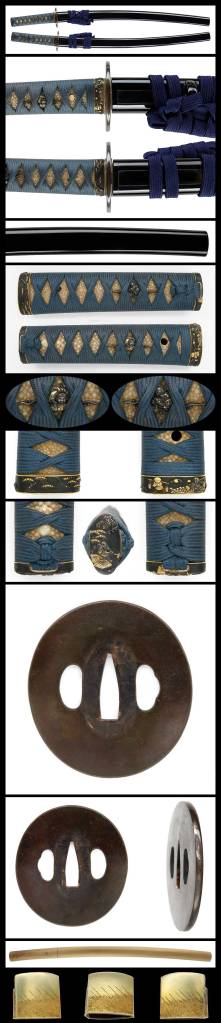
Saya : black roiro saya.
Tsuba : Shibuichi round shape.
Menuki : engraved men with gold color.
From Aoi Bijyutsu: “This work is the work of the first Kawachi Daijyo Fujiwara Masahiro and has Suriage Machiokuri (cut shortened). Koashi is added to the beauty of Jigane and the deep suguha of nioikuchi to create an elegant pattern.”
I wanted to feel an historic blade in hand to compare against my modern collection. As a shortened katana, the point of balance is forward, so I do not know how a purpose-forged wakizashi “should” feel, but the projected blade weight has pragmatic benefits. Compared with the Paul Chen “Practical Plus” wakizashi, the blade is slightly longer, thicker and the spine is stouter. The speed in hand is similar – and because the historic blade is weight forward – it feels faster through the cut. Recovery time for each is quick because the blades are short. Overall I do not notice a significant difference in hand between the historical and modern swords.
 Protective Arts