Raising children is an amazing and humbling experience. During her pregnancy, my wife found a mom’s group where other similarly concerned mothers would gather to share insights, anxieties, and valuable learned lessons to help support one another throughout their pregnancy. The social composition was predictable: upper-middle class, and well-meaning progressive. Discussions started in the early trimesters around pre-natal vitamins, the best washable diaper, then progressed to doulas, and water birth options as the delivery date became imminent. After the baby arrived, co-sleeping, nursing, and creating an active learning environment was the focus. This was a mom’s group and I was not a participant, I was simply there to help implement the decisions.
There was a militant mindset to some of these mothers who were adamant not to impose social structures on their babies – they wanted only natural toys (wood, no plastics!) and all of them were gender neutral (don’t force preferences on these impressionable babbling babies). I was unimpressed with their theories (and dubious that the desired outcome would result) but I was raised by artists who got me hooked on Marlo Thomas as a kid, so I just shrugged and wrote it off as an over-reaction by people who were never forced to eat a carob Easter Bunny. I watched them all bundle their kids off to Waldorf schools to have them experience the over-structured free-exploration dictated by a dead Austrian. Again I shrugged. We couldn’t afford that and Heidi was a dedicated stay-at-home mother.
As Adin grew to a toddler, the big controversy was what content and how much screen time was acceptable, a concern that was only outmatched by the disallowance of toy guns. How could any responsible parent allow anything that promoted violence?
I am not sure when Adin got his first toy gun, but I suspect ours was the first household to violate this urban Portland orthodoxy. It may have been around the same time that I got my first firearm.
Although I had taken professional instruction and had obtained a concealed weapon permit many years prior, I only purchased one in response to two specific incidents.
At the time we were living at 3634 NE 8th Avenue, just north of Freemont Street. It was a transitional neighborhood – you can accuse me of being part of the gentrification of the area. But I was early to the process. My neighbor to the south had a ramshackle shot-gun house with a huge excavated pit for a driveway. He was a long-haul trucker and parked his tactor out front when he was home. When he wasn’t, the feral cats who adopted the open crawl space under his house would roam looking for hand-outs.
Adin was an active baby and he would wake up early. Being a well-trained husband, I would get up with him and (if it were before 5AM) put him in a sling and go for a walk until he fell back asleep, or (if it were after 5AM), simply get up and play with him. The first incident occurred one early morning when he woke slightly after 5, so we were playing quietly on the front porch – which was elevated and set back from the street.
Someone I didn’t recognize was walking along the street (not the sidewalk) but then stopped by my neighbor’s car and began fiddling with the door. I heard the snap of the shot before I saw my neighbor walking (revolver extended one-handed) down his rickety steps leading to the sidewalk. The prowler yelled “Damn nigger you crazy!” as he ran from the car. It didn’t take long before the police had taped off the block and began interviewing my neighbor. Fortunately, I heard his answer: “This guy was breaking into my car (true) and when I came to stop him, he had a knife in his hand (it was a screwdriver) and he came at me (nope) so I shot at him (actually he shot before the prowler even knew he had been seen),” so I was prepared when an officer interviewed me, “Sir, did you see anything?” Why yes, I did see a prowler who did have something in his hand as he ran away, and I did hear the shot, but I didn’t really see the confrontation. Enough to corroborate so my neighbor was cleared of the discharge. Yes the shot was reckless and unlawful, but, it was in the right direction, there were no bystanders (so no innocents in harms way), and I figured the dirtbags would talk and not come around for a while for fear of getting shot.
That incident probably did keep crime down for a while, but on my very first day of my new job at Unico, I got a call from a Portland Police officer who told me he was standing in my living room. I frantically drove home and the officer told me someone had broken in through my front door, but a neighbor had called it in. Fortunately, Heidi had not been home and the police were responsive so no one was hurt and nothing stolen. But that second incident (and the persistent drug deals and hookers in the area) convinced Heidi to allow me to purchase a firearm: a Mossberg 500 tactical (she also had me put in an alarm system).
Now we had a firearm in the house: How would we answer the fashionable question of concerned parents before playdates, “Is there a gun in the house?” No one ever asked about swords, knifes, or other instruments of death and destruction, but guns were verboten! So we did what any socially conditioned person would do when confronted, we lied. I suspect it was the same tuck-tail lie my Protestant ancestors told when confronted by Mary I’s zealots.
Over the ensuing years, I had the very good fortune to take numerous classes at the Oregon Firearms Academy before it closed in 2016. I also put myself through (and maintained) an active armed security card with DPSST for a decade before I let it expire. I still maintain a CWP (in OR and Utah) but do not train or practice nearly as often as I should to maintain the perishable skills I paid and trained to acquire. Fortunately, my boys are now old enough (Heidi being the arbitrator of that date) so I have introduced them to the proper use of firearms and I can once again train more often and with a broader array. My collection has grown since the Mossberg, to include several handguns, small caliber carbines, and even a dreaded AR-15.
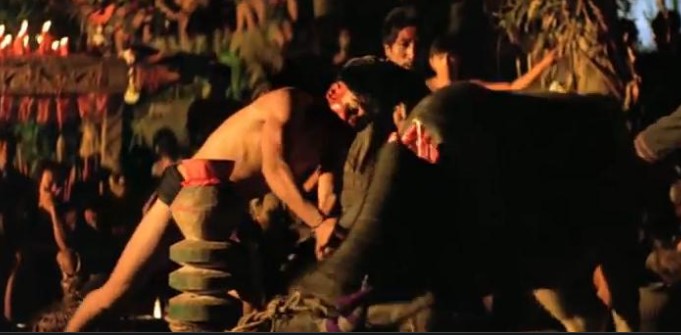
Which brings me to the banner image from the maligned sacrificial scene in Apocalypse Now, which reminded me of the rite of Buphonia and to the ritual’s conclusion:
One of the priests they call the ox-slayer, who kills the ox and then, casting aside the axe here according to the ritual runs away. The others bring the axe to trial, as though they know not the man who did the deed.
Pausanias, Description of Greece 24.4
The ritualistic shifting of blame from the active agent to the inert weapon is an ancient exoneration, a means of purification to make a horrible sacrilege acceptable to the community.[1]
I do not know if Congress will finally have the courage of their mouthed convictions and pass better legislation, but I fear it will merely try the gun and not the agency of the actors. We humans are culpable, the tools are merely tools.
I firmly believe in the necessity of the 2nd Amendment, which was explicit in preventing the government from taking weapons from its citizenry:
A well regulated Militia, being necessary to the security of a free State, the right of the people to keep and bear Arms, shall not be infringed.
Contextualize that forbearance on governmental authority: we had just won a Revolution because the average citizen was armed (and knew how to shoot). Everyone knew that only an armed population could become citizens while an unarmed peoples could only be subjects. Long history and English tradition taught that lesson deeply. The wording is also such that it refers to the right as if it were pre-existing, which it was, having been grounded in the English Bill of Rights (in response to the Stuarts). And the arms everyone had were military grade – there was only superficial difference in kit between the Royal and Revolutionary army.
The importance of the right to keep and bear arms – of military grade – is to keep government mindful that the true power is with the people. That is the reason for the ordinal position of the right as the second – second only to the right of freedom of expression.
These two rights are first and second because they are the foundation of a democratic body politic. We must be able to speak freely and have an open debate unfettered by censorial control. And to preserve that right we must have the right to self-defense, which must not be limited by any restrictions on the technological means. However, what is forgotten, because it was implicit at the time the rights were penned, is that the Responsible use of those rights resolves in the Individual. The Rights are unalienable but the Presumption was that the individual would be Responsible to use them appropriately.
It is of critical importance that a citizenry is educated so that speech is intelligent and civil. I assert that proper training to use firearms also should be a mandate (whereas in the past it was a given based on practical necessity). Both were preconditions when the Constitution was written. The problem is not with guns – the problem is with people. Therefore, I would fully support a very robust expansion on requisite screening (including psychological as well as technical ability) before allowing anyone to purchase a firearm. As a libertarian, I would argue that the certification of competency should be issued by Private groups to ensure its quality (because they would be civilly liable for getting it wrong). We have seen how poorly public education has preserved the intelligence of discourse protected by the First Amendment. I would hate to see a similar travesty result in conveying the responsibility for the Second.
_______________________________
UPDATE – 6/24/22
The Supreme Court reversed NY state restrictions >full text< of the decision. This, I contend, was the right decision because it simply makes NY a “must issue” state, which is closer in spirit to the 2nd Amendment and no longer allows NY to require that citizens prove “proper cause” for the license. Must issue is the right decision, but requiring demonstration of proper training and sound mental capacity can (and should) still be a precondition for issuance. I am very glad to see that the bipartisan gun violence bill doesn’t appear to ban “military style” weapons and properly focuses on added requirements, but it does not go far enough – licensing requirements (and renewals of that license) should be at least as stringent as a driver’s license (both are deadly weapons) as proof of competency.
_______________________________
Machine Learning Can Predict Shooting Victimization: the beginning of Minority Report Artificial Intelligence in lieu of precogs?
_______________________________
The concentration of violence clusters in poor neighborhoods and the increase correlates well with the BLM protests:
Alex Tabarrok June 30, 2022
What Caused the 2020 Spike in Murders?
I think there’s clear evidence that the current murder spike was caused primarily by the 2020 BLM protests. The timing matches the protests well, and the pandemic poorly. The spike is concentrated in black communities and not in any of the other communities affected by the pandemic. It matches homicide spikes corresponding to other anti-police protests, most notably in the cities where those protests happened but to a lesser degree around the country. And the spike seems limited to the US, while other countries had basically stable murder rates over the same period.
I agree with Scott Alexander. I would also add that each step in the mechanism–protests lead to police pullback which leads to an increase in murders–is well supported on its own in the academic literature. Step one, for example, is that protests lead to police pullback. In The effect of highly publicized police killings on policing: Evidence from large U.S. cities Cheng and Long document exactly this:
Our regression discontinuity and difference-in-differences estimates provide consistent and strong evidence that those high-profile killings reduced policing activities, including police self-initiated activities and arrests.
That’s step one. Step two is that police on the street reduces crime which you can find from my research using the terror alert level as well as that of many others. Step one plus step two leads to the 2020 spike in murders.
As Alexander noted, we also have plenty of evidence on a micro level. For example, I showed clear evidence of a “blue strike” and consequent increase in crime in Baltimore after the Freddie Gray protests. Put it all together along with the timing and other evidence and the case is strong that the 2020 BLM protests led to police pullback which led to a spike in murders, especially in black communities.
| Highly concentrated |
| Thirty-five people were killed in mass shootings in Buffalo, Uvalde and Tulsa over the past few weeks, focusing national attention on America’s unique gun problem. |
| In that same time, around 1,800 people were killed and almost 500 wounded in nearly 1,600 other shootings in the U.S., including at a Los Angeles warehouse party over the weekend. Mass shootings account for less than 4 percent of gun homicides in a typical year, and most gun violence in the U.S. takes a different form. So I went to Chicago, where shootings are a daily occurrence in some areas, to see what more-typical gun violence looks like. |
| There, I met 24-year-old Jomarria Vaughn. After spending time in jail on domestic violence and weapon charges, he has tried to rebuild his life. But his past haunts him. |
| The last time he was on Facebook, he found out his best friend had been shot to death. He now tries to stay off the site, out of fear that posting the wrong thing could anger the wrong people — and make him a target. |
| In his neighborhood, he tries to avoid spending too much time “out on the block,” he said. Even if he is not a target, violence is so common there that Vaughn worries he could be hit by a stray bullet. |
| “I’m scared,” Vaughn told me. “I have my guard up all day.” |
| This is what daily life looks like for many Black Chicagoans. Across the city, the murder rate for Black people is higher than it was from the 1980s through the 1990s — a violent period that drove a nationwide push for mass incarceration. Black Chicagoans are nearly 40 times more likely to be shot to death than their white peers, according to an analysis by the University of Chicago Crime Lab. |
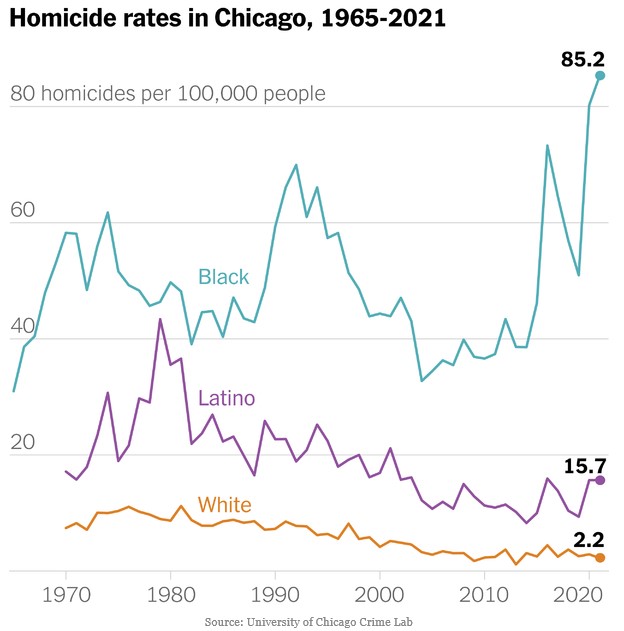
| Similar disparities exist across America. Black and brown neighborhoods suffer higher rates of poverty, and violence concentrates around poverty. The violence is so intensive that a few neighborhoods, blocks or people often drive most of the shootings and murders in a city or county. And this is true in both urban and rural areas, said Patrick Sharkey, a sociologist at Princeton. |
| The disparities have held up as murders have spiked across the country since 2020. So while the numbers are typically reported through a national lens, the reality on the ground is that a small slice of the population — disproportionately poor, Black and brown — suffers the most from it. |
__________________
[1] A longer version is told by Porphyry of Tyre in his third century classic, On Abstinence from Killing Animals, which is a great survey of the ancient reasons for vegetarianism. It should be required reading for vegans!
29 In ancient times, as we said before, people sacrificed crops to the gods, but not animals, nor did they use animals for their own food. It is said that when there was a public sacrifice at Athens one Diomos, or Sopatros, who did not belong to the country by race but farmed land in Attica, had set out a cake and other offerings in full view on the table, to sacrifice them to the gods. One of the oxen coming from work devoured some and trampled others. He was greatly angered by this, seized an axe that was being sharpened nearby and struck down the ox. The ox died, he recovered from his anger, and realised what he had done. He buried the ox, went into voluntary exile on the grounds of impiety, and took refuge in Crete. Drought took hold, and there was terrible crop failure. A public delegation was sent to consult the oracle, and the Pythia responded that the exile in Crete would expiate it, and when they had punished the murderer and raised the dead during the sacrifice in which he died, it would be better for those who tasted the dead and did not hold back. An investigation was made, and the one responsible for the deed was found. Sopatros thought that he would escape his problem of being accursed if everyone did this communally. So he said to those sent to find him that an ox must be cut down by the city. They were at a loss to know who would strike the blow, and he offered to do it if they made him a citizen and shared in the murder. This was agreed, and when they returned to the city, they organised the act like this, as the custom still remains among them.
30 They chose young girls as water-carriers. These bring water for people to sharpen the axe and the knife. When they had sharpened them, one man handed over the axe, another struck the ox, and yet another cut its throat. Then people skinned it, and everybody ate the ox. After this had been done they stitched up the skin of the ox, stuffed it with straw and stood it up, looking as it did in life, and they yoked a plough to it as if it were working. Then they held a murder trial and summoned all who shared in the act to defend themselves. The water-carriers said the men who did the sharpening were more to blame than they were, and those who had sharpened said it was the man who handed over the axe, and he said it was the man who cut the throat, and the man who did it blamed the knife, and since the knife could not speak, they found it guilty of murder. From that day to this, every Diipoleia at Athens, on the acropolis, these participants carry out the sacrifice of the ox in the same way. They put a cake and ground grain on the bronze table, and drive round it the oxen that have been selected for the purpose, and the ox that eats the offerings is cut down. There are still families of those who perform the rite. One group, descended from Sopatros who struck the blow, are all called boutupoi, ox-hitters; others, descended from the man who drove the ox round the table, are called kentriadai, goaders; and those descended from the man who cut the throat are called daitroi, carvers, because of the feast which follows the sharing-out of the meat. Having stuffed the skin, and been brought to trial, they threw the knife into the sea.
Porphyry, On Abstinence from Killing Animals pp 66-67
 Protective Arts