I have covered this is other posts >here< and >here< but give the importance of visualization in weapons training, I thought it useful to revisit the topic.
The eight basic suburi are kata that anyone can practice solo.
To my way of thinking, the most effective way to learn the pattern is to ensure the movements have meaning – a contextual purpose.
To understand the purpose of the movements one must first tell the story of each kata in order to visualize how the moves are effective.

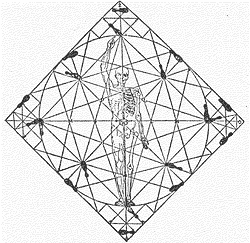
Shihogiri and happogiri are important to learn the foundational footwork and possible avenues of attack. Should you find yourself surrounded with sword wielding opponents, eight is the maximum number that can attack at any given point (and they would need be incredibly synchronized to do so without hitting a friendly).
The image above is to teach European fencing, and note that the eight-directions are a universal. Envision the eight directions as hours on a clock face with you in the center and your nose at 12 o’clock – so someone facing you is at 12 while someone directly behind you is at 6 o’clock. Your right flank is 3 o’clock and your left flank is at 9 o’clock. The basic eight kata ignore the 45-degree angles.
With this orientation language:
| Kata | Ashi sabaki | Weapon Action | Opponent Position |
| #1 | step back | cut shomen | first at 12 |
| step in | tsuki | first at 12 | |
| withdraw & raise | |||
| pivot | cut shomen | second at 6 | |
| #2 | step forward | cut shomen | first at 12 |
| step in | tsuki | first at 12 | |
| withdraw & raise | |||
| pivot | cut shomen | second at 6 | |
| #3 | tenkan | cut up (target wrist) | first at 6 |
| finish turn | cut down | second at 12 | |
| step in | tsuki | second at 12 | |
| withdraw & raise | |||
| pivot | cut shomen | first at 6 | |
| #4 | draw step | cut up (target wrist) | first at 6 |
| finish turn | cut down | second at 12 | |
| step in | tsuki | second at 12 | |
| withdraw & raise | |||
| pivot | cut shomen | first at 6 | |
| #5 | move 90-step back | cover & cut | first at 3 |
| step in | tsuki | first at 3 | |
| withdraw & raise | |||
| pivot | cut shomen | second at 9 | |
| #6 | step 90 degree forward | cover & cut | first at 3 |
| step in | tsuki | first at 3 | |
| withdraw & raise | |||
| pivot | cut shomen | second at 9 | |
| #7 | irimi tenkan (tight) | cover & cut | first at 6 |
| step in | tsuki | first at 6 | |
| withdraw & raise | |||
| pivot | cut shomen | second at 12 | |
| #8 | hanmi “booty scoot” | cover & cut | first at 9 |
| step in | tsuki | first at 9 | |
| withdraw & raise | |||
| pivot | cut shomen | second at 3 |
Visualizing an opponent (shadow-boxing) when performing the moves should help solidify the movements. You need to be able to see the actions of your invisible opponent that are the stimulus to your response. Practice with the spirit of shinken-shōbu (真剣勝負, lit: win-lose by live sword) because you are training to survive combat to the death. Or, as I phrased it in the earlier post – “Action in dead earnest.” You must put everything you have into your Aikido as if it your life were at stake.
So, the kata should allow you to focus on the principles – good targeting, smooth transitions, and the ability to visualize counters (anticipate the potential responses). The kata, therefore, should coordinate your internal mechanics – integrate mind and body. And the rote repetition to build muscle memory is critical – the movements need be learned deeply because you need to recall the appropriate movement when you need to act in fractions of a second. We cannot think in the moment – it is just too slow. The kata must “think” for us so that we can react appropriately.
The suburi and kata are designed to program your body. First, learn the movements related to the technique or response that you plan to make reflexive. Coordination and familiarity with the movements create the ‘neural map’ that makes it reflexive. As I stated earlier – we must practice and repeat correct motion – mindful practice and quality repetition together with a clear understanding of the right mechanics are imperative. The more you practice and refine the movements involved in the technique, the more easily and quickly you can access them. After many repetitions, your mind will eventually consolidate all the individual motor movements – the points on the path – that comprise the technique into a line of flow. This is when the discrete points become a line of movement.
From there we can begin to add additional stimulus – contact with uke’s sword. The kata contain most of the movements that will become linked together, in synchronic flow. But to take advantage of muscle memory, you must first create an experience that you can remember. If your central nervous system does not have a complete profile on your technique, then you cannot expect the recall to be very smooth or accurate.
 Protective Arts