Aristo– is a word-forming element meaning “best,” or “of the aristocracy,” from Greek aristos “best of its kind, noblest, bravest, most virtuous”” (of persons, animals, things). In its Greek form, aristos denoted that which was excellent in kind, noble in bearing, virtuous in conduct. It was not yet the title of a class. The aristoi were those who embodied aretê, excellence in the moral, intellectual, and physical sense (Aristotle, Nicomachean Ethics, II.6–7). The word carried no contempt until democracy began to mistake equality for virtue (Plato, Republic, VIII). Today, aristocrat suggests privilege, elitist a sneer. Yet the ancients knew that excellence is not tyranny; it is the measure by which a people sustain themselves against decline. When excellence is vilified, mediocrity becomes moralized. The modern crisis of democracy is not its inequality, but its fear of distinction (Tocqueville, Democracy in America, II.7).
This essay follows directly from my earlier reflections where I described how contemporary academia’s fetish for equality has displaced the pursuit of merit. The Greeks would have found such moral inversion incomprehensible: equality was a civic safeguard, not a moral standard. To them, virtue could never be collective, it was the achieved quality of the individual.
In Excellence and Athleticism, I use examples from ancient Greece, specifically the Odyssey, to highlight ideals of arete: moral courage combined with ability which are requirements of being aristos. The earliest stories were always teaching texts; they provided examples of how to live and what to aspire to. In this sense, the heroic epics served the same social function as education should: the cultivation of excellence rather than its apology.
In the earliest Greek imagination, the aristoi were not simply the wealthy or well-born but those whose actions displayed a harmony of character and courage (Homer, Iliad, IX). The Homeric epics do not teach equality; they teach proportion (Thucydides, History, II.65). Achilles and Odysseus represent the two poles of human excellence; force and intellect, passion and prudence (Homer, Iliad; Odyssey). Achilles is the god-touched hero who burns brightly and dies young, the image of martial purity. Odysseus is the man of craft, a weaver of lies and plans, whose excellence lies in endurance and wit. Both are aristoi, but Odysseus is the prototype of exclusively human excellence (Aristotle, Poetics, 1454b). His heroism is measured not in glory but in return, not in conquest but in restoration (Odyssey, XXII).
Although a king himself, Odysseus embodies the tension between inherited excellence and acquired skill. His aretê is not that of divine favor but of learned craft and endurance. However impressive his athletic exploits (Book 8 of the Odyssey), he is also curiously mercantile; his interest in property is not only for prestige, but for its utility. The booty he won at Troy is lost early in his return voyage, and he replaces it only through the aristocratic gifts received from the Phaeacians, tokens of xenia, the sacred code of hospitality that bound status to generosity. Odysseus returns to Ithaca replenished; his restored wealth mirrors his restored order, proof that true excellence unites prudence with possession. [1]
_____________________
Odysseus is not the direct descendent of any god.

The closest he gets is through his maternal line to his great-grandfather, Hermes. Achilles, by contrast is son of an immortal Nereid and his paternal great-grandfather is Zeus himself (details). Ajax the Greater is the son of Telamon, son of Aeacus and (another) grandson of Zeus. Through his uncle Peleus (Telamon’s brother), he is cousin to Achilles. So, Odysseus is the most human of heroes.
_____________________
The Greeks never confused democracy with equality of condition. Aristotle wrote that the polis exists for the sake of the good life, not for mere living (Politics, 1252b). The city is the vessel through which virtue is cultivated; its purpose is moral, not economic. Yet he warned that the polis has natural limits (Politics, 1326b). Beyond a certain scale, citizens can no longer know one another well enough to share responsibility. A city too large becomes a crowd, and a crowd cannot act with conscience. The strength of the ancient polis was that each citizen bore the consequences of his decisions. The rich fought beside the poor, the hoplite phalanx bound in literal interdependence (Hanson, The Western Way of War). In such a world, “tax the rich” made no sense, for the rich bled with the rest. Citizenship was a moral bond, not an entitlement.
The modern franchise has inverted this proportion. Representation without consequence has produced a democracy of appetite rather than of virtue (Oakeshott, Rationalism in Politics). Scale has destroyed sympathy; bureaucracy has replaced neighborly duty. The ancient polis required citizens to act together for the sake of the common good; the modern state requires only that they vote and demand (Arendt, The Human Condition). Aristotle would not have called this democracy at all but ochlocracy, government by the multitude’s passions (Polybius, Histories, VI.4). The citizen of Athens understood that freedom was a discipline. The citizen of the modern West believes it is a right (Berlin, Two Concepts of Liberty).
This confusion owes much to Christianity’s leveling impulse and to the Enlightenment’s rational optimism (Nietzsche, Genealogy of Morals, I), but it reached its political consummation in America’s moralization of equality. Tocqueville saw the danger early: democracy would lead men to love equality more than freedom, and they would accept servitude if it meant sameness (Democracy in America, II.1). The ancient Greeks feared hubris; moderns enshrine it: we no longer fear the gods but presume to perfect ourselves through policy. The result is moral fatigue disguised as justice (Bloom, The Closing of the American Mind).
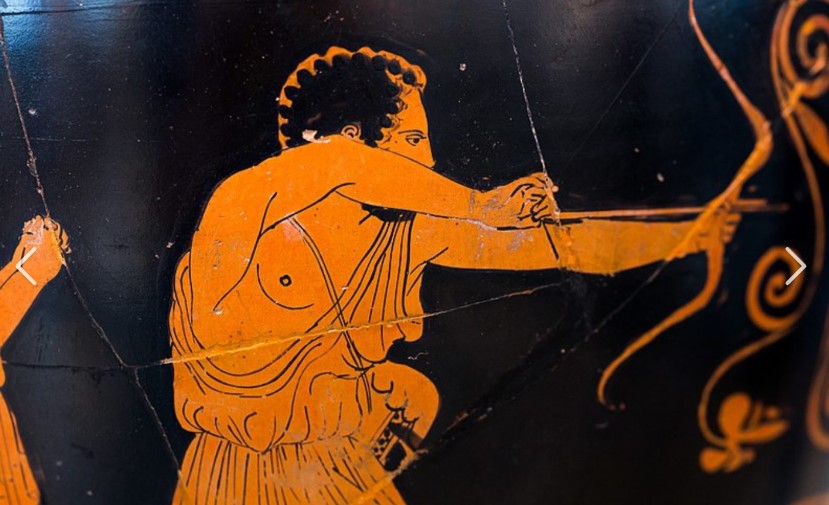
In the ancient world, excellence implied responsibility (Aristotle, Ethics, IV). The agôn, the contest, was sacred because it revealed merit in full view of others (Nicholson, Aristocracy and Athletics). The games were not entertainment but judgment. Each man’s aretê was tested before the community. When Odysseus strings his bow to slay the suitors, it is not only an act of vengeance but of restoration: the right order of the world reasserting itself (Odyssey, XXI).
He earns his kingship anew. The Greek understood that rule must be justified continually by virtue; authority divorced from aretê was hubris (Politics, III.12). In this sense, aristocracy was never hereditary; it was performative (Plato, Laws, III). Nobility without excellence was a fraud (Thucydides, II.40).
Modern societies have inverted this ethic. We defend incompetence as inclusion and mistake equality of outcome for fairness (Hayek, The Mirage of Social Justice). Where the Greeks sought to honor the best, we are taught to suspect them. The “Woke” moral vision does not correct injustice; it levels aspiration (Scruton, How to Be a Conservative). It claims compassion while breeding resentment. In erasing standards, it annihilates meaning (Lewis, The Abolition of Man). To reject excellence because it offends equality is to commit the oldest sin: envy recast as ethics (Nietzsche, Genealogy of Morals, I). Plato warned that democracies decay when the unfit demand the honors of the excellent (Republic, VIII–IX). Aristotle called it the corruption of timocracy: when ambition survives virtue and prestige detaches from desert (Politics, V.8). Once the moral authority of excellence collapses, only power remains (Tocqueville, II.2).
Yet excellence, rightly understood, is not arrogance. The true aristos serves as exemplar, not ruler (Xenophon, Memorabilia, II.6). He leads because his character commands imitation. Odysseus’ metis, his cunning, is inseparable from his endurance and his piety (Odyssey, IX). He is not the strongest but the most complete (Auerbach, Mimesis). His excellence arises from the union of intellect, skill, and humility before the gods. When he blinds the Cyclops, Homer compares his precision to that of a shipwright drilling timber (Odyssey, IX.382–94).
They took the stake of olive-wood, sharp at the point, and thrust it into his eye, while I, throwing my weight upon it from above, whirled it round, as when a man bores a ship’s timber [385] with a drill, while those below keep it spinning with the thong, which they lay hold of by either end, and the drill runs around unceasingly. Even so we took the fiery-pointed stake and whirled it around in his eye, and the blood flowed around the heated thing.
Book 9, Odyssey
The poet celebrates craftsmanship as nobility. To work well is to be virtuous (Arendt, The Human Condition). The modern world forgets this. We divide labor from dignity, wealth from service, intellect from humility. The ancient Greek would find this madness: to be excellent was to be whole (Ruskin, The Stones of Venice).
The decline of aristocratic ideals has also impoverished leadership. Modern elites are not the best of anything; they are functionaries of a system that confuses credentials with character (Schumpeter, Capitalism, Socialism and Democracy). The bureaucrat thinks compliance and adherence to policy is virtue. The political classes now govern by sentimentality and spectacle, not by wisdom or restraint. They have preserved the appearance of moral authority while severing its moral root. They moralize because they cannot lead. The result is a moral vacuum filled by slogans. We are ruled not by aristoi but by advertisers listening to pollsters.
The Greeks knew that every virtue has its vice when abstracted from measure. Aretê without humility becomes hubris, courage without prudence becomes recklessness, justice without wisdom becomes vengeance (Aristotle, Ethics, II.7). The polis endured because its citizens still believed in proportion (Plato, Philebus, 64d). The modern state, swollen beyond recognition to Leviathan, has replaced proportion with process (Hobbes, Leviathan). The citizen is reduced to consumer, and democracy becomes a perpetual redistribution of grievance. The tragedy of egalitarianism is that it breeds dependency, and dependency breeds tyranny (Tocqueville, II.4).
We must therefore recover the moral meaning of elitism. To be elitist in the Greek sense is to believe that the best should lead and the rest should strive to become better (Nietzsche, Thus Spoke Zarathustra). It is to honor excellence as the path to justice. The ancients did not envy their heroes; they emulated them (Plutarch, Lives, “Pericles”). We resent ours and then lament the absence of greatness (Bloom, Closing of the American Mind). The culture that mocks virtue cannot produce it (Kimball, The Fortunes of Permanence). If democracy is to survive, it must again become aristocratic in spirit: a fellowship of excellence bound by duty, not a marketplace of resentment (Oakeshott, Rationalism in Politics).
The remedy is personal before it is political. The polis begins in the soul (Plato, Republic, IV). The citizen who cultivates his own excellence restores the moral order from below. Craft, courage, and integrity are still the building blocks of freedom. Odysseus, the craftsman-king, remains our truest model (Odyssey, XIII–XXIV). He suffers, endures, and restores. His journey is the allegory of civilization itself: skill rescuing virtue from chaos (Weil, The Iliad, or the Poem of Force). We are his descendants when we learn the art of returning home (Camus, The Myth of Sisyphus).
The ancients would have laughed at our bureaucratic pieties. They understood that laughter itself disarms power. “Power can be resisted and undermined by laughter,” wrote Milan Kundera (The Book of Laughter and Forgetting), who grasped what Homer knew: irony is the weapon of the free. And the Athenians paid their citizens to attend the plays that served precisely this purpose, to mock political leaders who overstepped (Aristophanes, The Knights, et alia).
The restoration of aristos will not come through institutions but through example. Excellence must again become attractive. We must learn to revere those who do things well, whether they build, heal, teach, or think. The path back from decadence is not through equality but through aspiration. The Greeks knew this, and so must we: a free people are bound not by sameness, but by shared admiration for the best among them. When that admiration dies, so too does liberty (Thucydides, II.40).
______________________
[1] The demonstration of xenia, the proper treatment of a stranger by a host, is a testimony to the Phaeacian king’s greatness and Odysseus’s excellence. There is a nice counterpoint (a faux-pas) made by the less experienced Telemachus who, when visiting Menelaus rejects a gift of horses because horses are not much used in Ithaca. Telemachus is too pragmatic and misses the point of aristocratic gifts: they are gestures of friendship to promote bonds and recognition of status, not merely things of utility.
______________________
References (Selective)
Aristotle. Politics. Translated by Benjamin Jowett. Oxford: Clarendon Press, 1885.
Homer. The Odyssey. Translated by Robert Fagles. New York: Viking, 1996.
Homer. The Iliad. Translated by Richmond Lattimore. Chicago: University of Chicago Press, 1951.
Kundera, Milan. The Book of Laughter and Forgetting. New York: Knopf, 1979.
Nietzsche, Friedrich. On the Genealogy of Morals. Translated by Walter Kaufmann. New York: Vintage, 1967.
Plato. The Republic. Translated by Allan Bloom. New York: Basic Books, 1968.
Thucydides. History of the Peloponnesian War. Translated by Rex Warner. London: Penguin Classics, 1954.
Tocqueville, Alexis de. Democracy in America. Translated by Harvey Mansfield and Delba Winthrop. Chicago: University of Chicago Press, 2000.
 Protective Arts