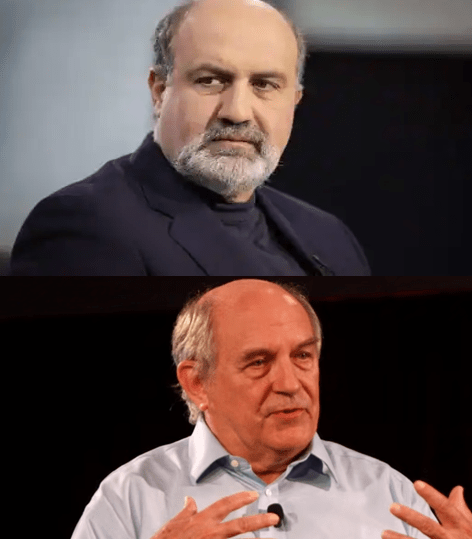
Nassim Taleb has indicted Charles Murray as a “mountebank” because Murray demonstrates that measured general intelligence, G, has a high correlation with financial success. Correlation has a strong resemblance to causation, especially when the measure of success is a broad proxy like income, which can lead erroneously to social Darwinism. Because this is a dangerous correlation, Taleb is quick on the attack and attempts to debunk Murray and others who use G as a meaningful measure.
I fear that Taleb’s laudable moral concern to avoid the historical horrors of eugenics has blurred his usually sharp statistical reasoning.
A very cogent refutation of Taleb’s article point-by-point is found >here< and can be summed as proving the durable correlation between G and income – people of higher IQ have a greater chance of earning more income.[1]
It seems to me that Taleb’s argument with Murray is based on an interpretive error rather than a philosophical divergence. It appears Taleb ignores the validity of G because he wants to avoid its use as a prognostic tool. His critique is less moral than methodological: he distrusts any Gaussian simplification of human ability and believes the tails of performance distributions are non-predictive in complex, “fat-tailed” domains. Yet he also sees the moral danger of such metrics, so his rejection of G is both a statistical and ethical hedge.
Murray acknowledges that G exists and that it dangerously exacerbates the disparity in social outcomes.[2] Murray is nostalgic for a more egalitarian America of the 1950s when it was possible to marry across the “wrong side of the tracks” because that created a culture with a broad appreciation for multiple perspectives. Take Murray’s Bubble Test and pay close attention to its implied indictment: America is a society now more greatly divided. Follow that intellectual thread to his treatment of G: generalized intelligence is in part hereditable and cultivated by parents who are high-performers. As America moves increasingly to an intellectual economy, the divergence in G speedily increases the divide that Murray believes will destroy the American ideal.
So I see Taleb and Murray highlighting similar concerns, just that Taleb’s are immature; the dreams of a nascent adult:
For I have a single definition of success: you look in the mirror every evening and wonder if you disappoint the person you were at 18, right before the age when people start getting corrupted by life. Let him or her be the only judge; not your reputation, not your wealth, not your standing in the community, not the decorations on your lapel. If you do not feel ashamed you are successful. All other definitions of success are modern constructions; fragile modern constructions.”
Nassim Taleb, The Bed of Procrustes: Philosophical and Practical Aphorisms
Murray posits a more mature perspective. Everyone participates in society and therefore reputation, wealth and standing are in fact very meaningful markers of success. Not because those markers are precise indications of any individual’s inherent worth, but rather that by having achieved them the broader society has benefited from the individual’s contributions to the betterment of the many.
Thus while Murray’s discussion of G as having high correlation with success can be taken as a neo-eugenic argument, his view is clearly the opposite. Murray is concerned that G is over-valued by the intellectual economy to the detriment of all. Murray knows we need janitors, mechanics, and plumbers as desperately as we need attorneys, computer scientists and quants like Taleb. Given the scaling on Murray’s quiz, I suspect he prefers blue-collar mechanics to quants. A good mechanic arguably has done more for society than Taleb did by shorting the market for a huge payday.
Taleb, like Lady Macbeth, doth protest too much. He, more than Murray, exemplifies the paradox he condemns: he has profited handsomely from his intelligence through shrewd exploitation of uncertainty, and some of his essay reads as atonement rather than argument. Taleb correctly predicted a Black Swan event and therefore garnered a huge financial reward. He is, ironically, an existence proof of the correlation between intelligence and wealth he seeks to deny.
Murray would point instead to assortative mating, the tendency of individuals to partner by education and cognitive similarity, as a key driver of class entrenchment and the very phenomenon Taleb’s life exemplifies. For Murray G is real and now has a far greater impact on social success, but that is not a positive result. Taleb misses Murray’s concern and makes a misguided indictment, presumably on statistical grounds.
The problem isn’t with G. Clearly there are differences in intellectual ability and the modern economy rewards those with greater general intelligence properly applied. Taleb is correct to remind us that those financial rewards are not the best indication of any individual’s worth. But his is a teen-ager’s definition of value. Murray is a social scientist whose concerns and definitions are on a societal scale. Therefore the worth of the individual is to be found in their contribution to the continuance of society. Being a parent and furthering the cohesiveness of the body politic are the best indicators of success, not a puerile evaluation of yourself relative to your 18-year-expectations.
Taleb wants to deny G as a valid statistical tool because he values the potential of every individual. That is an aspirational argument, but empirically naïve. Murray also believes that everyone has a valid role to play in society regardless of their intelligence. Murray fears that job-segregation by intelligence has a negative stigma: those in higher prestige jobs (that require higher G) have no genuine connection to (or empathy for) those employed in traditional blue-collar jobs. Murray knows G is real and fearful of its divisive impact. Taleb just wants to pretend it doesn’t exist.
As much as I respect Nassim Taleb, Charles Murray has the better argument and understanding of the value, and danger, of G and its distribution among the general population.
______________________
[1] The Widening Achievement Gap Between Rich and Poor in a Nordic Country,
The connection appears to have an upper limit – The plateauing of cognitive ability among top earners, but nevertheless the fear is that there are insufficient numbers of high-IQ workers:
The Extreme Shortage of High IQ Workers
by Alex Tabarrok January 9, 2023 at 7:22 am
At first glance it seems peculiar that semiconductors, a key item of national strategic interest, should be produced in only a few places in the world, most notably Taiwan, using devices produced only in Eindhoven in the Netherlands by one firm, ASML. Isn’t the United States big enough to be able to support all of these technologies domestically? Yes and no.
Semiconductor manufacturing is the most difficult and complicated manufacturing process ever attempted by human beings. A literal spec of dust can ruin an entire production run. How many people can run such a factory? Let’s look at the United States. The labor force is approximately 164 million people which sounds like a lot but half of the people in the labor force have IQs below 100. More specifically, although not everyone in semiconductor manufacturing requires a PhD, pretty much everyone has to be of above average intelligence and many will need to be in the top echelons of IQ.
In the entire US workforce there are approximately 3.7 million workers (2.3%) with an IQ greater than two standard deviations above the mean. (Mean 100, sd, 15, Normal dist.) Two standard deviations above the mean is pretty good but we are talking professor, physician, attorney level. At the very top of semiconductor manufacturing you are going to need workers with IQs at or higher than 1 in a 1000 people and there are only 164 thousand of these workers in the United States.
164 thousand very high-IQ workers are enough to run the entire semiconductor industry but you also want some of these workers doing fundamental research in mathematics, physics and computer science, running businesses, guiding the military and so forth. Moreover, we aren’t running a command economy. Many high-IQ workers won’t be interested in any of these fields but will want to study philosophy, music or English literature. Some of them will also be lazy! I’ve also assumed that we can identify all 164 thousand of these high-IQ workers but discrimination, poverty, poor health, bad luck and other factors will mean that many of these workers end up in jobs far below their potential–the US might be able to place only say 100,000 high-IQ workers in high-IQ professions, if we are lucky.
It’s very difficult to run a high-IQ civilization of 330 million on just 100,000 high-IQ workers–the pyramid of ability extends only so far. To some extent, we can economize on high-IQ workers by giving lower-IQ workers smarter tools and drawing on non-human intelligence. But we also need to draw on high-IQ workers throughout the world–which explains why some of the linchpins of our civilization end up in places like Eindhoven or Taiwan–or we need many more Americans.
[2] Child-Driven Parenting: Differential Early Childhood Investment by Offspring Genotype
A growing literature points to children’s influence on parents’ behavior, including parental investments in children. Further, previous research has shown differential parental response by socioeconomic status to children’s birth weight, cognitive ability, and school outcomes—all early life predictors of later socioeconomic success. This study considers an even earlier, more exogenous predictor of parental investments: offspring genotype. Specifically, we analyze (1) whether children’s genetic propensity toward educational success affects parenting during early childhood and (2) whether parenting in response to children’s genetic propensity toward educational success is socially stratified.
_______________________
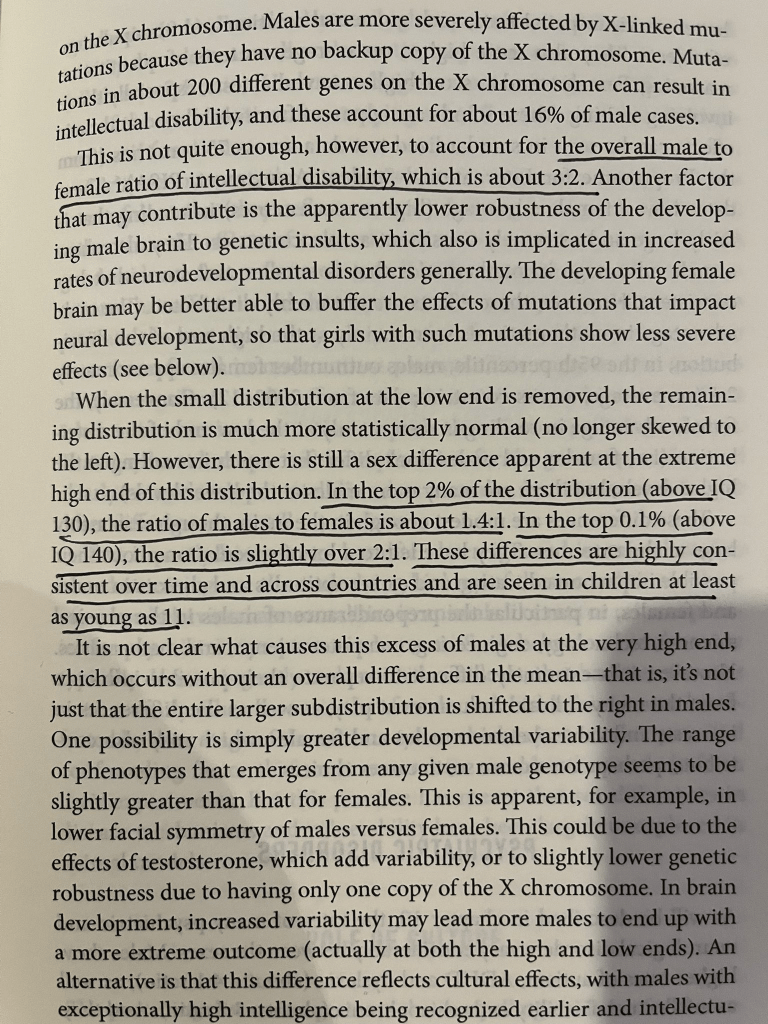
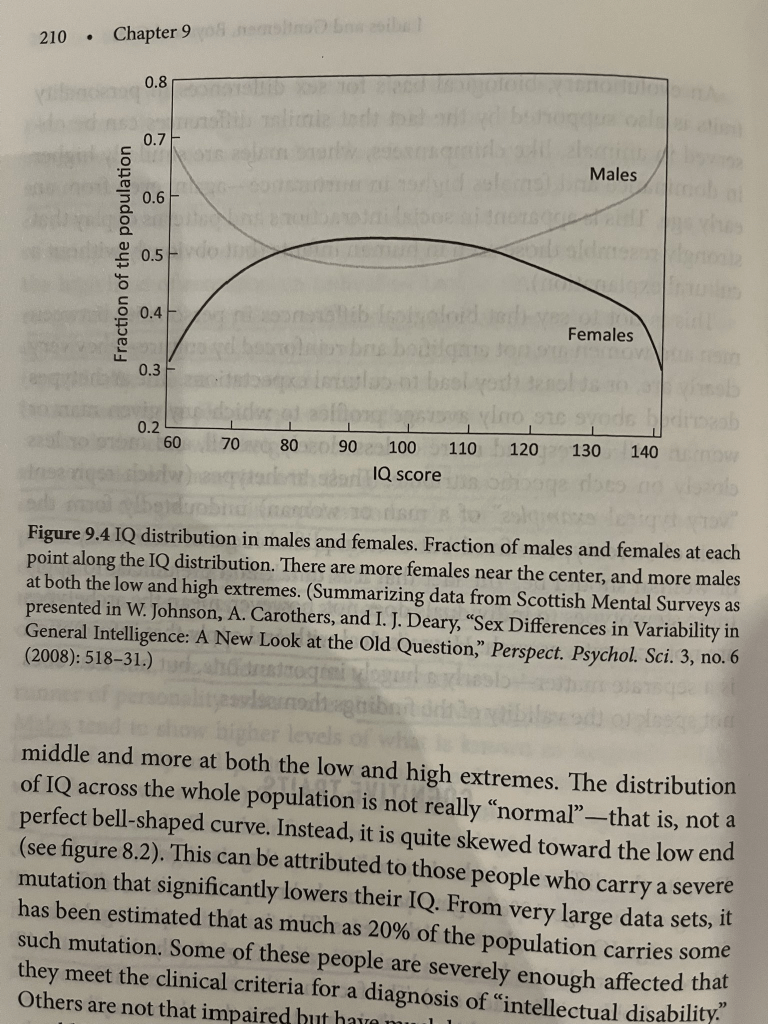
IQ distribution varies with gender. The overall male to female ratio of intellectual disability is about 3:2 … in the top 2% of distribution (above IQ 130), the ratio of males to females is about 1.4:1. In the top 0.1% (above IQ 140), the ration is slightly over 2:1. Male IQ clusters more at the extremes than does female intelligence.
 Protective Arts