Class Outline
Establish familiarity with takemusu Aikido exercises:
Gyakyu hanmi tenkan – soft committed elbow, move from shoulder (learn to move self)
Ashi-sabaki – same arm shape, driven by hips (learn to move uke)
Ashi-sabaki ushiro tenkan – same arm shape – learn to lead uke : uke learns to commit to movement
Yokomen uchi – uke must learn to attack with commitment : magic wall : cast hand from shoulder : acute angle
Yokomen direct – kihon : nage moves in (superior time) and towards uke’s flank with two hand response (intercept attack and atemi uke’s face) this is body displacement whereby nage takes uke’s position with tanren advance. The advanced counter : nage uses one-hand parry-riposte (cam the arm) : eye spear – but the arm is same shape [from here in basic class, move to beginning of hubud-lubud* to effect ikkyo – rokkyo]
* the tie-up in the FMA is a blend in Aikido to keep uke in motion (thus requiring the ikkyo – rokkyo immobilizations)
Yokomen ushiro-tenkan (blend) – arm is in same shape, just low line – timing is nage must intercept, like direct just yield to uke pressure, then double dagger
Both direct and ushiro-tenkan are inside line plays where nage stays inside the tight arc of uke’s strike
Then there are the outside plays:
First a slip – where nage uses the intercepting hand, but folds at the elbow to pass uke’s strike – use a feint then fade to make the slip to the flank (Mulligan sensei special)
Second avoids by entering in for a direct elbow strike (Shibata sensei special) – sidestep while advancing under uke’s strike (but it is not a ducking action!)
Hubud interpretation to irmi-nage is a four-beat entry. Yokomen to (1) direct parry, fade to slip, then (2) nage passes the yokomen with back hand to achieve the outside line, then (3) replace back hand with intercepting hand to control uke’s elbow (contact forward pressure trap) then (4) original backhand becomes straight thrust (irimi nage) throw.
Passing the attacking hand. Nage uses the outside hand to catch/pass the yokomen (rather than intercept on the inside) – chasing timing – to feed to the low-line where nage’s back hand can replace with a pressure-trap. From there, an Aikido irimi to the flank – using the control hand as a fixed point to move away from! Don’t disturb uke’s hand while moving to shikaku. From that position, nage can execute irimi nage omote or ura.
__________________________
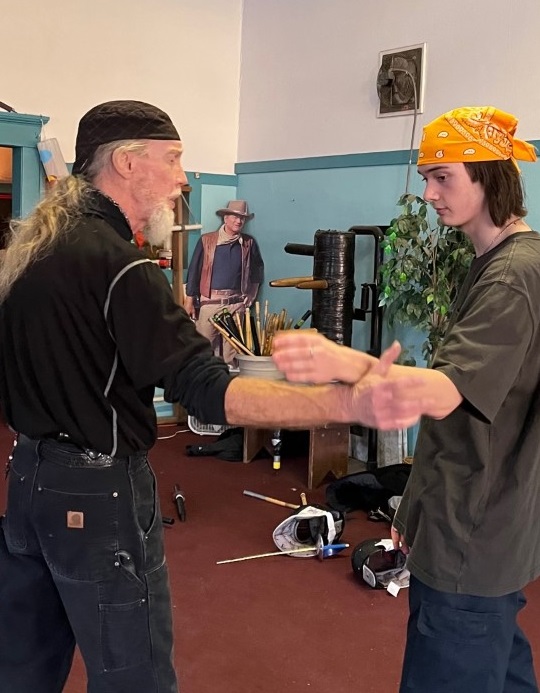
The banner image is Kyrian doing sticky hands exercise with Master Keating who is the inspiration for the interpretation – sensitivity drills are critical for knife work and are an under appreciated basis for informing Aikido’s movements
 Protective Arts