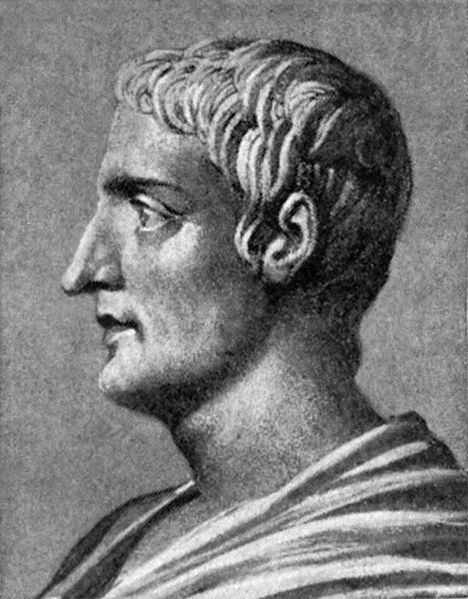
Tacitus wrote Agricola to honor his father-in-law, Cnaeus Julius Agricola, who died August 23, 93 CE.
After a short introduction (exordium, 1-3), Tacitus organized the work in three parts. In chapters 4 to 9, Tacitus narrates Agricola’s life before he became governor of Britain in 77 CE. In the second part (chapters 10-38), Tacitus covers Agricola’s governorship of Britain from 77 to 84 CE. It opens with descriptions of the main geographic, ethnographic, and political characteristics of Britain (10-12), and of the Roman attempts of conquest and pacification before Agricola (13-17). Next, he covers the main military operations led by Agricola during his governorship (18-38). In the third part, Tacitus narrates briefly what Agricola became after he was recalled (39-43). The work ends with an epilogue that tells Agricola’s death and presents his life as being an example to follow (44-46).
Agricola proved his martial valor and expertise in his first campaign. He arrived in mid summer, when the legionaries assumed the campaigning season was done. To their dismay, Agricola marched them out to confront the Ordovices and he was at the fore of the vanguard. Once his campaign successful, the Ordovices conquered and his military capabilities proven, Agricola then took personal charge of administration to ensure the Romans and natives alike knew who was in command.
But then he did something both brilliant and insidious. After the second year of campaigning, Agricola used the idle winter months strategically:
The following winter passed without disturbance, and was employed in salutary measures. For, to accustom to rest and repose through the charms of luxury a population scattered and barbarous and therefore inclined to war, Agricola gave private encouragement and public aid to the building of temples, courts of justice and dwelling-houses, praising the energetic, and reproving the indolent. Thus an honourable rivalry took the place of compulsion.
Agicola, 21
Agricola encourages constructing civic centers where the tribes previously had been disbursed and settled in whatever glade met their fancy. This concentrated the populous. In addition:
He likewise provided a liberal education for the sons of the chiefs, and showed such a preference for the natural powers of the Britons over the industry of the Gauls that they who lately disdained the tongue of Rome now coveted its eloquence.
Agicola, 21
Agricola is “Romanizing” the elites while he is further separating them from their people and cultural origins. The exacerbation of differences as a strategy – divide and conquer.
Hence, too, a liking sprang up for our style of dress, and the “toga” became fashionable. Step by step they were led to things which dispose to vice, the lounge, the bath, the elegant banquet. All this in their ignorance, they called civilization, when it was but a part of their servitude.
Agicola, 21
The civilizing process as a means to enslavement.
Tacitus presents Rome as a civilizing power bringing peace, comfort and culture to these uncivilized Britons. However, Tacitus then shows their inexorable decline because of the enervating effects of civilization – a people grown soft.
Prior to conquest, the Britons were barbarians who lived in “scattered” (dispersi) settlements, in an uncivilized (rudes) manner, and were universally war-like (in bella faciles). Agricola brought them peace (quies) and leisure (otium). Peace and leisure need a locus to be enjoyed collectively. Thus, Agricola arranges the construction of temples, forums and houses – the most visible and beneficial manifestation of Roman rule. These three building types best represent Roman civilization: the temple and the fora were the centers of religious and political activities, and houses (domi) provided residences for the elites. It also kept them geographically proximate – corralled.
But linguistic dominance was the ultimate conquest. Tacitus tells us the Britons became educated and craved eloquence, … ut qui modo linguam Romanam abnuebant, eloquentiam concupiscerent, “As a result, those who used to spurn the Roman tongue began to covet its eloquence.” Latin best embodies the true power of Rome (note the use of the adjective Romanam and not Latinam in the original) because it is spoken every day, is more present than buildings and more enduring. Latin shows the extent and spread of the Roman Empire. Cultural dominance through language.
The last element that Tacitus presents as the essential garb of Roman civilization – the toga. The toga was traditionally connected with peace, but it importantly symbolized membership within the community of Roman citizens. (Conspicuous consumption as class membership.)
Yet for all the benefits of Romanization, Tacitus leaves us with a warning, “it was but part of their servitude.”
Every civilizing improvement inexorably led to a decline. The impressive architecture and engineering that brought potable water and public baths become places of seduction and debauchery – Tacitus here follows Ovid Ars Amoris III.387 and Juvenal Satires VI.60-61. And the domi of the elite hosted feasts and banquets that were frequent occasions of transgression of social conventions. The Ordovices are a mirror for Romans to see their own decline. The seductions of vice (delenimenta vitiorum), of comfort and luxury led progressively to their enslavement (servitutis). Tacitus’s true audience is the Roman reader – he admonishes that Romans ceased to be true and virtuous warriors when they started to enjoy the benefits of conquest – wealth, comfort and peace. Nietzsche (the great philologist that he was) couldn’t have said it better: “In their ignorance they called this culture (humanitas), when it was part of their enslavement (servitutis).”
This is a reminder that every technology or service is at first a luxury – until it becomes so normalized that we can’t go back. Our “wants” becomes a “needs.” Liberating technology becomes enslavement.
I review Tacitus to remind myself of the dangers of comfort. As we prepare for a Thanksgiving feast in the warmth of our domi surrounded by friends and family it is too easy to be seduced to think this is normal and deserved. The benefits of easy living, I remind myself, are hard-won and we need always be grateful for them.
If there be any habitation for the shades of the virtuous; if, as philosophers suppose, exalted souls do not perish with the body; may you repose in peace, and call us, your household, from vain regret and feminine lamentations, to the contemplation of your virtues, which allow no place for mourning or complaining! Let us rather adorn your memory by our admiration, by our short-lived praises, and, as far as our natures will permit, by an imitation of your example… Whatever in Agricola was the object of our love, of our admiration, remains, and will remain in the minds of men, transmitted in the records of fame, through an eternity of years. For, while many great personages of antiquity will be involved in a common oblivion with the mean and inglorious, Agricola shall survive, represented and consigned to future ages.
Tacitus, Agricola, 46
 Protective Arts
2 thoughts on “Conquest Via Luxury”