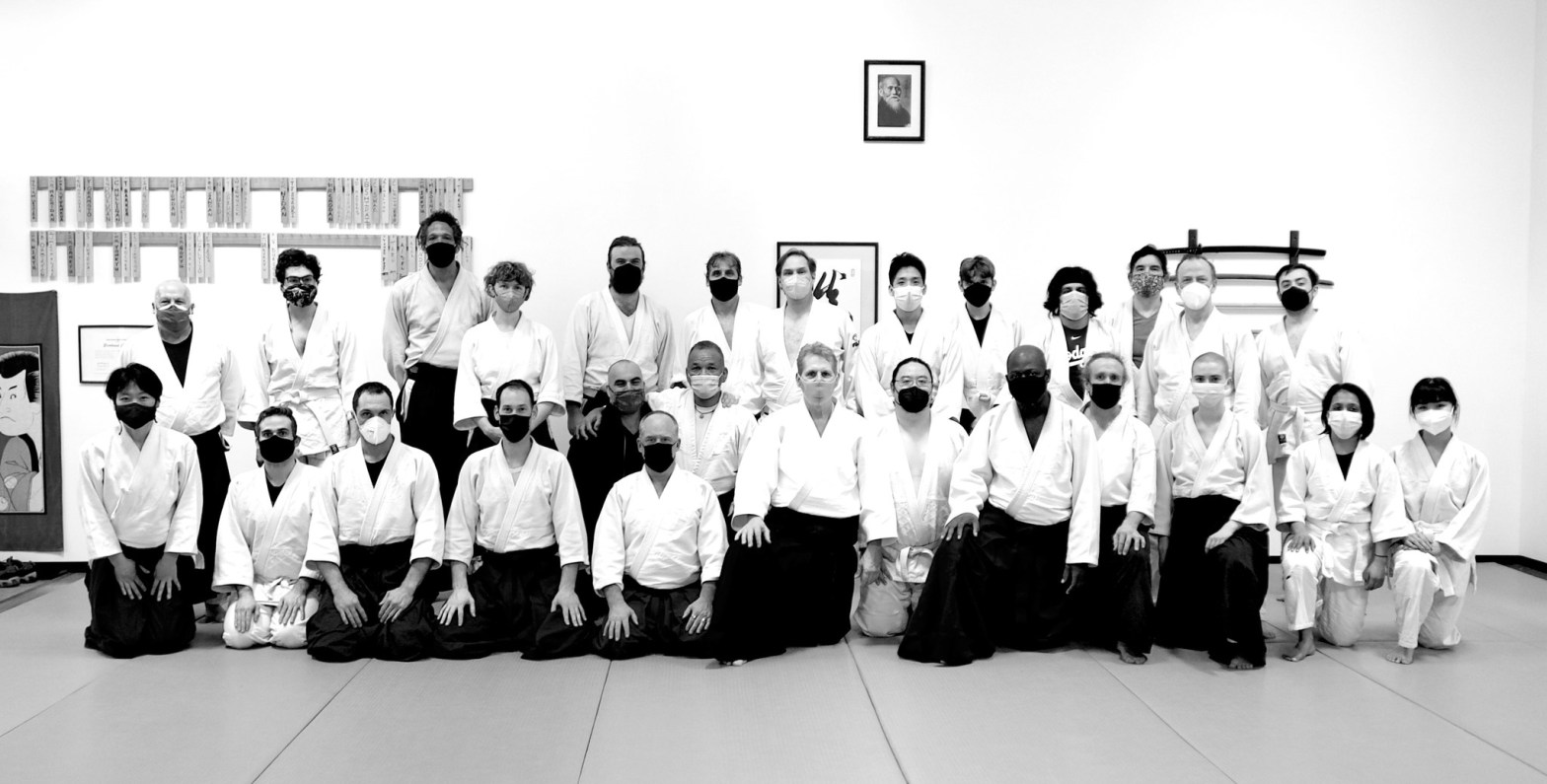
A much belated post on Mulligan sensei’s returned to Portland for a workshop weekend March 5 & 6, 2022. It was a welcome return to seminar training! On Saturday, he covered two basic forms of entry (ashi sabaki) as a precursor to the disarm class on Sunday.
My subsequent classes were an homage to Mulligan sensei’s presentation. I focused on the second ashi sabaki form, the footwork from sword kata #8, in order to further emphasize Mulligan sensei’s focus on accuracy and precision with both foot work (movement and the resulting positioning) and hand work (both positioning and structural alignment).
To raise the energy level, we did some focus mitt striking. As Mulligan sensei reminded everyone, the structure of the hand is critical. His analogy was that the Aikido hand is always holding a glass. When holding a glass, the fingers are curled inward and the thumb engaged to nearly meet the fingertips. When actively engaged like this, the bones of the hand are less susceptible to damage.
I showed the “handshake” trick and used that as a segue to the proper use of the shyuto. A properly shyuto strike requires a muscularly engaged hand. The fingers are stiffened to form a spear hand and the thumb closed tightly against its base. The actual striking surface of the hand is the fleshy base. We repeatedly struck the focus mitts to provide some sensory feedback – and frankly we need to do this more often. The hand needs conditioning and pain is a great teacher.
From the striking practice, we then moved to yokomen uchi blend (as Mulligan sensei showed) and I played with both the blending slip and the catch and release.

The application was irimi nage’s position. And because I am a student of both Mulligan and Okamoto sensei, my preference is for a perpendicular position rather than a deep parallel for irimi nage’s throw. Mulligan sensei correctly cautions that a perpendicular position means uke can see nage. My suggested solution to that problem is an eagle claw control of the mastoid muscle so that nage rotates uke’s head – removing their visual field as a concern.
From irimi-nage’s position, we moved to the catch-release ude kime nage. I made the point to emphasize the pragmatic approach.
From uke’s strike, nage intercepts with the lead hand to cam and deflect the inbound strike, but does not break contact. The intercepting arm rolls under uke’s arm as the strike continues past and therefore becomes the fulcrum under the elbow. From this position, I then showed how the body (chest) could supplement or replace the arm as the fulcrum. And finally as a chaining exercise, I showed the progression from the arm-bar to the chest, from the chest to the hand supported ikkyo then to the bunkai of tendon manipulation with 2 knuckles – Okinawan tuite.
Lines and points – the kinonagare flow of Aikido and its focus on continuity of motion hides the importance of points – knowing precisely where to hit and when to hit along the line of motion. Lines are a compendium of points but not all points are of equal value!
Photo credits Russ Gorman
 Protective Arts