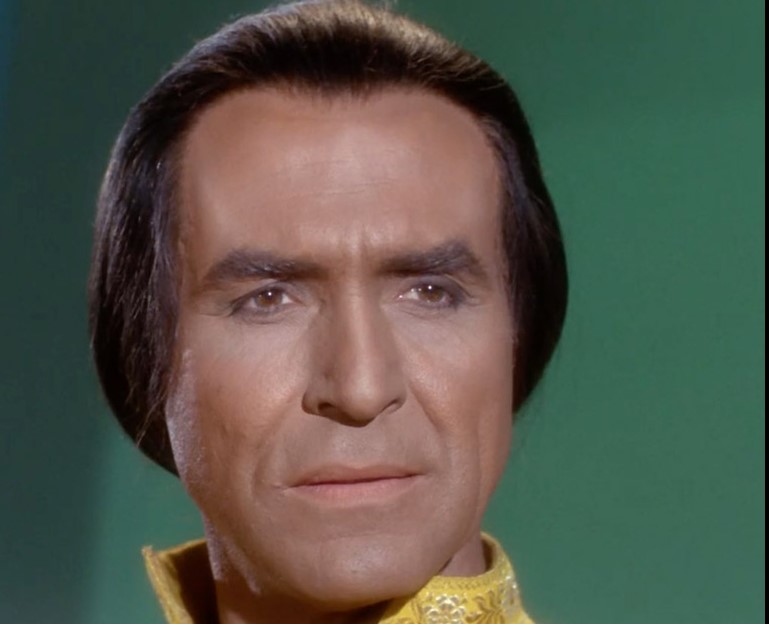
Khan Noonien Singh is my favorite Star Trek character. In Space Seed (1967), Ricardo Montalbán plays Singh the genetically engineered despot known as the last tyrant from the Eugenic Wars::
KIRK: Name, Khan, as we know him today. (Spock changes the picture) Name, Khan Noonien Singh.
The full script
SPOCK: From 1992 through 1996, absolute ruler of more than a quarter of your world. From Asia through the Middle East.
MCCOY: The last of the tyrants to be overthrown.
SCOTT: I must confess, gentlemen. I’ve always held a sneaking admiration for this one.
KIRK: He was the best of the tyrants and the most dangerous. They were supermen, in a sense. Stronger, braver, certainly more ambitious, more daring.
SPOCK: Gentlemen, this romanticism about a ruthless dictator is
KIRK: Mister Spock, we humans have a streak of barbarism in us. Appalling, but there, nevertheless.
SCOTT: There were no massacres under his rule.
SPOCK: And as little freedom.
MCCOY: No wars until he was attacked.
SPOCK: Gentlemen.
KIRK: Mister Spock, you misunderstand us. We can be against him and admire him all at the same time.
SPOCK: Illogical.
KIRK: Totally.
In under two minutes, the episode distills humanity’s oldest paradox: our irrational admiration for strength, even when it enslaves us. Trump, Putin, Xi the modern strong-men, trade on that same primitive attraction, promising national order and renewal. (Small-minded religious zealotry fuels the Taliban, Khamenei, etc., who hold power because of a similar slave-mentality of the populous.[1])
KIRK: Forgive my curiosity, Mister Khan, but my officers are anxious to know more about your extraordinary journey.
SPOCK: And how you managed to keep it out of the history books.
KHAN: Adventure, Captain. Adventure. There was little else left on Earth.
SPOCK: There was the war to end tyranny. Many considered that a noble effort.
KHAN: Tyranny, sir? Or an attempt to unify humanity?
SPOCK: Unify, sir? Like a team of animals under one whip?
KHAN: I know something of those years. Remember, it was a time of great dreams, of great aspiration.
SPOCK: Under dozens of petty dictatorships.
KHAN: One man would have ruled eventually. As Rome under Caesar. Think of its accomplishments.
SPOCK: Then your sympathies were with
KHAN: You are an excellent tactician, Captain. You let your second in command attack while you sit and watch for weakness.
KIRK: You have a tendency to express ideas in military terms, Mister Khan. This is a social occasion.
KHAN: It has been said that social occasions are only warfare concealed. Many prefer it more honest, more open.
KIRK: You fled. Why? Were you afraid?
KHAN: I’ve never been afraid.
KIRK: But you left at the very time mankind needed courage.
KHAN: We offered the world order!
Kirk has trapped Khan drawing out his confession. Yet the deeper irony is that the very existence of Starfleet implies that humanity is in fact unified, as Rome under Caesar, capable of amazing accomplishments such as an inter-stellar Federation.[2]
Khan’s claim that he left Earth for “adventure” is disingenuous; he and his supermen were overthrown and they fled. In Star Trek canon, the Eugenic Wars lasted only four years so Khan’s rule was contentious at its start and did not last. For all his genetic superiority, Khan was far less successful than Xi.
The themes tackled by shows in the 1960s provide a robust analysis of the human condition. Both Star Trek (1961-1969) and The Twilight Zone (1959-1964) continue to reward the careful watcher. Yet for all their insight, the conclusions were steeped in post-war American optimism.
The idea that Khan’s tyranny was overthrown so easily feels naïve, implying that people naturally reject order. If the order Khan provided was truly benevolent, rebellion would be unlikely. Clearly it takes severe oppression of life and liberty before people revolt. The Arab Spring (2010-2011) blew over with no real change. And while I would love to see the current (2022) protests in Iran and China cause political change, I am not optimistic.[3]
Along with the unrealistic optimism that Khan’s tyranny was overthrown, is that Kirk defeated him. Selective breeding for the betterment of the race doesn’t ensure success.
KIRK: Well, they were hardly supermen. They were aggressive, arrogant. They began to battle among themselves.
SPOCK: Because the scientists overlooked one fact. Superior ability breeds superior ambition.
KIRK: Interesting, if true.
Eugenics holds the promise of perfection, but the writers in the 1960s were often the same men who fought Hitler and knew first-hand the horrors of a master-race inspired vision. The hubris of Nazi Germany was undone not by supermen but by ordinary soldiers: an echo of Copland’s Fanfare for the Common Man.
Although the global population has crested eight billion, the declining birth rate (in the West) is a much bigger risk to civilization than global warming, according to Elon Musk. Musk and other tech elites believe they represent the solution to declining birth rates by ensuring humanity’s survival through interplanetary expansion. This is Musk’s motivation to colonize Mars – so that mankind isn’t a mono-planetary species.
Genomic Prediction – Life View
Superior ability leading to superior ambition: to believe that you have the answers and are the solution.
It’s a proposition uniquely suited to Silicon Valley’s brand of hubris: If humanity is on the brink, and they alone can save us, then they owe it to society to replicate themselves as many times as possible
It is hard to argue with Musk’s tweet about the movie Idiocracy, in which the intelligent elite stop procreating, allowing the unintelligent to populate the earth.
Been around the world
Harvey Danger Flagpole Sitter (made more famous by Green Day)
And found that only stupid people are breeding
Cretans cloning and feeding
It does feel that way.
It is easy to criticize the idea that demography as destiny because those countries with higher birth rates are generally less economically developed. Thus a policy which would encourage higher birth rates among the successful will quickly bleed, erroneously, to eugenic theories (qv. Taleb vs Murray). There is an irony that in the modern economy, the successful, typically, have far fewer children precisely because they have been successful and therefore have fewer evolutionary challenges constraining their ability to reproduce. Modern technology has removed traditional limitations and economic incentives are such that it is “better” to shower resources on fewer children so they can compete successfully.
Musk (and others) frame pro-natalism as moral duty: to reproduce excellence for the species’ sake. (To be fair, Musk would more likely embrace tech-enhancement over genetic refinement.) Reportedly, his goal isn’t domination of the species but rather its assured continuation. Should humanity’s population grow to its interplanetary carrying capacity? If so, should it be comprised of those who have the highest potential?
Script writers resist that narrative of planned perfection. Consider Gattaca (1997), The Accountant (2016) – with autism leading to higher performance, and Oliver Sacks reported that Tourette’s can lead to hyper-accurate surgeons. In short Darwinian mechanisms could select for non-optimal (by current measures) genetics. Evolution prizes adaptability, not design. Are we seeking perfection or survival? There is a distinctly American optimism that acts as an antidote to elitism: perfection is the enemy of the good.
Space Seed concludes with Kirk exiling Khan and his followers in the Ceti Alpha star system on a planet that is “habitable, although a bit savage, somewhat inhospitable” according to Spock, but one which Kirk remarks is “no more than Australia’s Botany Bay colony was at the beginning.” The closing lines were originally intended to be optimistic:
SPOCK: It would be interesting, Captain, to return to that world in a hundred years and to learn what crop has sprung from the seed you planted today.
KIRK: Yes, Mister Spock, it would indeed.
But the optimism of 1967’s episode proved too cheery for 1982‘s darker sequel.[4]
____________________________
[1] The American moral police, fortunately, are failing to establish a majority despite the Dobbs Decision. Fortunately, women’s rights (and the general spirit of Liberty) are ingrained sufficiently to bolster the legal system’s protections. Let us hope that each state actually enacts formal legislation. More tellingly, the US Supreme Court has never overturned Buck v. Bell (1927) that allows forced sterilization…an uncomfortable reminder that eugenic thinking was not confined to fiction or the Axis powers.
[2] In the original series, the unification of Earth isn’t well addressed and the inter-stellar relationships forming the United Federation of Planets are a multicultural democracy. Gene Roddenberry was an unrepentant optimist who believed in humanity:
We are an incredible species. We’re still just a child creature, we’re still being nasty to each other. And all children go through those phases. We’re growing up, we’re moving into adolescence now. When we grow up – man, we’re going to be something!
Gene Roddenberry
This optimism was not naïve; it was deliberate humanism. Roddenberry imagined the Federation as an aspirational Caesarism, empire sublimated into cooperation, reflecting America’s postwar belief that progress could redeem power.
[3] As long as tyrannical regimes retain military loyalty, mass protest rarely translates into regime change. The West is fortunate that self-determination and weapon ownership have deep cultural and legal foundations. An armed citizenry, whatever its costs, complicates the consolidation of tyranny. (cf. Is There a Relationship between Guns and Freedom? Comparative Results from 59 Nations, Kopel, D. et alia, Texas Review of Law and Politics, Vol. 13 (2008)). The data can be parsed, of course, and The Atlantic has an intelligent review that concludes with a lower confidence on the relationship, but I believe Casey Michel critique underestimates the historical coupling of civic freedom and martial competence.
Dr. Pippa Malmgren asks the cogent questions and shows tyrannies fear their populous – hence zero-Covid policies and Great Firewalls. She concludes that the breakup of these “autarkies” is possible: “What is the probability that both, or either, Russia and China actually break up into smaller pieces as people fight against being locked up in virtual digital prisons, in the prison of involuntary conscription or in the home in lock-down, which has become the new prison?” She is far more optimistic than I am.

“We want food, not Covid tests, We want reform, not Cultural Revolution. We want freedom, not lockdowns. We want votes, not a ruler. We want dignity, not lies. We are citizens, not slaves: Remove the despotic traitor Xi Jinping!”
Let us hope the Chinese people prevail!
Update 12/4/22 – Iran signals the abolishing of its moral police in response to the continued protests. Hmmm…. I remain skeptical.
Update 12/5/22 – Alas, skepticism justified…
[4] The Wrath of Khan released in 1982 when tensions between the United States, Russia and China were no better than they are today. The difference then was that Russia was perceived as the greater threat but China’s ambitions for Taiwan were only just starting to be thwarted. US – Soviet relations had deteriorated and the START negotiations were largely at impasse (summary).
 Protective Arts