
I was never overly impressed with self-reported happiness indices and country rankings, until I read this 2022 working paper by Blanchflower and Bryson. The paper still uses self-reported data but this time, they add the negative dimensions of personal experience to tabulate a net happiness score.
Combining data on around four million respondents from the Gallup World Poll and the US Daily Tracker Poll we rank 164 countries, the 50 states of the United States and the District of Colombia on eight wellbeing measures. These are four positive affect measures – life satisfaction, enjoyment, smiling and being well-rested – and four negative affect variables – pain, sadness, anger and worry.
This is a more sensible ranking and leads to a ordinal ranking that is surprising, but upon consideration, probably more reflective of a lived experience.
Combining rankings on all eight measures into a summary ranking index for 215 geographical locations we find that nine of the top ten and 16 of the top 20 ranked are US states. Only one US state ranks outside the top 100 – West Virginia (101). Iraq ranks lowest – just below South Sudan. Country-level rankings on the summary wellbeing index differ sharply from those reported in the World Happiness Index and are more comparable to those obtained with the Human Development Index.
The United States fares very well in the net well-being rank-order and is granular by state:
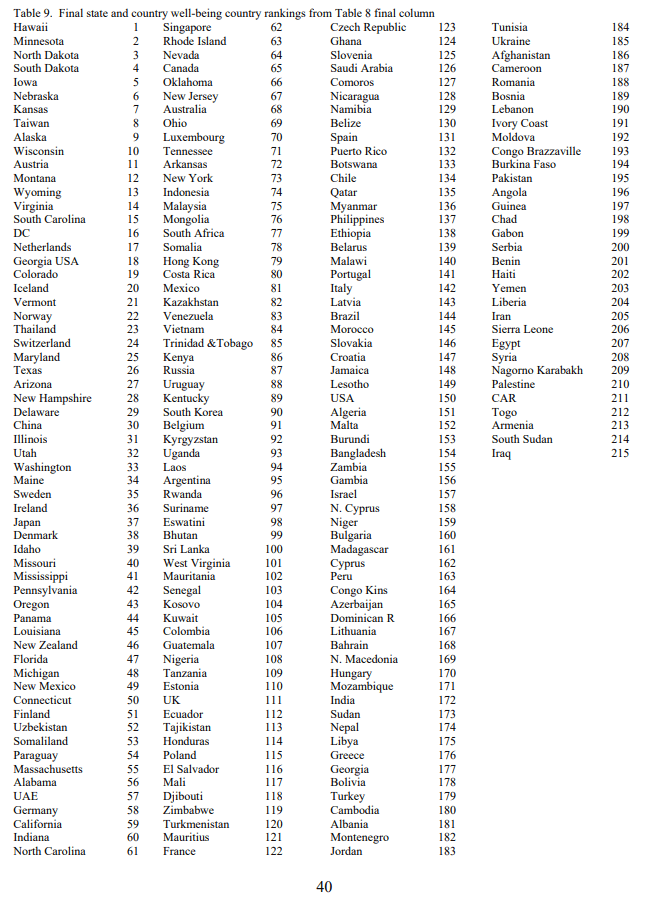
There are surprising comparisons in this table for me: Russia (87) much higher ranked than UK (111) but both below Kazakhstan (82).
Of course happiness comes with a price – flattening around median income of the US according to Kahneman (2010) – but later self-reported studies show a continued increase as wealth does.
 Protective Arts