My boys twisted my arm into getting Elden Ring so we could all play together. It was an easy sell (I wanted an excuse) and it is another way we three can bond. Too many hours later, I cannot keep up with them. Perhaps it is perceptual speed. Perhaps their keyboard skills are better. Whatever the reason, I need their help with boss-fights. They have both completed the main quest while I am still fumbling through.
The graphics are extraordinary. The soundscape is too good. I cannot hear the whine of the wolves when I am forced to kill them without feeling that something has been violated. Even in a virtual world, I am loath to do them violence.
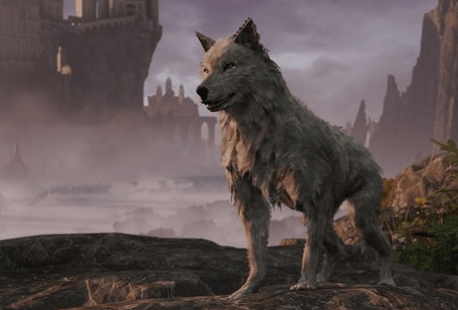
I do not know why I have an affinity for wolves. Perhaps it is Never Cry Wolf (1983) which gave me my first image of the wolf as something other than threat. Perhaps it is the way they move: a flowing command of space, as if the terrain were built for them and everything else is visiting.
Wolves and humans have had, and continue to have, a contested relationship. As wolves reassert old hunting grounds, they are again a focal point of debate between ranchers and environmentalists. The economic loss is visible. The systemic benefit is harder to see.
There is also a deeper psychology to overcome. The wolf has a reputation. The Big Bad Wolf. Little Red Riding Hood. As recently as 2011, wolves were cast as the adversary in mainstream cinema.
In The Grey, a suicidal Liam Neeson finds the will to survive when the tables turn: the hunter becomes the hunted, pursued by a pack across an Alaskan waste. It is effective because wolves fit the role: intelligent, coordinated, relentless.

Fables offers a different figure: Bigby, the detective-sheriff of Fabletown; the predator given a jurisdiction. He is very good at the job.
I do not know why I have an affinity for wolves. What follows is an attempt to find where that accounting began.
___________________
We had no name that could be carried in the mouth. We did not need one. We knew ourselves in the press of bodies in winter, in the pull of the hunt, in the long hunger that did not end. We were what moved when nothing else could.
And you. Unfinished, upright, holding ground where nothing holds.
***
The earliest genetic evidence places dogs alongside human hunter-gatherers at least 14,000–16,000 years ago, well before agriculture. These populations occupied overlapping ecological niches, hunting the same prey across the same terrain.
They were not encountering an unfamiliar animal. They were encountering another hunting system. Group-coordinated pursuit. Shared kill. Territory marked and defended. Young raised within structure. The resemblance was not exact. It was sufficient. In such conditions, competition is not the only stable outcome.
Parallel systems can merge.
The first domesticate was not a sheep. It was a rival.
The timing coincides with instability. The Younger Dryas (~12,900–11,700 BP) disrupts established patterns; cooling, drying, fragmenting ecosystems. Some groups range further, breaking into smaller units. Others contract around reliable patches of water, wild grains, recurring herds.
Mobility increases at the margins. Fixation increases at the nodes. The edge becomes consequential.
Fire marks the decisive break. In Greek terms, Prometheus gives the gift. What follows is not comfort but division. Fire extends activity into night, deters predation, and fixes position.
A boundary appears where none existed before.
***
Some of us came near it.
Not the dominant animals. Not those who held the center. The marginal ones; those for whom the edge offered something the interior no longer did.
We had not chosen you. We had chosen the place where the world had changed.
There was no agreement. Only repetition.
***
Two dominant models explain early domestication: commensal proximity and human adoption. Evidence suggests a blended process; tolerance, repetition, and eventual integration over generations.
To remain is not only tolerance. It is advantage.
Two hunting systems aligned produce more than either alone:
Speed joins endurance.
Scent joins sight.
Perimeter joins tool.
Such alignments require no agreement – only mutual recognition. In the present, wolves and ravens hunt in loose coordination, one tracking, the other signaling, both benefiting without shared intent. Proximity that proves productive persists.
Several thousand years later, another pattern emerges.
At sites such as Göbekli Tepe (~9600 BCE), large stone enclosures are constructed by hunter-gatherers before agriculture. These are not dwellings. They are places of return.
People gather before they settle. They build before they farm.
By this point, dogs are already present, moving with humans, hunting alongside them, sharing their space. The integration is assumed.
Gathering creates a second boundary between the individual and the group. The structure precedes the explanation.
One consequence is exogamy. Small bands face a problem not visible at the level of experience: genetic concentration. The solution appears as practice, mates taken from outside, reinforced through custom or exchange. Humans regulate reproduction before they understand inheritance. Modern attempts to recover these practices often outrun the evidence. Speculation is that monumental sites were places of celebration and dissolution.
In Greek terms, this belongs to Dionysus. If Artemis marks what remains outside, Dionysus dissolves what remains separate within.
The fresco at Plaincourault Chapel has been interpreted by some as depicting a hallucinogenic mushroom. The claim has been repeatedly rejected by art historians.
Its persistence is instructive. Ambiguous images invite projection. But the evidence increases. The use of wine and beer, and older compounds continue to be pushed further back.
The Greeks record altered states without systematizing them.
Nepenthe removes grief. The Lotus-Eaters dissolve purpose. Dionysus dissolves the boundary of the self. These are observations, not explanations.
***
Those who remained outside continued to test the edge.
We were inside it.
Not because you were stronger.
Because we had stayed until staying became structure.
***
By the time dogs appear clearly in the archaeological record, they are already integrated: extending human perception, moving within human systems.
Wolves remain outside and test the boundary.
Dogs remain within and become the boundary.
***
When the old kind come near, and they always do, we felt them before we saw them.
We do not go.
We warn.
***
I watch coyotes in my neighborhood walk bold and brazen in the middle of the paved roads in daylight. Unafraid as I drive by or walk the family dog.
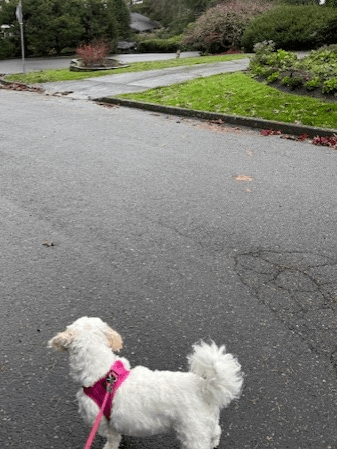
They playfully watch and try to entice my dog to follow. Not to join. To become prey.
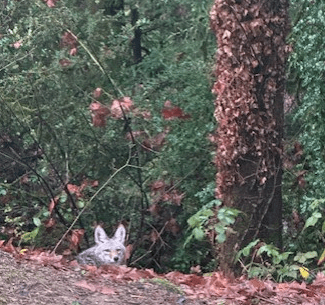
The division persists. Wolves return to the margins. Humans respond. The line is enforced, violated, redrawn. The boundary is not a solution. Cultural memory preserves the split.
The Big Bad Wolf encodes what remains outside as threat. The dog encodes what has been brought within. One enters the system. One defines its edge.
Bigby Wolf, holding a line he did not choose, is the more honest figure.
The transformation does not stop at behavior. It continues inward.
Dogs and humans now share disease profiles, cancer, metabolic disorders, cognitive decline, arising from shared environments.
This is convergence. To enter the human system is to inherit its limits.
***
We lost the range.
We gained the fire.
The fire comes with everything fire comes with.
***
There is no evidence of wolves choosing in the human sense. Only selection for those who remained. The system stabilized not through elimination of force, but through its deployment. The early relationship among the proto-dog and humans must have been fragile. Both species must have sensed the dangerous tension.
The Greeks knew the problem. Heracles brings force inside the house and the house breaks. Neoptolemus inherits violence without formation and spends it where it cannot be contained. They understood the danger.
Heroes are too dangerous to be fully contained by the polis. Wolves must have been viewed thus.
***
We stand at the boundary we were shaped to hold.
The range is elsewhere. The silence is elsewhere.
We are what remains when a wolf decides, across ten thousand years of nights, that the fire is worth what the fire costs.
It costs everything outside the fire.
You call this loyalty.
We call it the record of a transaction.
The terms were not negotiated. They accumulated.
You inherited a guardian.
We inherited your world.
 Protective Arts