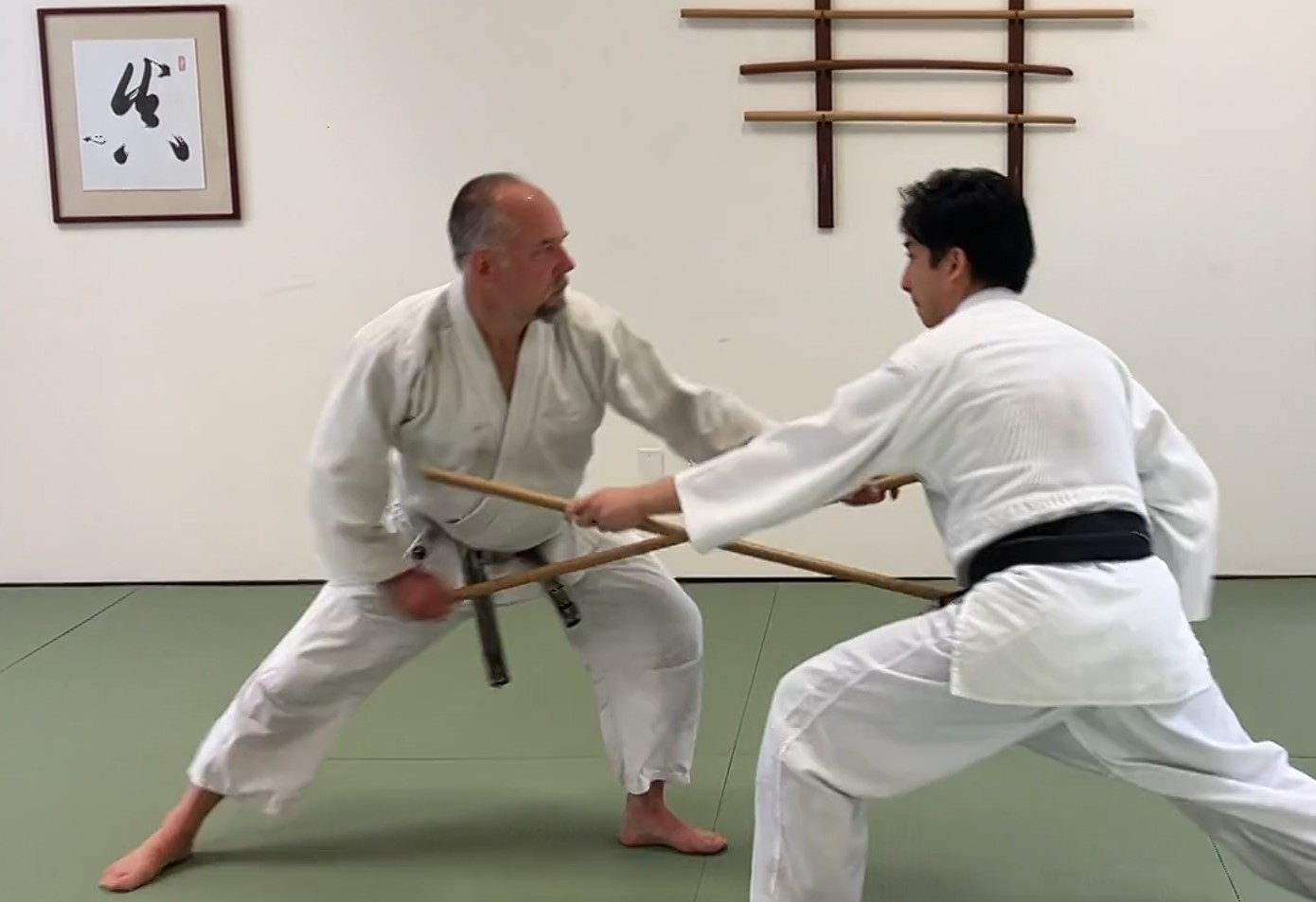
This is a refinement of the kihon 8 count kumijō by Takumi Suzuki.
The purpose of the refinements are pedagogical as well as practical.
Contrast the explication of the kihon version (linked above) and the refinements are evident. The traditional sequence (and its bunkai) is as follows:
- Junte chudan tsuki
- Cover
- Yokomen (#1)
- Hasso
- Yokomen (#2)
- Stab to the rear
- Strike leg / block
- Strike hand
Reset to start the sequence again.
Takumi adds the measure (a full count in actuality) of makiotoshi after step 2 – hence the somewhat whimsical designation “8 1/2 count:”
- Junte chudan tsuki
- Cover
- Makiotoshi
- Yokomen (#1)
- Hasso
- Yokomen (#2)
- Stab to the rear
- Strike leg
- Strike the center
Reset to start the sequence again.
Why add the makiotoshi? Specifically to help students understand that the “flow” of a covering action to a counter-yokomen is not achieved by “helicoptering” the jō around the head. Inserting the mackiotoshi requires that both players cover their centerline, drop with a camming action on the jō, then raise up their centerline before executing the yokomen – now as a discrete attacking action.
The form now forces the proper attack and eliminates a “false flow” signal that the traditional form can impart.
Yokomen with the jō should be tight so as to allow the strike to be delivered even when close to a wall – review the “magic wall” exercise. To do so requires that the jō remain in a protective orientation along the practitioner’s centerline and to deliver the strike with the hands in front of one’s forehead – a forward snap, not a pulling from behind. It is a sharp attack that keeps the tip of the jō accelerating and descending in a tight arc – no expansive circles, no “helicoptering.”
But there are other subtleties to attend to:
1. Tsuki. The initial thrust is delivered from the tip by driving forward with the back hand, which explicitly is not drawn back. No telegraphing wind up, but rather a sliding advance with the front foot to augment the thrust. This action will also drive both practitioners much closer than is rational, but that is intentional and forces a fully integrated body to move to the second step;
2. Cover. Because the initial move closed the maai, the covering action must start with a deep sliding retreat to open the distance. This is a matched action, but one that must keep the centerline covered and keep both players oriented toward each other.
3. Makiotoshi. Inserted as a pedagogical step, it also has the benefit of forcing the practitioners to keep in alignment with proper center line cover on both the ascending line (step 2) as well as the descending line (step 3). The forced addition of time and connection breaks the habit of rote repetition. Pay attention to your hand rotations on each phase – rising and lowering – to feel the jō camming. Feel what the weapon is telling your body to do!
4. Yokomen (#1). The proper delivery of this strike is critical – study the arc to really understand the path of least resistance. Geometry is sacred!
5. Hasso. My earlier post and in-class explication of the application (the bunkai) of this step is to “clear” an on-coming low-line attack. However, in this presentation, the focus is on the lead hand extending toward the opponent – tip control – prior to the back hand initiating the driving arc to hasso. The line of the jō is more linear – less focus on an outward sweep or clearing action. Explicitly, the goal is to keep the orientation on the opponent and to keep the potential of the leading end of the jō an imminent threat – do not immediately run to a defensive use of the jō.
6. Yokomen (#2). As in the traditional presentation, the second yokomen from hasso requires a hand change and delivery from the shoulder rather than the top of the head so the biomechanics are different. From the connecting strikes, both players then;
7. Stab to the rear; an action which is clear: The driving action of the rear-stab, initiates by extending the lead hand (closest to the opponent in front of you) to then drive the jō precipitously down and back at an angle that follows the line determined by your forward yokomen.
8. Strike the leg. Note that the linked concept of “blocking” is eliminated from the description because the refinement is of an older spirit – “all offense, all the time.” From the rear low-line strike, nage now delivers a forward low-line strike. That requires the practitioner to raise the top hand along his sternum (centerline) while turning briskly toward the front, then delivering the down strike from the top hand. The jō to jō contact in now incidental and not a focus of connecting. The simultaneous delivery of a precise strike will create the connection – do not seek it as an end.
9. Strike the center. Again, notice the description is different – “center” not “hand.” From the low-line connection where the strike was the goal, but a mutual block was the result, each player simultaneously tries to strike the center of his opponent. Because this is a training exercise, each player slides back while executing the strike – but the spirit and the intention should be to hit the opponent’s forehead as a primary target and the hand as a secondary. By focusing on the opponent’s head, nage will default to a stronger (extending) strike, rather than the contracting “choking” strike that results from focusing too closely to one’s body.
The differences may seem trivial if one simply learns the kata as choreography. They are not. By inserting a single step in a traditional kata/kumijō, Takumi has added a level of richness that should force a re-examination of once familiar movements.
 Protective Arts