These posts – and most of my classes – as I stated in my Introduction, are pedagogical experiments: My attempt to understand, explain, explicate and communicate the why and how of each technique to derive universal principles.
My last several classes have explored shomen-uchi kokyu nage direct. I have presented it as a three-beat response: cross-hand intercept (block), back hand replacement (clear), and forehand counter (strike). Parry-beat-riposte. The basic presentation is a return of force on the line of approach – uke is thrown 180 degrees to their initial line of attack. From nage’s perspective, nage drives through uke on the same vector that nage is facing initially. The basic matrix (assuming a right handed initial strike):
| NAGE | hanmi | UKE | hanmi |
| Shomen R | migi | ||
| Meet RvR | migi | ||
| Insert L | hidari | (redirected 180) | foot rotates |
| Strike Shomen R | either* | forward roll | migi |
[*For nage’s final strike, the “simple” delivery would be from hidari (cross body), whereas the “complex” would step into the strike (augmented power) but requires that uke be more responsive – lest the maai and force of the counter strike be too impactful.]
I later refined the counter by changing the vector nage takes. My assertion is that “basic” responses are on the line of attack (zero, 180, or 360 degrees) whereas more advanced responses take the 90 (or 45 degree) line. Taking these corners requires nage slip attacks, which requires more subtle timing.
In the advanced class, I tried to demonstrate the difference in timing to achieve a new vector while using the same “beats” of the arms. The upper carriage does almost the same action (and in the same sequence) whereas the lower body makes the shift in time and position. In the advanced version the cleaning hand (second beat) redirects uke so that the strike is now chudan rather than a descending cut to the neck. In practice, a hip check, step-through push rather than a shot to the liver.
The “advanced” version requires that nage exert a more balanced – meaning equally energetic – use of each of their arms but in different vectors. The “basic” is a constant advance on a line and replacement of contact points: block, replace/hold, strike. The “advanced” requires the initial block to be an intercept that helps the replacing hand initiate redirecting out and down while the final lead-hand strike follows in close measure to strike the hip as the same-side leg steps through.
| NAGE | hanmi | UKE | hanmi |
| Shomen R | migi | ||
| Meet RvR | migi (but fade inside as L slides out) | ||
| Cut L | the intercept/replace hand now adds vector – shuffle slide but migi | (redirected 90 R) | foot rotates |
| Strike R | lead hand hip-check push + step through to migi |
Developmentally, I then added the leg as a brace. I did this specifically to force uke to avoid planting their weight on the lead leg and to force nage to advance the timing of their footwork.
The technique per-se doesn’t change but the sequence of operations does.
| NAGE | hanmi | UKE | hanmi |
| Shomen R | migi | ||
| Meet RvR | migi (but fade inside as L slides out) | ||
| Cut L | the intercept/replace hand now adds vector – back hand to jodan while advancing to hidari (L leg steps to the side of uke’s R – lead – leg) | (Uke here will feel leg impinged/trapped so must release weight) | |
| Strike R | lead hand strikes neck with hip rotation | breakfall |
The progression in complexity may not be immediately obvious from the written presentation, but in the classroom I realized I may have advanced the concepts too quickly.
Forcing a breakfall with leg impingement resulted in two conceptual errors.
First – nage used the leg as a brace to effect a judo-esque throw over a static line. That wasn’t my intent. Rather I wanted the nage’s leg to act as a “tell” or signal to uke that their lead leg was braced and therefore vulnerable.
Second – uke’s response to having their leg braced was to plant it more firmly – compounding the problem I was trying to solve for.
So – my approach failed to impart the lesson I was hoping to inculcate, which was this:
At speed – advanced techniques require a higher degree of sensitivity and responsiveness precisely because the context is weapon based and at speed.
The simple axiom: when thrown in an “advanced” technique, the fulcrum (point of rotation) is always the threatened joint.
I failed by making uke feel as if the leg were the threatened joint because that is where the “new” pressure and point of impingement was – which made uke forget their neck was the target of the strike. The point of rotation should have been the neck – therefore uke’s feet had to be light and moving continuously to compensate for the higher point of rotation – the concentration of mechanical advantage that nage was exploiting through superior position and timing.
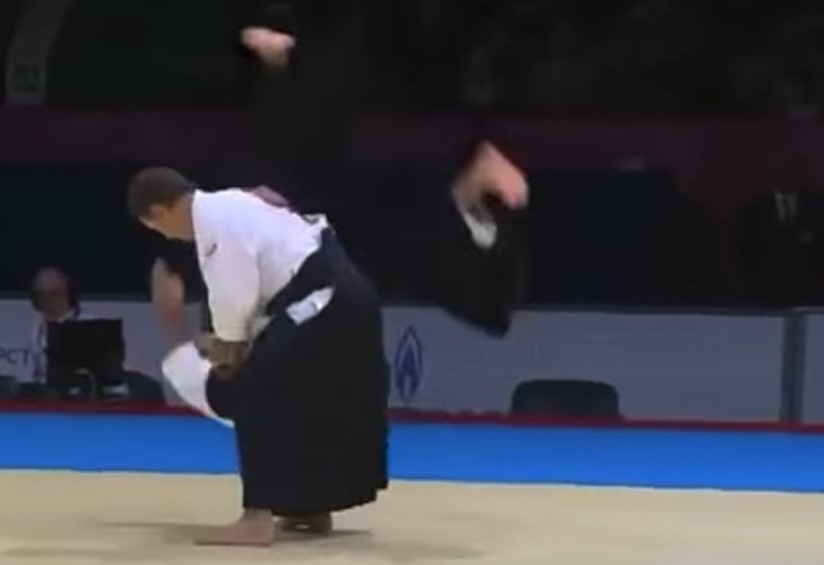
After class, I tried to refine my presentation by showing the high-fall response to irmi-nage. The best exemplars is the ukeme taken by Christian Tissier’s students. Watch the compilation video and think about the fulcrum and the logic of their dramatic falls. There is logic to the dramatic beauty in their responses.
[Note – you can find better resolution videos of each segment in this compilation, but this was a good summation of the point I am trying to make and the responses I was trying to elicit. Here is a cleaner video that highlights the responsive clarity we should aspire to develop.]
 Protective Arts