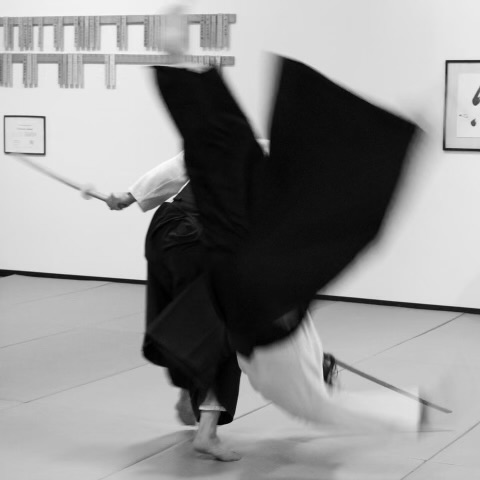
I have been presenting sword-takes away from the paired sword form san-no-tachi.
The reason to show the disarms from a paired sword exercise is to train the visual system to recognize how the moment in time looks and to teach sensitivity in weapon engagements.
Form 1 is done on after the first kirikaeshi. Shidachi executes kirikaeshi, uchidachi rises to strike shidachi’s exposed wrist. This is the moment to “see” both in time and space – to memorize how uchidachi’s sword is poised at the apex ready for the accelerated cut and to take measure of the physical distance you will need to cover to enter deeply enough. Once you learn to see, the technique can be executed in true time: Shidachi inserts his sword between uchidachi’s wrists as uchidachi raises shomen. Shidachi then enters irimi with the left foot to uchidachi’s outside line, turns tenkan, and cuts outward to throw uchidachi using the sword. (This could just as readily be done with a jyo.)
Done with a weapon, this disarm is frightening because it is dangerous. Shidachi, essentially, executes a thrust to the face before uchidachi can execute the cut to the kote. Uchidachi has to trust that shidachi will not actually strike and shidachi must execute the move with extreme caution. Trust and care are essential.
I introduced this form as the precursor because it demands much of each player in the encounter. The extra care means both partners must start slow. Slow is smooth. Smooth movements can be executed quickly. But at first, we are learning to see threats and openings. Once you learn to see the opening, you can learn to fill those voids – the space between the wrists, that brief pause at the top of uchidachi’s arc. To fill the openings (tsuki) without harming your partner requires higher skill than hitting them. To enter safely both players must tie themselves – ki-musubi – and keep a focused pace.
A focused pace starts and maintains honesty of intention and consistency of speed. Honest intention means you continue to strike at your target’s original position, even if the target moves. Consistency of speed means that whatever speed you initiate the action, keep that same pace. No alterations of angle or velocity.
Recognizing what the moment of opportunity looks like is your visual cue: a “go” signal. Move with the proper order of operation using weapons on the offensive: weapon, hand, body, foot. The kissaki rises between the opponent’s wrists, the hands advance the blade, the hips move in towards the opponent’s outside line pushing the left foot deeply irimi, then shidachi briskly turns tenkan which provides the rotational extension to throw (cut) uchidachi forward along their initial line of attack.
Disarming with a weapon in hand informs the un-armed technique. The movements are the same. Nage must enter as uke cuts shomen at the precise moment they previously inserted the sword. Only nage’s initial presentation of self is different. With weapons, a stance (kamai) is necessary. When facing an armed opponent, the best stance is shizentai – the natural open stance.
Nage faces the opponent squarely – feet and hips aligned and weight ready to move either left or right, arms free and relaxed at the side. This stance forces uke to select a target (usually the head) in order to land a decisive attack.
As soon as uke raises the sword, nage must boldly enter irimi – and for Form 1 – move the left foot and left hand extending out and up so that the web of the thumb meets just under the base of uke’s descending right hand.
The meeting point is the fulcrum and nage’s arm is a lever. The ideal is the meet the momentum of uke’s strike, and provide it extra energy as nage turns to continue the forward arc so that nage capture’s uke’s momentum and forces it to the mat – snappily throwing uke off his own sword.
The body-art analogy I used is katadori-menuchi because the tension is the same – nage uses their arm as an extended lever to meet uke’s strike in order to drive uke’s center up (for the kuzusu) and then out using the tanren rather than a collapsing arm to execute the throw. The use of the body and mechanical advantage is the same.
Form 2 done with weapons is executed on the second kirikaeshi. Shidachi turns kirikaeshi, uchidachi strikes kote, shidachi receives uchikomi, turns kirikaeshi, and as ukedachi raises for the second strike (men), shidachi takes ukedachi’s kote at the top for a cutting throw. (Alternatives include a draw-cut “do” or simply leaving the kissaki on the line of attack – “forcing the opponent to place their body on your sword.”)
This form is to uchidachi’s inside line (uke’s left side), thus shidachi moves to their right.
The moment to see here is much the same point in time and space – that moment just before uchidachi can begin to accelerate the sword for the decisive cut. Thus, shidachi must move the kissaki first toward uchidachi’s left wrist (much like roku-no-tachi). Once the shidachi has touched the opponent’s wrist, they must move to the right with the hip driving the front (right) foot and the left follows with an angular energy to assist the cutting action which is nearly perpendicular to uchidachi’s original line.
Executed without a weapon, nage must again start with shizentai. As uke first raises the sword, nage boldly enters to their right (uke’s inside) with the right arm raised for a counter-shomen and the left arm bladed out and away from the arc of uke’s sword. This time nage will meet the descending arc of uke’s sword – now with nails down, taking a “hammer” grasp of the handle. Once contact is made on the handle, nage continues to press down, adding energy to uke’s cut, but because nage has moved their body 90-degrees to the initial line, nage tightens the arc and throws uke when the sword hits the mat.
This is a muscular approach, and if uke feels too overpowered, their likely reaction will be to tighten the grip on the handle and stop their own cut. In this event, nage will have to sharply drop their weight to get uke to make a rebounding lift of the sword to off-balance and start the throw again – except now with a much tighter arc and shorter range of motion. (For those who have watched me for perhaps too many years, you will know I will step on uke’s foot to pin it and destroy the balance – ankle – as an augmentation.)
Of course the ideal would be to so precisely match uke’s timing and momentum, that merely “riding” the arc to the point uke intended and only gently changing the angle of the arc so that uke’s balance is thrown. I showed that to a few of you in class – so it can be done and works, but is an aspirational goal, not a pedagogical explanation.
Further classes will explore additional forms from both the inside and outside lines.
 Protective Arts