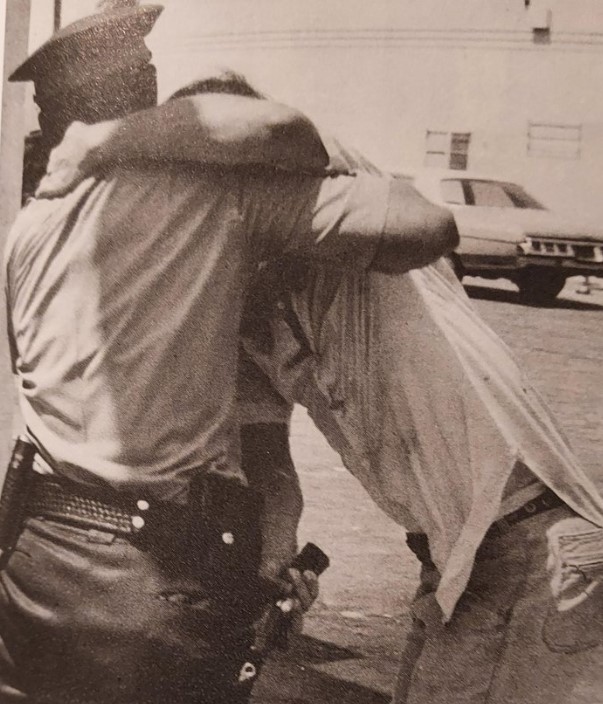
The banner image is a sobering reminder that retaining control of your weapon is imperative in close quarter combat. Primary weapons are always carried at the waist, thus the focus on chudan level.
The ritual endures longer than the reason for it – try to deduce the martial logic behind the ritualistic rote repetition in the art.
Ai-hanmi katate dori ikkyo ushiro tenkan
Uke attempts to grasp nage’s weapon that is held by the obi (belt) on the left hip. (Because warriors are right handed, this is a RvR encounter.)
Nage withdraws the weapon handle from uke’s grab by turning the left hip while using the left hand to raise the handle vertically and making a small step ushiro tenkan. Uke then orients to take nage’s right hand – the only viable target.
Nage cams their grabbed arm – elbow down, shyuto rotating inward – which defines the axis of the encounter where uke’s need to keep contact (lest nage immediately deploy the weapon) necessitates that uke’s elbow is moving vertically upward while their balance is being drawn forward. Keeping the grabbed hand as a static point, nage can use their left hand to control uke’s elbow and execute a controlling cut through uke’s center.
This narrative could be expanded to describe nage using their left hand to feed the saya up so as to place the handle into their right hand, which would allow (with a drop of nage’s hip) drawing the weapon and use it as an inducement for uke to move (as the blade rests against the back of uke’s neck).
Note that this presentation – and narrative description – of ikkyo is very different from an action in superior time. In superior time, ikkyo is a “lumberjack jam,” or an immediate counter-strike, or makiotoshi, or a lead to other techniques, which is why ikkyo really is a path to solve the infinite.
As a weapon-retention technique, the ikkyo narrative presumes a standard (nails-up) draw of the weapon.
A nails-down (reverse grip) draw results in irimi-nage.
Ai-hanmi katate dori irimi nage
Uke reaches for nage’s sheathed weapon. Nage slips irimi in time so that the weapon moves past uke’s grasp, while grabbing the handle in reverse grip, so that nage’s body movement effectively draws the weapon and uke is forced to grab nage’s weaponized hand – the knife point already toward uke’s center. Only uke’s extended arm prevents nage from immediately using the lethal point. The goal is to make your opponent place their body on your weapon’s point.

This momentary impasse where nage is behind uke, in their shikaku, while uke is preventing the stab, is solved by nage grasping uke’s neck with the left hand, making a small inward rotation to torque uke’s neck and spinal alignment, while keeping inward pressure with the knife and simultaneously shifting bodily back on an outward angle. This multi-vector movement will destabilize uke. If uke relents on the pressure holding nage’s knife, then nage will deploy it immediately. If uke keeps the tension while being destabilized, then nage has the opportunity to use their grabbed arm to throw uke using a traditional irimi-nage throw (rotational throw using the freedom of action at the shoulder).
An attentive reader should understand that these descriptions are a re-framing of Okamoto sensei’s demonstrations.
 Protective Arts
One thought on “WEAPON RETENTION”