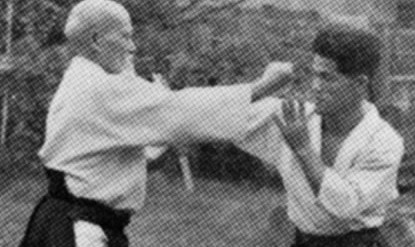
Atemi (当て身) is often misconstrued as a generic term to mean a “strike” or “hit,” but it means “to strike the body” and with the implication that it is striking a specific target.
Without any denigration of the sweet science – the pugilist art of Western boxing – which has incredible history and strategy, ultimately, has the goal of delivering a KO with a fully loaded transfer of mass. That is not what we are training.
In his Budo Renshu, O’Sensei made clear and distinct uses of atemi. Some encounters merited a strike reminiscent of Western boxing – upper cuts and jabs:

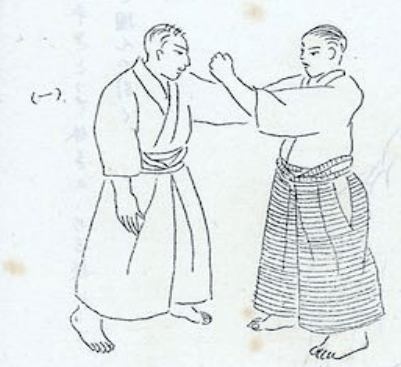
But concentrate on the less familiar.
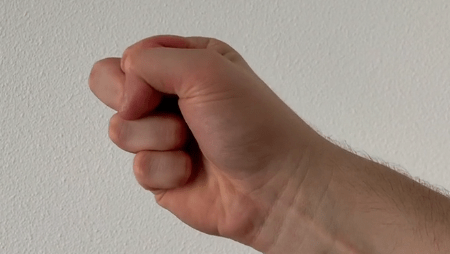
The single knuckle punch, often referred to as ippon-ken (一本拳), is a focused striking method found in both Karate and Tuite (Okinawan grappling and seizing techniques).

And its use was distinctly applied. The proper use of atemi usually requires strikes that are precise: targeting typically aimed at nerve centers, tendons, and (for the highly trained) acupuncture meridians. The goal of the strike is to create a neurological response – pain compliance, flinches, release reflexes – to facilitate the joint lock, throw, or control.
Ippon-ken is a punch where (most frequently) the second joint of the middle finger is extended slightly beyond the rest of the fist, concentrating force into a smaller surface area.
In this article I will mix lexicons, so a quick primer to disambiguate:
The Okinawan tradition uses tuite (取手), often translated as “seizing hand” or “grabbing technique.” In Japanese Jujutsu or Aikido, the closest equivalent is kansetsu-waza (joint techniques). But there’s a practical difference:
| Term | Okinawan (Tuite) | Japanese (Jujutsu/Aikido) |
|---|---|---|
| Approach | Lock follows a pain or balance disruption | Lock follows kuzushi (off-balancing) |
| Tool | Atemi embedded in kata | Atemi sometimes secondary or omitted |
| Lexicon | Rooted in Chinese influence (via Bubishi) | Rooted in Daito-ryu or battlefield grappling |
The refinement of terminology in Japanese (vs Okinawan) was driven home for me when my Kenpo instructor’s father told me “Aikido is like a laser, Karate is like a shotgun.” He was speaking both the to specificity of technique in Aikido’s curriculum vs the breadth of Karate, but I think also to the fact that Okinawan arts embed striking in the kata whereas Japanese systems tend to formalize and isolate terminology. Thus, in Okinawan, the ippon-ken isn’t a “strike” in isolation: it’s an inseparable part of an interlocking tactical sequence.
Tuite is not joint locking for its own sake, it’s structural exploitation. For a lock to work, the opponent has to lose structure or posture. Often, this can’t be achieved mechanically alone; pain or shock must create the opening.
Hence ippon-ken.
Examples:
- When attempting a wrist flexion lock (nikyō) and the opponent’s posture remains intact, a sharp ippon-ken into the inside forearm collapses their resistance.
- In transitioning from a lapel grab to an elbow lock, a knuckle strike to the floating ribs disrupts their ability to breathe or rotate away.
This isn’t theory. It’s anatomical reality.
An excellent reference to delve deeper is Bubishi: The Classic Manual of Combat translated by Patrick McCarthy – I recommend his work.
Often called the “Bible of Karate,” Bubishi contains illustrations and explanations of both vital point striking (kyusho) and small joint manipulation. In particular, its anatomical diagrams (Sections 28–32 in many editions) show targets such as: The medial biceps tendon; the intercostal nerve zones; the mandibular angle; and the radial nerve plexus near the wrist.
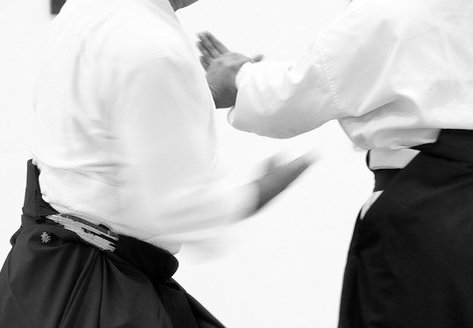
Many of these zones correspond exactly with the modern tuite targets or points of contact where Aikido effects a lock or throw (alas too often without a full appreciation of why that target was selected). The Bubishi doesn’t name ippon-ken directly, but its implied methods, sharp penetration with concentrated force, match the function of the single-knuckle punch.
A quote attributed to the Bubishi’s transmission of Chinese White Crane fighting reads:
“To strike with a small point is to cause deep pain without the appearance of force.”
This is exactly what ippon-ken delivers.
And while I have not shown all these applications in class, I have demonstrated the medial biceps tendon strike adopted from the “dirty boxing” taught to me by Master Keating, Panantukan.[1] Just as Okinawan tuite uses atemi to make the joint available, Panantukan uses similar percussive contact to make the opponent’s structure vulnerable to sweeps, controls, or disarms.
Both systems converge on this reality: damage isn’t the goal, disruption is. The damage follows the disruption.
__________________
[1] Panantukan incorporates knuckle rakes in addition to the single knuckle and expand targets to include the forearms, or inside the thigh to cause deadening effects. Furthermore, elbows (Master Keating’s Hellbows, Salute, and double-taps) are delivered to disrupt balance, but even more interesting are the gunting (scissor) strikes that simultaneous destruction of the attacking limb using knuckle strikes or ridge hands to nerve centers.
 Protective Arts