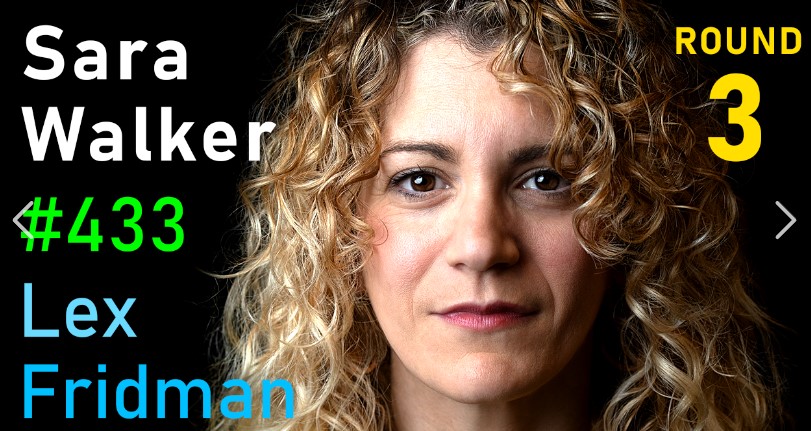
I learned about Sara Walker from a podcast with Lex Fridman. The entire conversation is worth the listen: Her conceptualization is brilliant and presented in an unassuming manner that belies the seriousness of the implications. Fridman’s long-format interviews are excellent in mining a guest’s breadth and depth of thought and I found Sara’s conceptualization of life fascinating, especially her use of scale to describe life as one of the largest structures in the universe because she incorporates time. Juxtaposing the size of life against a cosmic scale was an upending comparison.
There’s a line from Vonnegut’s Slaughterhouse-Five that always catches:
All moments, past, present, and future, always have existed, always will exist.
Vonnegut’s formulation is redolent of Nietzsche’s Eternal Return: that what has been will be again, with no variance and no relief. Both views load us with metaphysical weight.
Vonnegut’s Tralfamadorians see time all at once and thus perceive life – each moment from birth to death – laid out like beads on a string.
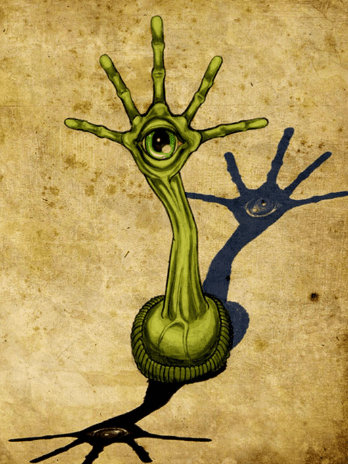
Billy Pilgrim, the war-haunted protagonist, bounces along that string involuntarily, unstuck in time. Perhaps being unstuck is a glimmer to the scale Sara Walker is alluding to: Her radical definition of life, not just the materialist molecules, but rather the entire chain of causes that led to its existence. Life, in her view, isn’t just here-and-now. It’s stacked-temporally, causally, recursively.
When Walker says life is “large,” she doesn’t mean big like a star. She means large like an algorithm that’s been running for four billion years. Every cell, every limb, every language and habit and scar is part of a recursive computation that remembers, anticipates, and somehow carries time forward.
So maybe the Tralfamadorians were simply too introspective. They saw time laid out and determined because they saw the entirety of a solitary life. But Sara has a broader view still. Its not just the individual but the species, life builds with it.
But how would the compendium, that building of life be accomplished?
In the Dune saga, Frank Herbert imagines the Bene Gesserit who can access “Other Memory,” the full sensory lives of their maternal ancestors: Genetic memory. Science validates Herbert’s vision. Research into epigenetics has shown that trauma, malnutrition, even scent aversions can leave marks on DNA that persist across generations. Holocaust survivors’ children have altered cortisol receptors. Mice whose fathers feared cherry blossom scent inherited the fear-even if they’d never smelled it. These biochemical echoes result from modifying gene expression based on the experiences of prior lives. We are-quite literally-haunted by our ancestors – we have genetically learned from the pain of others.
Here’s where it gets personal. If Walker is right, if life is structured in composite time, then our genealogical archives might be more than nostalgia. It might be survival instinct. To know your grandfather’s path through the Depression, or your great grandmother’s flight from famine, is not just to “honor the past,” it’s to glimpse the inputs that shaped your own default setting. In this light, genealogy isn’t just biography, it’s system analysis. Your family becomes a lineage of recursively structured information flow.
[Let me be clear, I am not advocating a determinist model, this is not predestination by DNA – replacing a Calvinist damned at birth by God. I am merely pointing to the latest evidence that information can be transmitted generationally, genetically.]
Take Walker seriously and we are all discursive agents integral to the continued development of life: at the intersection of narrative, biology, and recursive memory. We are not poor players that strut and fret upon the stage, but key conduits that propel life through time. We are causal agents that generate novelty against the grain of entropy.
So maybe the real Tralfamadorian error wasn’t in how they saw time. It was in their fatalism. “So it goes” is elegant resignation. But Walker’s conceptualization is one of continued growth. You don’t escape your history. You ingest and metabolize it. You incorporate it into form and pattern.
Playing with a gastronomical analogy is fitting for a biological definition, but my default is Greek. And Walker by trying to separate from both the Vitalists and the Materialists, sildes back to Aristotle’s telos. Life as anti-entropy is purposeful. Walker posits life’s new telos. She doesn’t name Aristotle, but I hear his echo – perhaps she is a direct descendant? Let me dilate:
There’s a moment in every enduring story where something old is taken apart and reassembled: a king unseated, a city razed, a body aged. And yet, somehow, the thing remains itself. This is the dilemma posed by the Ship of Theseus: if every part of the ship is replaced over time, plank by plank, is it still the same ship? And if you reassemble the discarded parts into a new vessel, which ship holds the true identity?
Aristotle provides the necessary distinctions to solve the riddle. In his Metaphysics, he distinguishes between matter (hyle) and form (morphe), insisting that what something is depends not merely on the stuff it’s made from, but on the telos it realizes. A knife is not just metal; it’s metal shaped to cut. A human is not just flesh, but flesh patterned toward rational activity. And a ship? It’s a thing that sails. Its identity may not reside in the wood at all, but in the continued act of navigation and sailing: its purpose enacted over time.
Sarah Walker’s definition of life adds modern resonance to this classical framing. She argues that living systems are vast structures in composite time, not because they’re spatially enormous, but because they embody the memory of their own construction. DNA is not inert – it is historical architecture. Each cell is a palace rebuilt in reference to palaces past, with blueprints written in adaptive scars and recursive function. If the Ship of Theseus still sails, it does so because the information that makes it a ship continues to govern its becoming.
This brings us close to the Aristotelian idea of entelechy – the actuality toward which a potential aims. Life, for Walker, becomes a process not just of chemical reactions, but of sustained identity through time via information that acts as a kind of internal cause. The form is not static, but alive and evolving and intentional in the Aristotelian sense. It seeks persistence, adaptation, and propagation. Not because it chooses to, but because those that did not, are no longer with us.
Walker and Aristotle both, it seems to me, reject dualism (bad Descartes!) without collapsing into reductionism. The soul (psyche), for Aristotle, is not a ghost in the machine, but the form of a living body. It is the organizing principle, the actuality of a body that has the potential for life. So when Walker speaks of life as causal structure encoded in information she is, perhaps unknowingly, reviving an Aristotelian intuition: Identity is not in the pieces, it’s in the pattern. More precisely, it’s in the pattern’s persistence through change.
This also re-frames the Theseus dilemma: it is not the planks or even the continuity that matters. It is whether the ship remembers how to sail. If the function endures, if the pattern persists, if the structure recursively reaffirms itself-then identity is not lost. It is transformed, matured, tested.
And that is how I interpret Walker’s formulation of what life is. Not a continuity of parts, nor even of memory, but of capacity of the ability to generate structure that sustains itself in the face of entropy.
So the ship sails on. Not because it’s made of original wood, but because it still catches the wind.
___________________________
A Stoic coda?
As much as I liked that final turn of phrase, I am not satisfied that telos is the right idea to end on. What if information isn’t just structure—but story? Sara Walker’s formulation already nudges us in this direction. Life, as she frames it, is information with causal efficacy. In this view, a living organism is less a machine than a sentence in progress. And the human being? Perhaps the longest, most recursive narrative structure in the known universe.
Walker has suggested that the arc of life includes not just biology, but our extensions: our tools, our language, our civilization. We are story-bearing, story-making entities, broadcasting patterns into space, encoding ourselves in stone, fiber, signal, silicon. Our survival depends on coherence: on keeping the story intelligible across generations.
Thus our myths, scriptures, oral traditions, and epics are not mere entertainment or ornament, they are cognitive infrastructure. Stories do what DNA does: they remembered what worked, what went wrong, who we fear becoming, and what we hope we might be. The Iliad, the Upanishads, Gilgamesh, the Analects these are operating systems.
Which brings me to the Stoics, who might have nodded gravely at Walker’s notion of life as causal structure. For the Stoics, the cosmos itself was Logos, which I capitalize because it is best translated not as ‘word’ but as ‘ordered rational speech.’ The Stoics believed the world was made, sustained, and understood as a kind of divine narration. God, they said, speaks the world into being—not once, but continuously. Creation is not an act, but a verb: an ongoing utterance. And as speaking animals, we are the image of God.
When we tell stories, we participate in that creative unfolding. To narrate is to bind cause to consequence, to name patterns, to cast significance. In that sense, storytelling isn’t just memory—it’s a microcosmic version of what life does: recursively structure the future using the grammar of the past, it is to make meaning resilient against time.
So I give the final word to Gene Wolfe (Shadow of the Torturer):
Certain mystes aver that the real world has been constructed by the human mind, since our ways are governed by the artificial categories into which we place essentially undifferentiated things, things weaker than our words for them. We believe we invent symbols. The truth is that they invent us; we are their creatures, shaped by their hard, defining edges.
 Protective Arts
One thought on “The Meaning of Life”