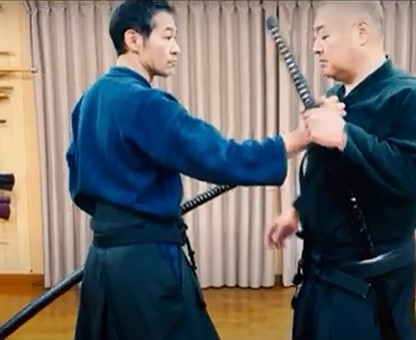
In a prior article, I explained ikkyo and irimi-nage arise from the moment of contested weapon access—the effort to draw and the counter-effort to suppress. The last Saturday weapons class continued that line of thought, focusing more precisely on ikkyo and nikkyo as a means to draw the katana in a contested encounter.
Protecting the katana from an opponent directly informs empty hand techniques. In short, technique is tactical.
I repeat, with some additional observations, my previous explanation:
Ai-hanmi katate dori ikkyo ushiro tenkan
The encounter starts because uke attempts to grasp nage’s weapon that is held by the obi (belt) on the left hip. (Because warriors are right handed, this is a RvR encounter, but train both sides for bi-lateral development.)
In response, nage withdraws the weapon handle, thereby removing it from uke’s grab by turning the left hip while using the left hand to pull the saya vertical and tight to the ribs, and making a small step ushiro tenkan. Uke then orients to take nage’s right hand – the only viable target once the handle is out of reach.
Nage cams their grabbed arm – elbow down, shyuto rotating inward – which defines the axis of the encounter where uke’s need to keep contact (lest nage immediately deploy the weapon). Nage’s shoulders must be soft and allow uke the illusion of a possible pin of the sword-drawing arm to nage’s chest. Nage must keep the armpits closed; do not try to keep uke away: invite the attack. At the apex of the turn nage’s grabbed arm will touch their opposite shoulder. From this point nage extends their fingers along the vertical line – absorbing uke’s pressure without contesting it. This will ensure uke’s elbow is moving vertically upward while their balance is being drawn forward. Keeping the grabbed hand as a static point, nage can use their left hand to control uke’s elbow and execute a controlling cut through uke’s center (direct attack to the head – shomen).
This narrative could be expanded to describe nage using their left hand to feed the saya up so as to place the handle into their right hand, which would allow (with a drop of nage’s hip) drawing the weapon and use it as an inducement for uke to move (as the blade rests against the back of uke’s neck).
But the further refinement is to understand what Okamoto sensei calls the “invitation” – nage must not move faster than uke. Uke must remain “interested” in the original intent: grabbing the sword (or the secondary target, nage’s hand). The difference I am explicating is one of timing. This is the ai-ki, the blending of timing and intent.
While the gross rusticity of the movement is to first prevent an opponent from taking your weapon, and secondarily drawing it even when the opponent has some physical control over a portion of your body, ikkyo ultimately is a lead and a capture. Once the movement is mastered and the practical use of the technique is understood, the next level is to find the connection in action.
Ai-hanmi katate dori nikkyo – direct
In the continuation of this exploration, nikkyo is no longer a simple wrist lock, but a derivative of a contested draw.
Where ikkyo starts with nage tactically removing the handle from uke’s grasp, nikkyo starts with nage drawing. Uke protectively arrests nage’s drawing hand (stop hit), uke forcefully intercepts the right hand at the moment nage has grasped the handle to draw.
At this moment, the technique is simply to use the handle as the short end (load) of a lever, where the grabbed wrist is the fulcrum and the back of the saya is used to deliver the effort – a first order lever. The mistake most students make is to forget that the sword is the tool, meaning students try to push the handle forcefully through uke’s wrist, forgetting the mechanical advantage of the handle (not their hand) as the load moving end of the lever. We get trapped by thinking the grabbed hand does the work. Once we understand that the encounter created an opportunity to use a lever, the crushing effect of nikkyo manifests.
Of course the subtle integration of the entire body must follow the gross mechanical advantage. Nage will employ a small withdraw, circle of the handle to gain positional superiority (above) uke’s wrist, and then turn his hip back so the handle points directly at uke’s center. Once properly aligned, nage must lift the saya up (dropping the handle down) and simultaneously shift his weight down and through the right thigh.
Once we understand precisely how the sword while in the saya creates mechanical advantage, we can extrapolate back to the empty-hand encounter. The shyuto of the grabbed hand is the handle and nage’s forearm is the saya. Consider the empty hand encounter where uke grabs nage’s wrist – in response, nage pronates his elbow inward toward the centerline, which then orients the shyuto vertical and above uke’s wrist. To do so, nage must move around the fixed point in space defined at the moment uke grabbed him because that point is the fulcrum.
Nage’s shyuto – is strengthened by spreading the fingers (expanding the space among the metacarpals) and then is levered over uke’s wrist when nage aligns his body around the fulcrum. With the right hand fixed as a pivot, nage’s left hand reaches across to reinforce, trapping uke’s hand to prevent uke from escaping the fulcrum. From here, nage drops diagonally backward and down, drawing uke slightly forward in a motion they cannot resist without losing their center. The purpose is not pain. The purpose is to freeze uke’s control over the draw and replace it with your own structure.
The structure of the wrist joint is the target, but it is a time interval that nikkyo truly captures. Uke’s attempt to control becomes their undoing.
Nikkyo is weapon retention by interruption. Where ikkyo removes the weapon from danger and leads uke’s energy forward and up to culminate with a draw and cut, nikkyo stops the attempt midstream and shatters the path of control with a trap. From the trap the draw can be completed with uke still on the arm.
It is important to understand then that nikkyo does not exist in isolation: like all Aikido techniques, it is contextual. Nikkyo can only occur when uke has latched on and is attempting to control the drawing hand. And it only works if uke remains interested in that control.
This is where Okamoto Sensei’s concept of “invitation” returns with new clarity. Nage must not move faster than uke. If uke loses interest in the draw, or shifts intent, nikkyo will not arise. The blend—the ai-ki—is in keeping uke’s attention on the hand that no longer holds the weapon, while their own spine becomes vulnerable to destabilization.
This requires not superior timing, but rather equal timing—interlocked timing (ki-musubi)—and from this interlock, structural advantage is extracted.
Once this functional origin is understood, nikkyo can be seen as a tactical necessity. In close quarters, it is the method by which the opponent is frozen long enough to reclaim your weapon—or to complete the draw with safety and control.
The ultimate training refinement is not in the pressure applied to uke’s wrist, but in the clarity of timing and the exactness of axis control—not suppressing uke’s action, but letting it complete itself on your terms.
Once the movement is mastered and the tactical value of the technique is understood, the next level is to find the connection in action.
____________________________
Additional technical considerations for nikkyo:
Review how the handle can be grasped as a lever-lock like any tessen or kobutan.
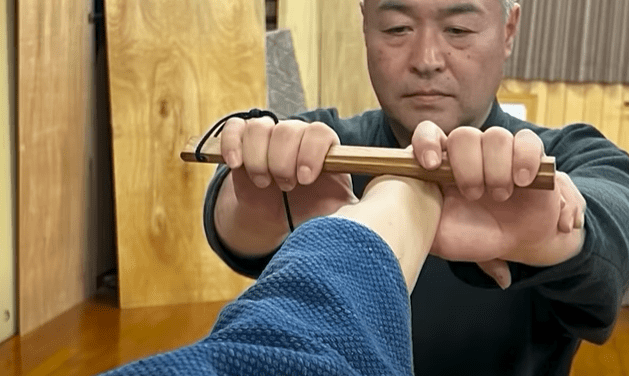
An excellent visual and historical aid to study for deeper understanding:
 Protective Arts