On September 30, 2025, researchers at Oregon Health & Science University announced they had developed functional eggs from human skin cells. Immediately, I thought of Frank Herbert’s gholas.[1]
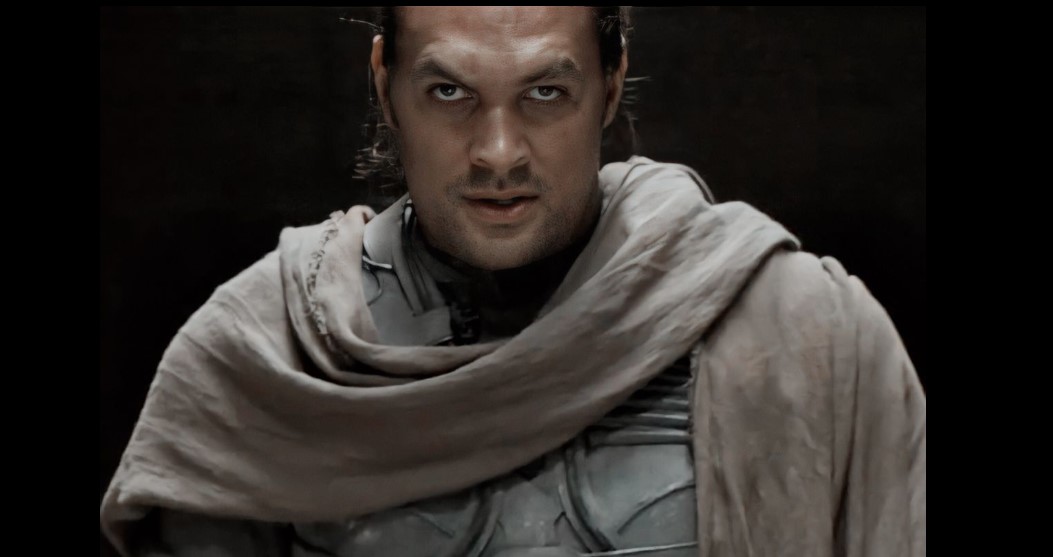
Duncan Idaho is the most-reborn man in Dune. From his first appearance on Arrakis, he is marked as archetype: Swordmaster of Ginaz, sensual, loyal, utterly alive. (Jason Momoa’s portrayal comes closest to Herbert’s sketch: curly “goat hair,” swarthy vitality, women quick to respond to him.) In Dune, Duncan dies protecting Paul Atreides’ retreat, only to return as the first successful ghola. In Dune Messiah, the Bene Tleilax present him as proof-of-concept: a body regrown from cells, memories dormant, a gift meant to tempt Paul with the promise of a resurrected Chani if he yields the throne.
It is Paul’s son, Leto II, the God Emperor, who makes Duncan unique in all human history: the man most often chosen for serial rebirth in the Axlotl tanks. Not resurrected once, but cloned, conditioned, and reawakened across millennia, until his identity grows thin beneath the weight of accumulated memory. Thinness here is not weakness but tautness: bandwidth under tension, more memory forced through the same channel. Each rebirth carries more: Mentat training, Zensunni philosophy, battlefield mastery. Yet Duncan remains bounded; he lacks the Siona marker, remains vulnerable to prescient scrying, and by Chapterhouse: Dune is slower and weaker than his genetically honed contemporaries.
Thinness, then, is the paradox of aging itself: physically diminished, yet far wiser, calmer, more deliberate than the swordsman who died for Paul. Duncan becomes a proxy for all men, his arc stretched across time. As skills and judgment accumulate, raw speed and strength recede. Duncan is pulled taut across the centuries, tensile with memory.
Published in 1965, Frank Herbert’s Dune planted the seed of a cycle that would carry Duncan Idaho across millennia. More than a decade later, Gene Wolfe’s Book of the New Sun appeared, serialized between 1980 and 1983. Wolfe was writing after Dune, and the resonance shows: both authors use memory as the vehicle of identity and continuity, though in strikingly different registers. Herbert presents Duncan as a man reborn serially, stretched thin across centuries. Wolfe reimagines the motif in Severian, the Autarch who carries within him the absorbed memories of all previous rulers. Duncan is the endlessly cloned swordmaster, his identity braided across bodies; Severian is the executioner-king, his identity layered across voices: a Bakhtinian polyphony, embodied.
Wolfe makes memory transfer possible through the alzabo: a beast that consumes human flesh and with it the voices of the dead, its glands distilling a potion that allows humans to take on another’s essence. Herbert’s Bene Gesserit encode a similar principle at the genetic level: their Reverend Mothers descend into the long braid of female memory, accessing lives embedded in DNA. Duncan’s gholas are another version of this recursion: not only flesh reconstituted, but memory carried forward, cumulative, accretive, stretching identity until it thins.
Humanity in all these visions is not merely a genome but a continuity of memory: swallowed, inherited, or regrown in the Axlotl Tank. It is memory, more than body, that constitutes persistence across time. But as in Duncan, persistence is never without strain: the self expands, yet grows taut, pulled across too many lives.
Modern science edges toward this possibility. Memory is no longer seen as confined to neurons. Immune cells “remember” past pathogens, carrying scars of inflammation. Glial cells, once dismissed as mere scaffolding, prove to be active stewards of memory formation, pruning synapses and tuning blood supply. Even skin and gut cells exhibit biochemical priming, altering responses based on prior experience. Memory, at its broadest, is cellular persistence: time inscribed into structure. But as in Duncan, too much inscription risks crowding out plasticity; structure itself grows thin. Into this widened frame arrives the OHSU experiment. By extracting the nucleus of a skin cell and coaxing it through a novel process they call mitomeiosis, researchers managed to mimic the chromosomal halving of meiosis. The result: eggs carrying the donor’s genetic signature, some of which could be fertilized in vitro. A handful developed into blastocyst. Most failed. None were carried further. The conceptual leap, however, is staggering: from somatic tissue to gamete, from a patch of skin to the beginnings of a human being. If cells outside the brain can “remember,” and if skin cells can be retooled into gametes, then the possibility of ghola-like cloning draws closer to plausibility. Not yet the resurrection of memory in a new body, but the reconstitution of the body itself from tissue that was never intended for reproduction. The scaffold is being built.
Here Blade Runner becomes the counterpoint. Tyrell’s Nexus-6 replicants are engineered with short lifespans, four years, to hedge against recombinatorial instability. Their personalities are stabilized by implanted memories, borrowed from others, which lend a sense of grounding but undermine authenticity. This is front-loaded thinness: stability purchased at the cost of expiration. Duncan, by contrast, bears back-loaded thinness: not expiration by decree, but attenuation by accumulation. Each life stretches further, but each new inscription narrows plasticity. Replicants expire because their design won’t bear long duration; gholas grow thin because their history overwhelms flexible adaptation. One collapses under the burden of too little time, the other under the burden of too much. Both are metaphors of recombinant stress. Both ask whether the weave of memory (implanted or accumulated) can sustain a coherent self across discontinuity.
Douglas Hofstadter’s Gödel, Escher, Bach: An Eternal Golden Braid describes recursion and self-reference: patterns that loop and echo at higher orders. Duncan is recursive in this sense: each ghola iteration loops back, carrying forward fragments of memory, layering them again. But unlike Bach’s fugues, which preserve motifs with crystalline fidelity, Duncan’s fugue is lossy, noisy, entropic. Each return repeats the theme of Idaho, but inverted, stretched, blurred. Here the skeptical note matters: recursion in formal systems is exact; recursion in biology is not. To press the metaphor too far is to mistake resonance for equivalence. But Herbert’s point is precisely this: identity is not preserved like a mathematical proof; it is refracted like a fugue, made audible only across multiple imperfect voices. Thinness is the strain we hear when too many voices overlap.[2]
By the end of Chapterhouse: Dune, Duncan flees the Watchers in a no-ship, bearing not only the genetic template of the first Idaho but centuries of layered memory. The Watchers call him thin because he is stretched across time, across selves, across lives. Like Vonnegut’s Tralfamadorians, who perceive all moments simultaneously, Duncan escapes because he has become duration itself. Herbert’s gholas, Wolfe’s eater of memory, Scott’s unstable replicants, Walker’s life-as-time, Hofstadter’s eternal braid, all circle the same question: can life weave continuity across discontinuity? Can memory persist beyond the fragile vehicle of the brain, into cells, into culture, into tissues that become seed once more? For now, 2025 is fragile: OHSU’s eggs are unstable, cellular memory is only partly mapped. Yet each threshold crossed makes the Ship of Theseus problem less an abstraction and more a practical matter. We may one day learn that our cells, too, remember enough to weave us forward. Never resurrected, but always reawakened, stronger in pattern, into the long braid of time.
_____________________________
[1] Months after writing this post, I watched Lex Fridman’s interview with Michael Levin. Amazing!
[2] “What, if some day or night a demon were to steal after you into your loneliest loneliness and say to you: ‘This life as you now live it and have lived it, you will have to live once more and innumerable times more; and there will be nothing new in it, but every pain and every joy and every thought and sigh and everything unutterably small or great in your life must return to you, all in the same succession and sequence…’”
“Would you not throw yourself down and gnash your teeth and curse the demon who spoke thus? Or have you once experienced a tremendous moment when you would have answered him: ‘You are a god and never have I heard anything more divine.’”
— The Gay Science, §341, “The Greatest Weight” (trans. Walter Kaufmann)
Nietzsche’s demon asks not whether life will repeat, but whether one could will its repetition eternally. The eternal return is a test of affirmation: could one embrace every joy and every pain, if condemned to relive them infinitely and identically? It presupposes a perfect memory, because only perfect recollection would make recurrence meaningful. Without memory, repetition is irrelevant. Nietzsche’s challenge is therefore ethical, not cosmological: to affirm the totality of life, unchanged, forever.
Herbert’s Duncan Idaho makes that metaphysics biological. Across Dune Messiah, Children of Dune, God Emperor of Dune, Heretics of Dune, and Chapterhouse: Dune, Duncan is not resurrected but iterated. Yet Herbert denies him the perfection Nietzsche requires. Each ghola begins as a blank organism; his memories return only through trauma or shock. In Dune Messiah, Hayt’s recollection “burst like a flood through a broken dam.” In God Emperor of Dune, Leto II calls this process “the pattern of his becoming.” By Chapterhouse, the Bene Gesserit admit, “He is never quite the same man.” Memory in Herbert’s world is partial, unstable: an entropy of recall that fractures identity even as it preserves continuity. Duncan is Nietzsche’s eternal return rendered material, and therefore mortal: recurrence under mutation.
Kundera, writing a century after Nietzsche, reverses the equation. The Unbearable Lightness of Being imagines the horror of perfect recurrence. “What happens but once might as well not have happened at all,” he writes; repetition gives weight, but infinite repetition would crush meaning. When Sabina refuses to spend eternity with Tomas, she affirms mortality as completion; a single life sufficient unto itself. Her “No” is both a betrayal of eternity and an act of self-preservation. Nietzsche’s heavy joy becomes, in Kundera’s world, the unbearable weight of perfection.
Herbert’s Duncan occupies the uneasy middle: he is neither permitted forgetfulness nor granted full remembrance. Each new life begins anew, haunted by echoes that cannot be perfectly placed. Herbert’s universe thus transforms eternal return into iterative decay. Memory functions like genetic transcription; capable of fidelity but always vulnerable to drift, noise, mutation. A perfect return would require a perfect system, immune to entropy. Herbert, Darwinist to the core, insists that life is entropy harnessed for persistence. A ghola with flawless recall would calcify; Duncan survives because he forgets enough to change.
The moral of this imperfect return is evolutionary: it is not recurrence that sanctifies life, but imperfection that permits becoming. Kundera’s Sabina and Herbert’s Duncan converge on this truth: eternity without loss is unlivable. Forgetting, far from failure, is freedom.
Current neuroscience supports Herbert’s intuition. Memory is not a recording but a reconstruction. Each act of recall alters the neural trace; reconsolidation updates memory with new context. Synaptic pruning and transcription noise keep the system plastic. Perfect memory would be pathology. Even at the molecular level, life depends on imperfection. DNA transcription and epigenetic methylation are probabilistic, not absolute; the very drift that causes aging also enables adaptation. Biological systems fight entropy by folding it into learning.
In this light, Nietzsche’s perfect recurrence becomes impossible physics, and Herbert’s lossy recursion a form of realism. The ghola’s fading precision mirrors the brain’s own strategy: remember approximately, or not at all. Biology sides with Kundera and Herbert. The lightness of being is not nihilism, but metabolism. A perfect return would freeze time; an imperfect one allows it to braid.
 Protective Arts
One thought on “Gholas and the Eternal Golden Braid”