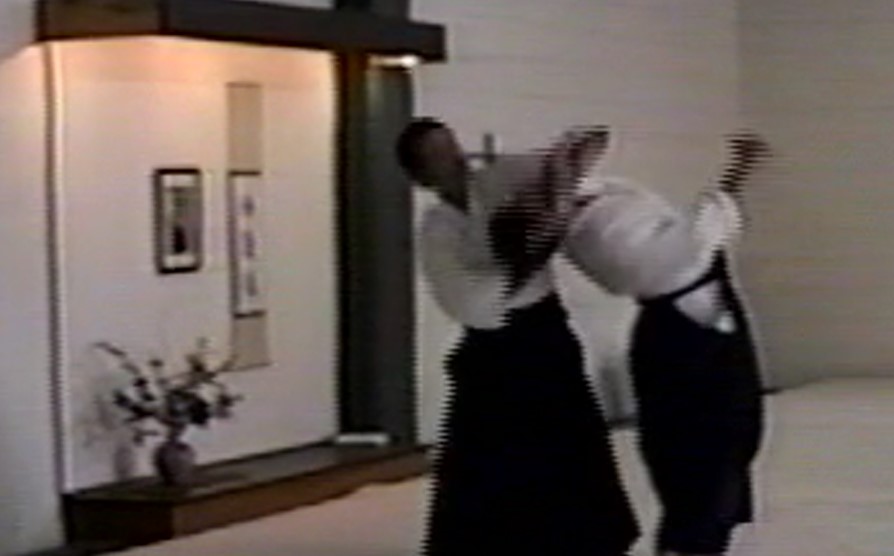
In the last several classes I have focused on irimi-nage starting from ai-hanmi katate-dori.
To develop precision and accuracy, I’ve emphasized how nage’s hand position determines the flow of movement. More importantly, the moment of contact defines the fixed point around which all subsequent action resolves.
What do I mean?
Much like tai no henko, where uke grabs a static wrist, nage must learn to move the body around the initial point of contact: without disrupting uke and without revealing intent. The grabbed wrist becomes the unmoving axis of the encounter.
So it is with the initial presentation of irimi-nage: where uke grabs, that point remains fixed in space.
Because the hand can present in various orientations, I have introduced three foundational forms:
Palm vertical — perpendicular to the ground.
Palm up — knuckles toward the earth.
Palm down — knuckles toward the heavens.
The chosen hand orientation dictates how nage must move. The use of the hand from a static grab teaches simple entry mechanics.
Palm Vertical.
Nage flexes the wrist outward so the base of the palm encourages uke to continue forward on a slight tangent. This subtle deflection preserves uke’s intent and allows nage to move inward as uke passes.
Palm Up (Chūdan Line).
Here, nage cams the thumb over uke’s wrist with a counter-grab, keeping uke on the middle line. It’s minimally disruptive. Uke believes their grab remains commanding. Concealment of intent is the goal.
Palm Up (Gedan Line).
Alternatively, nage cuts over uke’s grab with the shutō, targeting the thigh or outer tendons of the knee. This transfixes the initial axis, rooting uke to the ground rather than letting them flow forward.
The aim across all three is to refine sensitivity: to move without giving uke reason to react. If uke believes their initial grab has succeeded, they will not need to counter.
Irimi is an aggressive strategy: stepping directly into uke’s vector. Nage presents the wrist as bait, allowing uke to “succeed,” then uses uke’s own momentum to pass inside the line and achieve shikaku. Only then does nage pivot so the hips align parallel to uke’s original direction.
From this parallel alignment, nage’s grabbed hand should “float” before uke’s center, precisely along the nose line, an implicit threat uke cannot ignore.
To build body sensitivity, I have uke maintain their grip and extension so nage cannot simply strike the face. This sustained tension creates a living feedback line. The path of least resistance is forward; yet if blocked, the shoulder must float (not lift), redirecting tension upward. The shoulder joint traces a circular arc along uke’s centerline, creating the basis for the throw.
Simultaneously, nage can seize uke’s collar, collapsing the spine so hips drive forward as the head retracts; eyes fixed on the oncoming arc. The entire action travels a single horizontal line: both move forward, both remain on the vector of the initial attack.
This basic presentation keeps the action along a singular line of motion. It is designed to promote forward movement so that uke can follow their initial attack vector. Both players move horizontally (albeit in opposite directions), and nage’s “throwing” arm remains on the line of attack.
The progression unfolds as follows:
- Uke and nage face opposing vectors.
- Nage enters (irimi), snapping parallel to match uke’s line.
- As the throwing arm crests the arc, nage reverses alignment, restoring the original opposition to complete the throw.
In the next level of study, nage manipulates uke’s spine diagonally down and back (using pressure on the shoulder or mastoid line) to achieve more decisive unbalancing. It’s not a pull but a redirection of structure.
As a bunkai or direct application, imagine two spears thrusting with equal ferocity. If nage keeps the bait hand fixed while uke reaches to seize it, the rear hand can strike uke’s grasping arm slightly off-line, ruining the grab. Because both advance along opposing vectors, uke impales himself upon nage’s still waiting bait hand, resolutely aimed at uke’s center. (I also gave you Chiba sensei’s double-atemi variation.)
The mechanics of irimi-nage descend from Daitō-ryū Aiki-jūjutsu’s entering-body (irimi) methods. Sokaku Takeda taught several such entries, irimi-zuki (entering thrust), iri-otoshi (entering drop), irimi-nage, each closing the line of attack, striking the balance axis, and rotating the spine against its own momentum.
I study the origins of the technique to remember its design intent. Irimi-nage is too often performed as a graceful arc, uke diving obligingly. That aesthetic betrays its essence. Irimi is not avoidance: it’s audacity. The act of entry trains us to override hesitation, to violate the imagined “safe space” of the opponent. It is, in its truest form, a pedagogy of courage.
When I echo Okamoto sensei’s dictum that you must “keep uke interested,” she means give them a reason to keep attacking and the freedom to move. But her technique reminds us that freedom is circumscribed by the logic of the encounter.
Irimi-nage isn’t just another throw. It is the principle that divides Aikido from defensive arts. You do not escape danger: you enter it, collapse it, and walk through with poise and sang-froid. That is shizentai in motion.
 Protective Arts