
I owe the allocentric framing entirely to Mark Hatmaker. In his most recent post (The Orthodox Fighting Stance, part 2), he introduced the neurological language that gives shape to a phenomenon fighters adopt reflexively; the preference for placing the dominant side to the rear when the stakes rise. Hatmaker wrote that this posture “turns off thoughts of the self and constant performance evaluation,” moving the mind from egocentric to allocentric focus, or what the samurai called mushin, “no mind,” the clear calm state in which perception becomes action. He found in recent research what warrior cultures had stumbled on long before science could name it: by altering how we stand, we alter how the brain attends.
The science he cites comes from Kenneth Heilman and others who have mapped how the cerebral hemispheres divide attention. The right hemisphere handles broad spatial awareness and allocentric mapping (perception oriented toward the world) while the left hemisphere favors analytic, self-referential tasks. The left visual field therefore enjoys an attentional edge for scanning, motion prediction, and global context. Hatmaker builds on this to argue that the orthodox stance (dominant hand and eye to the rear, chin tucked, gaze through the upper-left visual field) engages the brain’s most efficient network for allocentric processing. “By gazing in this manner,” he writes, “we engage the sensorimotor allocentric bias so greatly that we can attend and perform with greater efficiency.”[1]
That claim is elegant and plausible, though not without limits. The left-field advantage is well supported; the vertical, “upper” component less so. The upper visual field tends to specialize in far-space search, while the lower favors peripersonal, action-based control (Previc 1998). Fighting, like fencing or swordplay, traverses both domains in a single heartbeat. It is therefore safer to say that orientation and field of gaze shape perception, but not that one configuration is universally superior. The brain provides biases; the art chooses when to exploit them.
This, I think, is where our paths converge. Hatmaker sees stance as a neurological key to outer-directed focus; I see it as an evolutionary compromise between readiness and commitment. He approaches from the ring and the clinch, where range collapses and reaction is the currency of survival. I approach from the sword (and the pistol), where geometry and precision govern the encounter. The sword, being a lever, demands orientation more than torque. In single-line systems, fencing, kendo, or the Western cut-and-thrust, the forward lead reduces time to contact and keeps the point alive. Power comes not from the rear but from linear alignment, from the ability to control centerline. In these systems, the strong-side lead is not a defiance of physiology but an adaptation to a constrained geometry: the duel, one opponent, one vector.
When range closes or the cut must finish decisively, the logic reverses. The rear leg coils, the hips twist, and the cut releases through the full kinetic chain. The old schools knew both conditions and trained them deliberately. Kashima Shinden Jikishinkage-ryū alternates right and left leads to cultivate bilateral coordination (Otake 1977–82). Yagyū Shinkage-ryū masks intent by beginning left-forward, then reverses mid-cut (Yagyū 2004). Ono-ha Ittō-ryū uses alternating footwork so that whichever side leads arises from opportunity rather than doctrine (Warner and Draeger 1978). They were already training against reflex; recognizing that any fixed habit could be read, timed, and killed.
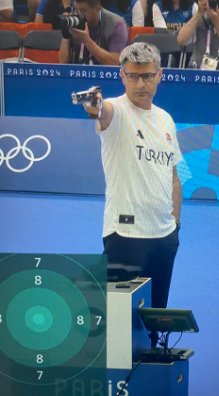
Firearms reverse the order again. Sight alignment and recoil management replace torque as the governing variables. In the modern pistol stances that grew from Fairbairn’s one-handed method to Weaver’s two-handed compromise and finally to Cooper’s isosceles, the human geometry gradually squared itself to the target. The goal was not allocentric awareness but visual dominance and recoil recovery. In these contexts, the placement of the dominant eye relative to the target dictates posture more than any hemispheric bias. The right-hemisphere advantage might contribute to calmness of perception, but the weapon demands that the sights, not the mind, stay level.
Still, Hatmaker’s principle of “hacking attention” through posture remains valuable. The same stance that quiets the self in combat may also train calmness in daily life. His description of the feedback loop, the way orthodox stance cultivates mushin, and mushin in turn reinforces allocentric awareness, rings true. It also hints at something deeper; that the stance might serve as a daily mnemonic for composure, a bodily reminder that perception precedes thought. I take this as a very powerful reminder that shizentai must become the repository for mushin. Our neutral open-stance becomes the “natural” posture of “no-stance,” so mushin becomes the default state.
A martial artist, however, must train awareness. Every common pattern is a potential target. If most fighters coil the strong side to the rear, one must learn to read and exploit that habit. Lead-side power is the natural antidote: the intercepting jab, the fencing thrust, the stop-hit that lands in the half-beat before the rear chain fires. Angle is the next weapon: step outside the loaded hip, steal the torque, and force the opponent to reset. Ushiro-tenkan is a perfect example of Aikido’s solution to the power strike. Close the range until the fight enters the lower visual field, where tactile and vestibular cues replace distant scanning. This is JKD’s and FMA’s trapping range. Sensitivity to pressure and pattern now take priority over vision. Vision, like stance, is a lever that can be turned against itself.
Left-handers offer another reminder that nature’s tendencies can be overturned by training. Southpaws are overrepresented among successful fighters (Richardson and Gilman 2019). The reason is simple: rarity. Most orthodox fighters spar mainly with their own kind, and the unfamiliar geometry of a southpaw (mirrored stance, reversed angles) creates momentary cognitive lag. The orthodox fighter starts behind the OODA loop. This “fighting hypothesis” has held up across decades of boxing and MMA data. Yet the advantage is frequency-dependent; it fades with exposure. The antidote, again, is training: make the rare common.
In the end, the strong-side reflex is an adaptive equation solved differently by context. The rear coil conserves potential; the forward lead spends it. The allocentric bias Hatmaker describes may govern the probing phase, where awareness must widen and the self must quiet. The egocentric bias returns in the moment of commitment, when everything narrows to the cut, the trigger, the decisive act. The human nervous system toggles between these states endlessly: scanning and striking, perceiving and doing. This rhythm, probe and commit, widen and narrow, is the grammar of combat.
Hatmaker’s practical insight, that the orthodox stance engages a neurological predisposition toward allocentric calm, is a significant addition to the literature of the fighting arts. My counterexamples from sword and pistol do not refute it; they delimit it. Where weapon geometry or visual precision dominate, other priorities supersede. But his larger point that body orientation governs attention, and that the trained warrior learns to direct that attention outward is an important reminder to us all. The lesson is to learn both sides of the equation: the coil and the release, the calm gaze and the decisive cut.
Hatmaker is preparing his third installment, and I look forward to his conclusions. If his preview holds, he will carry the discussion from neurology to ethics, showing that posture, attention, and conduct are ultimately one continuum. That movement from stance to spirit is a worthy frontier for any martial study.
[1] The general argument of dominant hand and eye to the rear is challenged by left-handers and those with cross-eye dominance, but those are statistical aberrations.
References (selected):
Heilman & Valenstein, Clinical Neuropsychology of Attention and Neglect (1985).
Previc, F. H. “The Neuropsychology of 3-D Space,” Behavioral and Brain Sciences (1998).
Otake, R. Katori Shintō Ryū: The Life-Giving Sword (1977–82).
Yagyū, M. Heihō Kadensho (2004).
Warner, G. and Draeger, D. Japanese Swordsmanship: Technique and Practice (1978).
Richardson, C. and Gilman, J. “Left-Handed Advantage in Combat Sports,” Laterality (2019).
Cooper, J. Principles of Personal Defense (1989).
 Protective Arts