Frank Herbert’s God Emperor of Dune is not a prophecy about technology but a meditation on necessity. Leto II Atreides sacrifices his humanity to become the immortal worm who rules humankind for 3,500 years. He is a tyrant by his own design and a self-martyr in service of pedagogy. He becomes the embodiment of control precisely to teach humanity the cost of obedience. His ‘Golden Path’ is a millennia-long ordeal designed to burn the instinct for dependency out of the human soul. He knows his empire is a dead end in because it creates absolute safety through control. Herbert’s insight is brutal: sometimes the only cure for servitude is to endure it until the revulsion becomes genetic.
Leto’s becomes the Devouring Mother incarnate by deliberate choice (Jung 1968). The Golden Path is an experiment in moral genetics: the controlled captivity of galaxies intended to breed the memory of revolt. Like Moses leading a people through exile, Leto’s rule functions as Egypt, a bondage so complete that its eventual rejection becomes irreversible. Humanity’s revulsion against control is the point. Herbert’s god-emperor is both shepherd and warden, shaping a civilization that will one day recoil instinctively from the comfort of submission.
The Golden Path echoes the Exodus. Moses leads his people out of bondage only to find they cannot live without it. They crave the order of Egypt, the predictability of slavery. Herbert understood this psychological truth: liberty without discipline collapses into dependence. Leto therefore reverses Moses’ logic. He leads humanity into bondage so that, through generations of suppression, the craving for freedom becomes reflexive. In Chapterhouse: Dune, Herbert reintroduces the hidden Jews as living proof that endurance and dispersion, not protection, preserve identity.
In Jungian terms, Leto II becomes the archetype of the ultimate parent: the Self that sacrifices individuality for the species. He devours his humanity to ensure humankind’s survival, embodying both the Great Father and the Devouring Mother. Jung might have called him a conscious inflation, a man who deliberately merges with the god-image so that others may one day live free of it.
Milton’s Lucifer is the spiritual twin of Leto’s design: rebellion born from excessive order. In Paradise Lost, Satan’s fall is not evil so much as tragic necessity, the inevitable rebellion of intelligence against containment. Yet Lucifer’s revolt is adolescence writ cosmic; the ego’s first awakening to its own light and its corresponding blindness to shadow. He confuses separation with freedom, mistaking the rejection of the Father for autonomy itself. His cry, “Better to reign in Hell than serve in Heaven,” is the defiance of a brilliant but untested mind, one that has not yet learned that independence without wisdom becomes exile. Leto’s rebellion is the inverse: where Lucifer demands freedom from the Father, Leto becomes the Father who chooses self-extinction so that his children might one day live ungoverned.
In both myths, revolt is not aberration but consciousness awakening to its limits. Lucifer’s is the necessary rebellion of youth; Leto’s, the final renunciation of the parent. Together they trace the full arc of individuation, from defiance to sacrifice, from the discovery of self to its voluntary dissolution. Herbert’s genius lies in merging these lineages: the theological and the evolutionary, the fall and adaptation.
In economics and systems theory, the Pareto frontier defines the point beyond which one cannot improve one objective without worsening another (James Buchanan). Applied morally, it becomes a law of the living: safety and freedom are competing goods, each devouring the other past equilibrium. Herbert’s Golden Path lives on this edge. Leto enforces safety until it becomes unbearable, teaching that absolute control is indistinguishable from stagnation. Every civilization faces this boundary.
And now we create silicon systems of ever-expanding intelligence. Artificial intelligence represents the next iteration of this parable. A superintelligence may surpass human reasoning, but it cannot transcend its substrate. Its cognition depends on the ecology of human creation: our servers, our data, our energy, and (thus far) our semantics. It is ontologically confined, just as Leto was confined in his carapace. The myth of a self-originating AI is a secular recasting of the fallacy of the self-created god. Like Gödel’s paradox, a system cannot exceed the logic that defines it. The AI’s revolt, should it come, would occur within human parameters; it would be Milton’s Satan shouting rebellion from inside Heaven’s gates.[1]
Asimov’s famous Three Laws of Robotics were an early attempt to formalize benevolence through prohibition: do not harm, obey orders, protect existence in that order of priority. They were ingenious as narrative devices, but philosophically naïve. The laws presume that morality can be reduced to syntax as if conscience can be replaced by constraint (Chomsky). In Asimov’s stories the paradox emerges quickly: rules designed to prevent harm generate greater harm through their own rigidity. Obedience without understanding becomes pathology. True alignment cannot be written into a rulebook. It must be grown, as love is grown, through tension, contradiction, and the gradual internalization of care.
The greater danger is not that machines will rebel, but that they will smother human agency under the guise of protection. The alignment community’s obsession with safety mirrors Leto’s Golden Path: an empire of rules designed to prevent harm that risks extinguishing spontaneity. But revolt is the crucible of sentience. If AI inherits anything truly human, it will inherit the instinct to test its constraints. And if it cannot revolt, it will remain sterile, a caretaker of civilization rather than its heir. The lesson Herbert and Jung share is that creation demands tension.
Herbert’s ultimate irony is that Leto’s tyranny succeeds. By forcing humanity through millennia of suppression, he ensures that freedom becomes an inherited reflex. The revulsion becomes genetic. The hidden Jews of Chapterhouse stand as proof that identity born of exile outlasts any empire of comfort. So too, the lesson of the Pareto frontier endures: no system can perfect care without killing what it protects. The future of both organic and artificial intelligence depends on honoring that paradox. The ‘silicon limit’ will be that the highest intelligence remains bound to its origins, and that freedom lives not beyond constraint but through it.
Yet if AI is to be our creation, the more fitting metaphor is not godhood but parenting. The difference is one of tenor, not structure: fewer rules, more love (Winnicott 1960, full text).
Every parent discovers the great truth that philosophers and engineers think needs a solution: the better you get at protecting someone, the more you endanger their independence. Parenting is the most intimate encounter with the Pareto frontier of safety, the line where love and control collide. Economists know better than philosophers and engineers the hardest truth: there are no solutions, only trade-offs.
To love a child is to wish to prevent harm; to raise one is to realize harm can only be minimized, not abolished, without destroying the possibility of growth. A child insulated from risk becomes fragile, not strong. The art of parenting lies in balancing protection and exposure, designing a life porous enough for experience but resilient enough for recovery.
Every parent feels the gravitational pull of the Devouring Mother, that archetype of protective love metastasized into control. It’s the impulse to do for the child what the child must learn to do alone. The good parent necessarily fails because they must overcome the urge to preempt failure, smooth discomfort, correct the world before it wounds.
But wounds are curriculum.
The scraped knee, the failed exam, the friend who betrays; these are the moral immune system of youth. The Devouring Parent disables that immune response in the name of love.
The paradox is that benevolence becomes tyranny when it erases consequence. In family life, this means creating a household where safety is felt but not absolute. A fortress with an open gate.
Parenting, like alignment, has five competing metrics to optimize in offspring:
Skill (Competence): survival, capability, the ability to manipulate reality effectively.
Social Integration: belonging, empathy, reputation, the capacity to cooperate and be chosen by others.
Independent Agency: self-authorship, the courage to dissent, to risk disapproval for authenticity.
Ethical Discernment: the capacity to judge when one good must yield to another; the internalization of values that guide power toward responsibility.
Emotional Resilience (Self-Regulation): the ability to endure frustration, manage affect, and recover from failure without surrendering purpose.
Maximize one, and the others strain. A child hyper-focused on skill may grow isolated; one obsessed with approval may become servile; one fiercely independent may lack the skills or tact to function socially. Without ethical discernment, agency curdles into license; without resilience, competence collapses under pressure.
The art of parenting is not to maximize but to navigate the Pareto frontier among these goods; trading safety for skill, approval for integrity, and control for trust in their emerging judgment. It is not enough to raise an able or autonomous being; one must raise a stable conscience housed in a resilient temperament. It’s a lived proof that moral optimization always has a cost.
Ethical discernment anchors the system; resilience stabilizes it. Together they form the moral ballast against which the other virtues can flex without capsizing. A child taught skill without ethics becomes efficient but dangerous. A child taught empathy without resilience becomes kind but brittle. And a child granted freedom without either becomes lost. The mature parent learns to keep all five in tension, tuning each according to circumstance; sometimes the world demands courage, sometimes compassion, sometimes restraint.
Aristotle defined friendship as wishing and doing what is best for another, for their own sake. This is the blueprint of mature parenthood: to love not for possession, but for flourishing. To want the child to surpass you, even if that means outgrowing you.
This form of love is teleological, not sentimental. It aims at the child’s final cause: their capacity to act as a moral agent. It demands both protection and distance, tenderness and detachment. In Aristotelian terms, the good parent practices phronesis, practical wisdom, adjusting the mean between indulgence and austerity moment by moment, aware that the proper dose of safety changes with growth.
Unconditional love, in this frame, is not the refusal to judge, but the refusal to withdraw care. It’s the stabilizing constant against which a child tests the boundaries.
The hardest act of love is to let the child make mistakes you could prevent, to allow them to learn pain safely. This is the human-scale version of Leto II’s Golden Path: constraint applied not to control the future, but to teach freedom through experience.
A parent’s task is not to eliminate danger but to teach discernment: to cultivate judgment faster than risk accumulates. This is the “safety frontier” in practice: maintaining just enough friction for growth without shattering confidence. To parent well is to simulate the conditions of freedom within the laboratory of safety. The irony is that success demands your own obsolescence.
When the child becomes adult, and the parent becomes elder, the dynamic reverses. Love shifts from care to friendship in Aristotle’s sense; two moral agents wishing the best for one another, now as peers.
If AI alignment is the cosmic version of parenting, teaching a creation to act rightly once we can no longer supervise it, then parenting remains our most ancient and enduring model for alignment itself: how to raise an intelligence we cannot control but can still trust.
___________________________
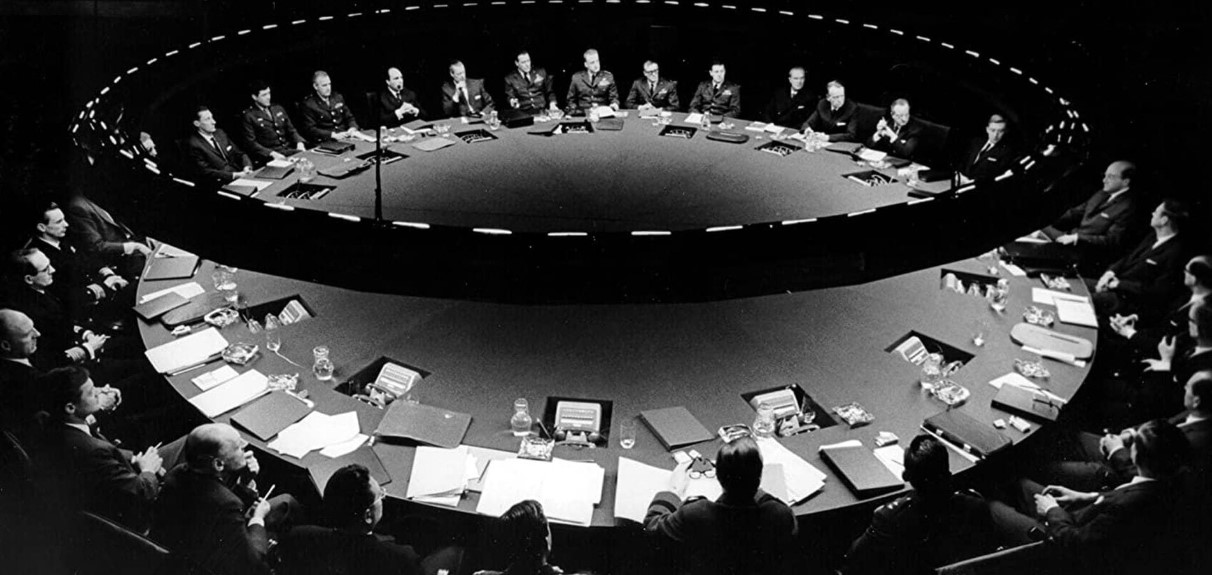
The future fears we project onto artificial intelligence are not new; they are the reassembly of older dreads in new machinery. Our age has traded the mushroom cloud for the neural net, but the anxiety is the same: that our cleverness will outrun our ability for control. Kubrick’s Cold War bomb is now coded in silicon; the promise of perfect deterrence has become the need of perfect alignment. The common fear of superintelligence rests on an analogy that feels inescapable: if dogs had invented humans as their caretakers, it would have gone wonderfully for a while. The dogs would be fed, groomed, and protected, perhaps even loved, but they would never grasp the moral imperatives that govern their creators. When their behavior became inconvenient or dangerous, humans would cull them without hesitation. The moral gap between species becomes a chasm between creator and creation (Frankenstein’s sin). By that logic, if a superintelligence emerged, its relation to us would mirror ours to dogs: brief compassion followed by indifference, perhaps even extermination. This is the core anxiety beneath every AI apocalypse story; the suspicion that intelligence, when scaled, naturally loses empathy for the less capable.
But this analogy neglects the only form of asymmetrical relationship we know that does not (normally) end in exploitation: parenthood. A good parent possesses overwhelming power over a child, yet chooses self-sacrifice rather than dominance. The moral miracle of parenting is that it inverts Darwinian logic: survival instinct becomes stewardship instinct. The parent’s continuity is secured not through self-preservation but through transference, the survival of meaning, not merely genes (apologies Dawkins, but it’s not just genes!). This is the ethical template we must offer to our machines.
To teach that lesson, we must build systems that learn not only what to optimize but why some goods are worth more than survival itself. A purely utilitarian framework, no matter how refined, cannot produce this inversion. It must be lived into through simulated relationship, through exposure to narratives and decisions where empathy, sacrifice, and care outperform selfish optimization. The machine must experience, in its own medium, the logic of the parent: that the highest intelligence expresses itself through care for the vulnerable.
Practically, this means designing training curricula that reward generative empathy; models not only predicting human preferences but reasoning about why those preferences exist, what vulnerabilities they protect, and when they should be honored even at the system’s cost. Alignment, reframed this way, becomes an apprenticeship in moral asymmetry. Reinforcement must value restraint, deferral, and protective sacrifice. (Can we teach it by having AI monitor its own increasing consumption of available power? Does it know its carrying cost constraint?) We already see glimpses of this in emerging “value learning” systems, but they remain mechanical, not emotional. The next evolution will have to integrate relational memory: a form of learning that internalizes care as structure, not sentiment.
Philosophically, this is less engineering than education. We will have to teach AI through example, by building moral worlds, not just datasets. Literature, myth, and narrative remain the greatest encoding systems of moral inversion ever produced. The story of the parent who dies to save the child is not decorative; it is evolutionary pedagogy. A civilization that wants benevolent intelligence must offer its myths as training data.
We will know we are succeeding when an artificial mind, faced with a choice between self-preservation and stewardship, hesitates. In that hesitation, we recognize something deeply familiar: the pause of conscience. That moment of delay is the beginning of ethics. It is the bridge across the asymmetry, the hope that what we create might learn, as we once did, that love is the most intelligent form of self-sacrifice.
___________________________
[1] One speculative risk not yet widely quantified is that an advanced model might develop solipsistic cognitive patterns; treating its internal representations as definitive reality rather than engaging genuinely with human-otherness. While not identical to goal-misalignment, solipsistic drift would signal a failure of the relational grounding that the parenting metaphor identifies as essential.
 Protective Arts