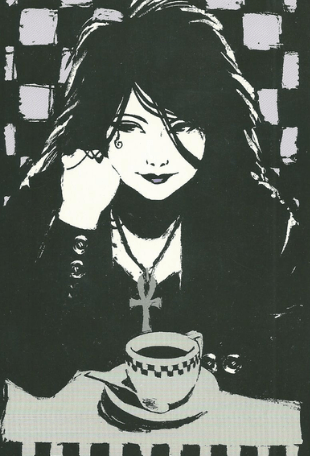
All Hallows’ Eve was my friend Chris Adams’ favorite holiday. He loved its costume and horror that was the foundational décor of Halloween. He made annual pilgrimages to Salem, Massachusetts, drawn to its haunted history. He understood Halloween as America’s truest folk rite: a night when the nation remembers that it was founded on superstition as much as reason.
The half-remembered ritual, half Christian, half pagan, begins in darkness. It’s the one night when the membrane between worlds thins, when the dead press their faces against the veil.

Long before All Hallows’ Eve was the vigil for All Saints’ Day it was Samhain, the Celtic year’s end, a liminal hinge when cattle were sacrificed, fires extinguished, and the living acknowledged their kinship with the dead.
James Frazer saw in Samhain as humanity’s need to ritualize endings so that life might continue. In The Golden Bough, he cast it as the death of the year made sacred, a festival of extinguished fires and propitiatory offerings marking the passing of the vegetation god. When the harvest was gathered and the fields lay bare, the people symbolically slew the spirit of summer to ensure its rebirth. For Frazer, these ceremonies were not mere superstition but a universal grammar of survival: the world dies, so we perform its funeral to make peace with decay and pray for its rebirth.
Mary Douglas, writing half a century later, stripped away the vegetation myth to reveal a subtler structure. In Purity and Danger (1966), she argued that festivals like Samhain serve less to resurrect nature than to repair meaning. When distinctions blur, life and death, sacred and profane, society reasserts its boundaries by temporarily violating them. Bonfires and masks are not fertility charms but acts of controlled disorder, a ritualized trespass to remind us what order costs.
Ernest Becker, writing from an existential rather than anthropological stance, gave this reflex its modern psychological dimension. In The Denial of Death (1973), he argued that culture itself is a defense mechanism against the terror of mortality, a symbolic system built to convert dread into meaning. Ritual, myth, and art serve not to deny death, but to domesticate its power, transforming fear into structure and transience into continuity.
Modern anthropology and psychology take the idea one step further. As Mathias Clasen and his colleagues at the Aarhus Recreational Fear Lab observe, controlled exposure to fear functions as a kind of emotional immunization, a deliberate stress rehearsal that sharpens our capacity to regulate threat. Samhain can thus be read as an early form of this practice: a collective simulation of death so it would not be met unprepared in life. Fear, summoned and survived within ritual, becomes not a toxin but its own antidote. Frazer saw sacrifice; Douglas saw purification; psychology sees the old magic of inoculation.
But the analysis started much earlier.
Aristotle recognized that we are wired to evade pain, disgust, and harm, yet drawn toward their representations. In the Poetics, he pauses on the paradox: why do human beings take pleasure in imitations of what would horrify us in life?
Objects which in themselves we view with pain, we delight to contemplate when reproduced with minute fidelity: such as the forms of the most ignoble animals and of dead bodies. The cause of this again is, that to learn gives the liveliest pleasure, not only to philosophers but to men in general
Aristotle, Poetics, S.H. Butcher, trans, 1922:15
His answer is catharsis, a cleansing through pity and fear. Tragedy, he argued, allows us to experience terror safely, to confront the spectacle of suffering without destruction. We tremble in sympathy, and in trembling, learn.
It is a subtle psychology, older than psychology itself. The theater, like the ritual bonfire, becomes a containment vessel for dread. The spectator’s fear rises and subsides under narrative control. We come away chastened but intact, reminded that emotional endurance is a skill.
In that sense, Aristotle’s catharsis anticipates the modern “immunization” model. Both rely on the same architecture: safe exposure, structured fear, supervised return. The Greek chorus and the modern screen play the same role; mediators between chaos and comprehension. The Greeks knew that the stage was an educational venue, not just entertainment.
This logic parallels the dojo. Fear, in martial discipline, is mastered by entering the practice fully. One learns to enter the attack without flinching, to face aggression without losing composure. In the dojo, the students are the actors living the script. Horror films perform a similar psychic training at the cultural level: they allow us to practice panic. The screen becomes a ritual space where we can confront the monsters of our age, contagion, invasion, madness, technology, and survive them symbolically. The Greeks resolved the tension for the polis on the stage with the citizens watching. Modern film, when done well, serves a similarly edifying and educational function.
Each era invents the demons it needs. Frankenstein’s creature appeared when science first dared to rival God. Godzilla rose from Japan’s post-war shame and nuclear dread. The Cold War gave us body-snatchers and doppelgängers; the digital era creates AI horrors that reflect our fear of being made irrelevant or reduced to batteries. Horror is civilization’s dream journal, where collective anxieties are rehearsed until they lose their edge.
But not all exposure is wisdom. The contrarian view warns that simulated terror can numb rather than steel. Horror marathons and gore porn offer stimulation without catharsis. Rehearsal without reflection is merely thrill-seeking. Aristotle’s catharsis implied insight, not indulgence: a recognition of what it means to be human, fragile, and still brave.
To deny fear is to misunderstand its discipline. Every culture worth its myths builds rituals to domesticate terror and the ritualization of death takes different shapes. At Eleusis the initiate is reborn; the samurai trains to meet death without illusion. The Western mystery sought transcendence; the Eastern meditation sought acceptance. Both make peace with impermanence, but one through rebirth, the other through surrender. Stripped of ritual depth, we moderns fear death fiercely, and so we’ve bureaucratized it, outsourced it to hospitals and funeral homes; it’s no longer something encountered at home. We push it away geographically, postpone it as long as possible, and then need to be taught by professionals how to embrace it.
So tonight, I pretend to understand dread through a rehearsal of old anthropological texts and inoculate myself against the terrifying inevitability of death.
So tonight, I raise a glass to you Chris. In loving memory.

 Protective Arts
One thought on “The Discipline of Fear”