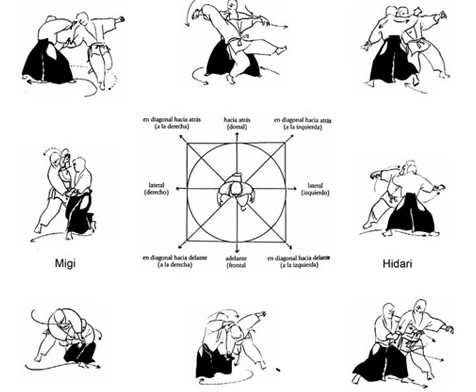
Aikido pedagogy has a recurring failure mode: it introduces words long before it stabilizes their referents. Terms like center, connection, and timing are used frequently but imprecisely, because they are experienced with the body (somatically). The very point of practice is to refine how those concepts are felt, both individually and in a partnered exchange.
In the last several classes I tried to show to the axis of the encounter and then attempt to demonstrate how several foundational Aikido ideas (sen, shizentai, ki-musubi) are not separate principles, but different descriptions of a shared physical encounter.
The axis of the encounter is the dynamic line of force, balance, and intent that emerges only at the moment uke commits and only where nage intersects that commitment (any specific attack).
It is not a static moment nor a metaphor. It is a definite moment in time and a relationally fixed point; a temporary structural fact, produced by two bodies entering a shared mechanical problem.
Once formed, the axis defines: where balance can no longer be recovered; which posture can survive without compensation; which movements increase instability and which resolve it.
Crucially on timing: The potential to create a shared axis exists briefly. Miss it early and nothing meaningful happens. Miss it late and you are managing damage, not controlling the encounter.
The axis is created at the moment nage adheres to uke’s initial attack.
I used adhere because, in Aikido, nage is never blocking or even meaningfully redirecting uke’s attack. The developmental goal is to learn sen-no-sen timing: to blend with the attack, capture initiative, and recognize the felt binding of the encounter. That felt binding is what we later call ki-musubi.
Thus the axis simply is that locus of those concepts manifested in time and space.
Once the axis forms, both uke and nage orient themselves around the same constraint. The encounter becomes intelligible precisely because there is now a shared problem. Neither party is “free” anymore. Every movement tightens or loosens the same structural limitation.
This mutual orientation is what aikido language often calls connection or blending. Those words are not wrong, but they tend to obscure the harder truth: the axis binds because it limits options.
Traditional discussions of sen categorize initiative as early, simultaneous, or late. I have discussed timing in several posts from an efficacity or strategic perspective, but in this context: Before commitment, uke’s movement is ambiguous. After commitment, the outcome is already collapsing. Sen exists only in the narrow interval where posture, intent, and trajectory align strongly enough to be predictive.
This reframes several common errors:
Speed ≠ sen
Fast movement before commitment produces motion without consequence.
Waiting ≠ patience
Late movement recognizes the axis only after uke already controls it.
Correct timing is recognition of uke’s intent, followed by immediate entry with positive and correct structure.
This leads directly to shizentai, which is often misunderstood as a neutral stance or relaxed readiness. A more precise understanding is:
Shizentai is not merely a posture you assume before engagement; it is the posture that remains intact after correct entry.
When the axis is entered properly: The spine remains vertically organized; weight settles rather than shifts dramatically; footwork is corrective, not compensatory.
This is the reason I am focusing on a lighter and less muscular engagement. Muscular bracing, large horizontal movements, and dramatic changes in force vectors are not signs of power, they are signals of axis failure.
Properly employed, shizentai is structural conservation. It preserves posture while force resolves around it.
Ki-musubi is not a mystical concept and has a practical meaning. Stripped to essentials:
Ki-musubi describes the felt certainty that uke and nage are now bound to the same axis and cannot disengage without worsening their condition.
At this point: uke should feel drawn forward (invited) even when resisting; nage should be committed even while relaxed; and ultimately, conjoined movement becomes inevitable rather than chosen. This is not harmony in the sense that both players elect to cooperate. That lexical label is just a convenient way to describe a more complex shared constraint.
Slow practice makes this sensation unmistakable. Speed allows evasion (and misses the point of the practice). Slowness forces both parties to inhabit the axis honestly, revealing whether posture is doing the work. If you have to put more energy into the encounter, then (ipso facto) you were not moving around the axis.
Hence foregrounding postural awareness at the axis is a pre-condition for correct technique.
I flip my pedagogy because I am not inherently convinced of the best developmental path. My current classes assume a developmental sequence:
- Shizentai preservation
- Ki-musubi sensitization
- Technique emerging as necessity, not choice
This is why slow is smooth, smooth is fast is not a slogan but a neurological truth. Speed amplifies what already exists.
This is not the developmental path I learned under. My training was less refined:
- Tanren builds the body
- Technique is deployed deliberately
- Failure of technique reveals problems to resolve
Those problems were then identified as issues of timing, structure, or intent. In other words, the learning sequence ran in reverse: from body to concept, rather than from perception to structure.
I am not convinced that either approach is inherently superior.
The working assumption in my current classes is that: Axis literacy will automatically generalize to resistance. I recognize the risk that without pressure escalation, students may mistake calmness for control. Furthermore, I assume students can tolerate ambiguity without continued mapping to kihon techniques. The risk is that (especially beginners) students require consistent presentation of form to anchor perception.
 Protective Arts
7 thoughts on “THE AXIS OF THE ENCOUNTER”