Deportment is never neutral. How one stands, how one moves, and – most critically – how one does not react are constant signals. In other posts I have argued that sangfroid is not merely an affect but a form of power: the capacity to enter any encounter, including conflict, with an unflappable calm that communicates competence before technique is even revealed.
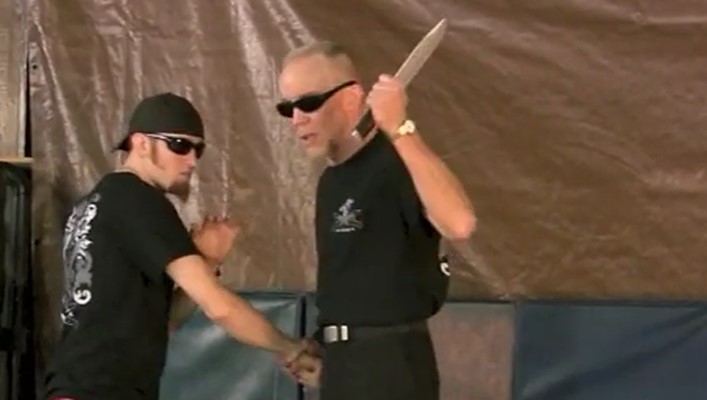
The last two weapons classes were sufficiently small that I could introduce Kali knife drills explicitly to build confidence. Not bravado but confidence born of structure.
I adapt these lessons from James A. Keating, whose motto skill banishes fear is not rhetorical but operational. We are training high-level skills by refining concepts, and by revealing connections between arts. Patterns that initially appear chaotic or overwhelming become legible once seen through the lens of Aikido.
The tone of these classes shifted as a result. The structure was looser, the conversations wider, and the atmosphere distinctly non-Aikido. That is deliberate. Keating does not publish an online video of the precise drill I adapted, but the structure is canonical in Kali knife-versus-knife fundamentals.
Sifu Kevin Goat does an admirable job demonstrating and explaining the drill.
The basic structure is the same, so the video is a useful tool to remember the pattern, but I adapt this drill to concentrate on postural alignment and training to not over-react to very intimidating stimulus: a knife directed at your jugular.
The training matrix is a simple structure:
The feeder attacks angle 1 (yokomen).
The receiver intercepts using a scissoring gunting, live-hand passing the attack onto the receiver’s intercepting knife, slicing the feeder’s inner wrist. The arms move from open to closed.
The feeder delivers angle 2 (gyaku-yokomen). The receiver stops with the back of the live-hand forearm, supporting the stop with the knife, blade on wrist.
From that momentary stop, the receiver scoops the knife arm to the low line and delivers angle 5 (chūdan tsuki) to the abdomen.
The feeder arrests the thrust with a live-hand grab, ending in gyaku-hanmi.
From this terminal position I demonstrated five distinct knife-retention options.
Because Kali is being used to illuminate Aikido, the explanations diverge. The arts are not the same. But the principles transfer cleanly.
First: you cannot over-react.
Jump away or move too far out of plane and the knife-wielding assailant will press and close. Over-reaction condemns you to perpetual defense and you cannot win a knife encounter defensively. The stakes are not symbolic.
As Mulligan Sensei often notes, the affect level rises sharply when training with knives. The first task is therefore internal: calm the spirit. Do not fixate on the knife. Learn its range and speed so you can meet it in time: sen-no-sen.
Second: once contact is made, adhere.
Remain sticky. Establish ki-musubi. Breaking contact forfeits control of the knife arm. Control, connection, and timing must coexist, or none of them function.
Footwork was intentionally minimized. I wanted students to become comfortable inside the lethal arc of the blade; inside trapping range. This removes the illusion that safety comes from distance and forces attention onto control rather than evasion.
With repetition, the arc of the knife becomes predictable. Students learn exactly how little movement is required to avoid the cut. Posture remains intact. Spinal alignment is preserved. Shizentai is no longer an aesthetic, it is necessary.
At first glance, an angle-1 → angle-2 → angle-5 sequence appears unrelated to the axis of an encounter. That illusion dissolves once students recognize that purposeful knife attacks constantly traverse the centerline.
When the receiver captures that traversal into a single, managed point of contact, the axis appears. This is the advantage taught by Doce Pares.
Aikido’s standard eight cuts train lines, all slashes. Doce Pares’ twelve angles remind the attentive student that every slash can become a point. The point can slash; the edge can stab. Once this is understood, the axis is no longer abstract.
From the base drill I introduced both outside (vine) and inside (snake) live-hand disarms. Kali refines these through a ruthless principle: move the man, not the knife. But my aim was subtler, to demonstrate how little lower-body movement is actually required to effect control.
Here I inverted Aikido habit deliberately.
Aikido rightly emphasizes hara integration and full-body deployment. My use of Kali drills temporarily removes that crutch to show Aikidoists that upper-body fluidity alone can suffice. This is pedagogical hysteresis: forcing the system away from its default to reveal what it has been leaning on. This is not a claim about ideal technique. It is a corrective lens.
Keating demonstrates these disarms with far greater depth and context here:
His Knife-Coach series on YouTube barely scratches the surface of his broader corpus. Studying it seriously, and training with him in person, is strongly recommended. (He has made some of his instruction videos available for download.)
From this fundamental drill, I tried to show the direct Aikido cognates.
Angle 1 maps cleanly toyokomen-uchi. Familiar ground. But intercepting via ai-hanmi inside-line or gyaku-hanmi outside-line passes, rather than shielding, is alien to most Aikidoists. (I have only seen Yokota and Shibata sensei use it.)
Angle 2 (gyaku-yokomen) is rare in Aikido, I often use it to set up ushiro-ryōte-dori, but the Kali stop-hit feels entirely foreign. Precisely for that reason it is valuable. It reintroduces positional relationships that Aikido practice often neglects.
Kali calls this line familiarity. Once each line can be intercepted, picked up, and redirected, technique no longer needs to be imposed. It emerges. Once one understands how each line can be intercepted, picked up, and redirected, then techniques can emerge.
Warning:
Training to remain inside trapping range cultivates calm and control but it can also normalize proximity that would be tactically irrational. Kali curricula typically balance this with aggressive angular exit and destruction. Aikido does not.
 Protective Arts