Neil Gaiman’s Sandman recasts Orpheus as the son of the Dream King, but otherwise leaves the ancient tragedy intact. In the television adaptation, Orpheus survives as an immortal, severed head, speaking calmly, prophetically, and with the explicit wish for death. He is neither alive nor dead, suspended between worlds. Gaiman uses this image to explore the cost of grief and the tension between immortality and meaning. Once a person has descended into the land of the dead and returned, they cannot be whole again. In Gaiman’s world this is not metaphorical. Orpheus quite literally carries the memory of death in his flesh.
The device restores the myth’s psychological force. In the classical tradition, Orpheus is the singer whose music softens the underworld itself. Apollodorus records the earliest thorough narrative: Orpheus charms the rulers of Hades into releasing Eurydice on the condition that he not look back until they have both reached the surface (Apollodorus 1.3.2). Ovid describes him moving stones and trees with his music and bending the very laws of death through enchantment (Ovid Metamorphoses 10.1–63). Virgil turns the backward glance into the inevitable result of human longing rather than a simple breach of rules (Virgil Georgics 4.453–527). In each version, Orpheus returns alive but empty-handed. He has crossed the threshold, confronted the absolute limit, and lost the one thing he descended to reclaim.
The myth is clear: Orpheus’s mistake is a human one. The backward glance is the nature of mortal love condensed into a single act. In Ovid’s version, Eurydice gently forgives Orpheus as she fades for the second time. Her final word is a soft farewell rather than a reproach (10.63–79). The tragedy is incompatibility. Mortal affection cannot survive the laws of death.
Again she dy’d, nor yet her lord reprov’d;
Ovid, Metamorphoses
What could she say, but that too well he lov’d?
One last farewell she spoke, which scarce he heard;
So soon she drop’d, so sudden disappear’d.
Gaiman’s severed head dramatizes what the older accounts knew but stated less directly. A katabasis cannot be undone. The psyche that has faced the dead carries the imprint forever. Greek myth emphasizes this not through enlightenment but through fragmentation. The deepest knowledge cannot be integrated into ordinary life.
Ancient Orpheus is shattered by his descent. He refuses the company of women afterward; sometimes turning to the exclusive companionship of young men, sometimes withdrawing into solitary ritual life. Some accounts make him a founder or emblem of Orphism, a loosely connected family of ritual practices concerned with purification, the immortality of the soul, and the cycle of reincarnation (Plato Symposium 179d; Diodorus 4.25). The failure to retrieve Eurydice becomes the seed of a body of wisdom concerned with the fate of the soul and the possibility of escaping death’s cycle entirely.
Gaiman’s Orpheus is frozen in the aftermath of his descent. Ancient Orpheus is scattered across it. The modern retelling becomes an entry point for returning to the ancient story with its original power intact.
Katabasis: a going downward. In mythic contexts it refers specifically to a living person entering the realm of the dead and then returning to the surface. Greek audiences heard in the word not just geography but ontology. A katabasis is a passage across the most absolute boundary available to mortals. The act of returning marks the hero as permanently altered. Not because of spiritual victory, but because surviving death’s territory places that hero outside the normal human condition.
Only four Greek heroes make this crossing and return: Orpheus, Heracles, Theseus, Odysseus.
Orpheus
Greek imagination placed him in an age when the boundaries between mortals and gods had not fully hardened. He is a son of the Muse Calliope and, in some traditions, of Apollo himself. His life unfolds before the cycles of Heracles and Theseus and long before the Trojan War.
Guided by love and armed only with music, Orpheus enters Hades to retrieve Eurydice. He softens the rulers of the underworld with song and is granted the impossible: the chance to walk her back to the light. His backward glance and the second loss of Eurydice seal his place in the mythic order.
He returns unable to reintegrate what he has seen. The anima is lost again. His descent generates not personal enlightenment but the seeds of an initiatory vision about the fate of the soul and the possibility of liberation.
Orpheus is the first to cross the threshold and survive.
Heracles
He belongs to a transitional generation of heroes whose lives unfold between the Argonauts and the rise of Theseus. His descent is a labor imposed by Eurystheus, undertaken not for love or revelation but as a demonstration of divine favor and brute capability.
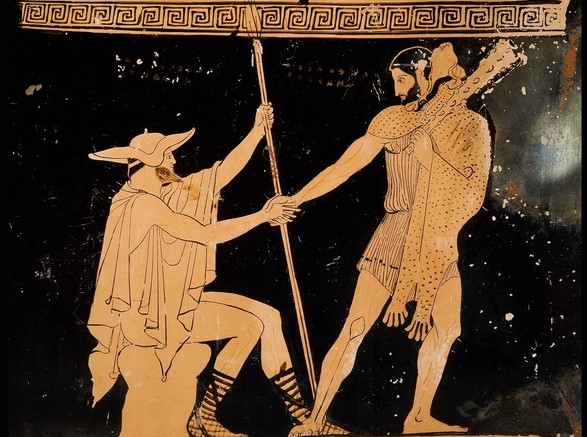
In Apollodorus’s account, he is initiated into the Eleusinian Mysteries, led to Taenarum, and descends through a physical entry to Hades to subdue and retrieve Cerberus (Apollodorus 2.5.12). Hermes and Athena guide him. He subdues the hound without weapons and leads it back up into daylight before returning it to its keeper.
This is the least ambiguous example of a katabasis. Heracles enters the realm of the dead as a living man and returns with a trophy that proves the journey was real.
He proves what no mortal should be able to prove. He does not come back wiser. The solar hero’s energy can enter the unconscious and return largely unchanged because it does not internalize what it encounters. His descent verifies power, not regeneration.
Theseus
He belongs to a generation slightly later than Heracles, though the two overlap. In Attic tradition Theseus matures in a world where Heracles is already a Panhellenic presence. His own katabasis is framed not as a sanctioned ordeal but as a misjudged imitation of greater heroes.
Plutarch records that Theseus and Pirithous swore to marry daughters of Zeus. When Pirithous chose Persephone, the pair descended to Hades to abduct her (Plutarch Theseus 31.1–3). Hades greeted them with eerie hospitality and invited them to sit. The seat was a trap: the Chair of Forgetfulness, a device whose stone fused to the flesh of whoever touched it. Theseus became literally adhered to the underworld, his body and the rock joined in a grotesque parody of initiation.
When Heracles later arrived on his own mission, he ignored warnings and hauled Theseus upward by force. Part of Theseus’s buttocks remained attached to the stone. Plutarch relates this without embarrassment, later preserved as a mock-etiology for why Athenian youths were supposedly “slender of glute” (31.4–5).
This is the first failed katabasis in Greek mythic chronology. The call is rooted in rash ambition. The threshold is crossed without sanction or guidance. There is no boon, no negotiated return, only rescue by a stronger hero.
The Chair of Forgetfulness: ego inflation in stone. Theseus tries to seize the queen of the dead and is punished by being glued to the underworld’s boundary, frozen at the exact point of overreach, hubris.
The texts do not show renewed humility. They show the comic-tragic truth that some thresholds punish those who cross them without necessity. Katabasis is not inherently ennobling.
Odysseus
He is a hero of the Trojan generation, living in the final glow of the heroic age before myth gives way to ordinary human time. His katabasis is not conquest, not rescue, not transgression, just a consultation.
Circe instructs him to seek Tiresias among the dead because only the dead can tell him the route home (Homer Odyssey 11.1–50). He travels to the edge of Oceanus, reaches the land of the Cimmerians, performs rites that summon the dead, and speaks with them. Plato later treats this as a legitimate descent, even if the geography is more symbolic than geological (Republic 521a). Odysseus crosses the threshold, interacts with the dead, and returns with knowledge that shapes the rest of his journey.
The Nekyia becomes a passage marked by dread, clarity, and hard introspection. Odysseus meets his mother, who reveals how much he has already lost. He meets Agamemnon, who warns him that even a victorious king may be murdered by his own household. Achilles tells him that glory is a poor consolation for the loss of life. Ajax refuses to speak to him at all.
Each shade is an encounter with a possible fate. Odysseus sees what he might become if he returns unwisely or fails to reconcile with his own past. He returns with altered understanding of home, danger, and destiny. His journey is the most sober and least theatrical of Greek katabases. The last great example before the heroic imagination begins to dim.
Joseph Campbell built his monomyth on patterns like these. In his account, the hero’s journey begins with a call that draws the hero away from the ordinary world, but the decisive moment is the crossing of the first threshold, when the familiar realm gives way to the unknown (The Hero with a Thousand Faces 1949). The katabasis becomes the starkest example of the liminal ordeal because descent into the land of the dead represents the most extreme crossing possible. Campbell’s interpretation emphasizes successful transformation: a return with an integrated boon.
The Greek material is colder.
Campbell borrowed his framework from ethnographers who studied ritual. Arnold van Gennep described rites of passage as consisting of separation, liminality, and reintegration, with the liminal stage marking the moment when an individual stands outside their normal social identity and becomes something ambiguous, transitional, and exposed (Rites of Passage 1909, 11–25). Victor Turner later expanded this idea, arguing that the liminal phase dissolves the structures that define ordinary life, placing the initiate in a condition of vulnerability where they are neither one thing nor another (The Ritual Process 1969).
The limen is a charged and unstable space where transformation is possible but not guaranteed. A doorway through which one must pass, but the passage itself is dangerous.
Greek myth treats this threshold with similar seriousness. The entrance to Hades is not simply a place. It is a rupture in the world’s structure where the laws governing mortal life no longer apply. To descend is to step into a liminal condition where one’s identity becomes uncertain and where failure to return means being fixed permanently in the state of the dead.
But the Greeks neither sentimentalized nor moralized this crossing. They understood that to stand on the threshold of death as a living person is to occupy a position outside the human order.
Campbell’s pattern presumes an integrated boon that can be carried back to the community. Orpheus carries no such gift. What he brings back is an awareness that the world’s beauty is inseparable from its loss. His music after the katabasis is the same music that won him passage into Hades, but it is now inflected with the knowledge that what is most beloved cannot be held forever.
Heracles returns with proof of capability but no inner change. Jung would call him the solar hero whose ego can penetrate the unconscious without being transformed by it. His katabasis is ordeal, not initiation.
Theseus returns diminished and ridiculous. His descent fails because it lacks legitimacy. He enters the underworld as a thief and leaves as a joke.
Only Odysseus approaches something like Campbell’s vision. But even here the knowledge gained is about fragility, not mastery. The boon is the recognition that homecoming requires cunning, humility, and an acceptance that the past cannot be restored unchanged.
Campbell misread the Greek material. He saw initiation where the Greeks saw violation. He saw integration where they saw fragmentation. The descents do not reliably produce enlightenment.
Greek myth does not traffic in the consolations of transformation. It knows that some boundaries exist precisely because crossing them extracts a price. The katabasis is an encounter with a boundary that takes something from the hero. The return (νόστος (nóstos)) is never a simple homecoming.
And the most famous return is Odysseus. But his story shows us, the route back requires sacrifice, cunning, and the recognition that what was lost in Troy – comrades, time, innocence – cannot be reclaimed.
The progression is not toward enlightenment. It is toward sobriety and an appreciate of the limits of being human. Know Thyself.
Γνῶθι σεαυτόν (Gnōthi seautón)
 Protective Arts
5 thoughts on “Katabasis”