Orpheus enters the story before the world has settled.
Before cities harden into law.
Before heroism becomes labor.
Before descent acquires technique.
He is born from music, not violence. A son of Calliope, sometimes of Apollo. His power does not break resistance; it rearranges it. Stones move. Trees follow. Animals pause. What yields to Orpheus does not surrender, it listens.
The Greeks knew this difference. Music is not command. It is alignment.
When Eurydice dies, Orpheus descends because music has never failed to open what stands closed.
Hades listens.
The underworld is not moved by beauty but by exactness. Song, properly aimed, is a force. Orpheus reaches what no hero has yet reached alive: consent without conquest. Persephone agrees. Hades stipulates.
Do not look back.
The condition is not moral. It is structural.
The dead cannot be escorted by the living. Hermes is the only psychopomp.
They begin the ascent. Eurydice follows. Silence gathers. Orpheus, the consummate musician, knows silence as a tool; its structure, how it frames, how it intensifies. But this is no pause. This is absence.
He turns.
In the instant Orpheus looks, Eurydice fades. The dead do not retreat. They vanish.
He looked back—and she was gone.
Ovid, Metamorphoses, A.D. Melville trans.
She slipped away, turning gently,
and with her dying breath whispered a faint farewell.
Orpheus returns alone.
The Greeks do not soften the aftermath. Orpheus refuses women. Some say he turns to young men; others that he withdraws into ritual and song. The details vary. The pattern does not. He no longer lives among equals.
The maenads tear him apart. They mistake withdrawal for insult. The violence is not random. Orpheus refuses the economy of desire that sustains ordinary life. The world responds.
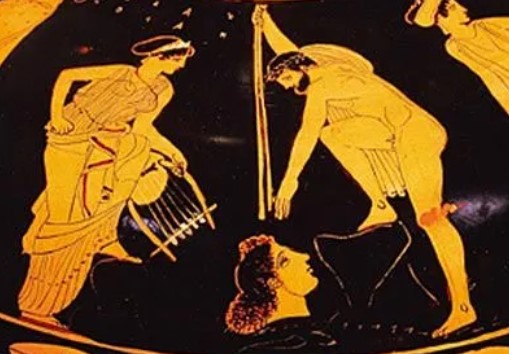
His head floats downstream, still singing.
This is not a miracle. It is inertia. A voice that has crossed death does not know how to stop.
The Greeks understand what this means. A katabasis cannot be undone. The one who descends and returns does not bring wisdom; he brings residue. Knowledge that cannot be integrated fractures the bearer.
Orpheus becomes the founder of religious imagination not because he mastered death, but because he failed to reconcile with it. He learns what heroes usually learn too late: the underworld grants passage, not restoration.
Music can open every gate except the one that closes behind you.
The gods allow Orpheus to descend.
They do not allow him to return intact.
 Protective Arts
4 thoughts on “Orpheus”