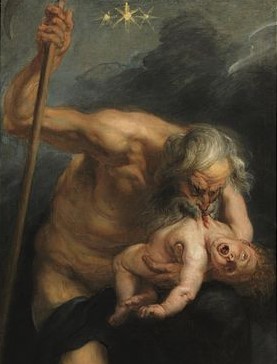
Hesiod stands at the beginning. He is the first to write down stories that had been circulating for centuries. His account is not a moral arc in the way the Hebrew tradition would later tell its story. Hesiod is part farmer’s almanac and part chronicler. This is how the seasons work, and this is who the gods are. His poetry maps structure and offers practical guidance, but it does not moralize. There is no salvific “ought” derived from the “is” being recorded: only consequence.
His record of the myths forms the foundation, but the true genius of the Greeks lies in how those myths are later used. In Heracles, Euripides deploys the myth to illuminate the dangers of unrestrained power before an audience in the midst of exercising it. The lesson is one of structural excess, not moral scolding. There is no finger-wagging insistence that “one should not do this.” Instead, the resolution carries a humility. A recognition of human frailty and a reminder of the necessity of acknowledging our humanity. We are reminded to know what kind of creature we are: human, not divine. Heracles leaves Thebes shattered, like a small boat caught in Theseus’ wake. An Athenian audience, conscious of its naval supremacy, would have recognized the force of that image immediately.
The Athenian playwrights used myth constructively. It is difficult to overstate the importance of these plays. If public expenditure is a reasonable proxy for civic priority, then their importance is unmistakable. A significant portion of Athenian resources was devoted to dramatic festivals. Citizens were paid to attend. Playwrights were awarded monetary prizes. The dramas produced were not incidental entertainments; they were instructive. Art mirrored life, and the message to the polis was never lost on its audience. These were warrior-citizens, hoplites, telling one another the stories they most needed to hear.
The foundational myths Hesiod first cataloged, and later mythographers such as Apollodorus organized, establish the baseline. Their careful preservation of variant traditions matters. But it is the Athenian tragedians who put these stories to work.
Aeschylus is chronologically the first. His Persians, produced in 472 BCE, is the only surviving tragedy based on a historical event. Written eight years after Salamis by a veteran of the battle, it is strikingly closer to warning literature than to triumphalist propaganda. The Greeks knew they had accomplished something extraordinary, and Aeschylus refuses to allow that accomplishment to harden into a sense of earned greatness. His reminder to the polis is austere and direct: remember your limits; know who you are.
Aeschylus remains a real-time civic commentator. His later works illuminate the democratic reforms of Ephialtes and Pericles, tracing the shift of authority from aristocratic councils to popular courts. The Oresteia provides the clearest example. Athena replaces vendetta with trial. Myth is used to ratify institutional authority. Athens is, in effect, writing its own constitutional myth.
Sophocles follows at the height of Athenian confidence. Silver from the Laurion mines funds naval expansion, and the Delian League (coerced allies and tribute-paying subjects) provides capital and momentum. Sophocles challenges this confidence in Antigone. She insists on burying her brother because she answers to a law older and greater than kings. The play is often read as individual conscience versus state decree, but that framing is anachronistic. Antigone is not asserting private autonomy against public power; she embodies an archaic natural law. That a sister must bury her brother is an axiom without which no civic decree can claim legitimacy. Law may be articulated rationally, but it rests first on older, chthonic imperatives.
This is why Medea is not a feminist revenge fantasy. Medea is not merely punishing Jason for abandonment; she is attempting, horrifically, to restore balance. She is driven by an imperative long encoded in Greek myth: structure endures even when human bonds fail. Even Zeus is subject to necessity. Medea is produced in 431 BCE, the year the Peloponnesian War begins. Euripides’ choice of subject is deliberate. Medea represents ancient power and foreign intelligence; an unassimilable force Athens attempts, and fails, to contain. She stands as the embodiment of raw capacity untamed by the polis.
The most powerful sequence must be acknowledged in Oedipus Tyrannus. Long before Freud reduced it to sexual melodrama, Sophocles dramatized the danger of concentrated power and the catastrophic failure of leadership. Oedipus is a relentless investigator pursuing the source of contagion with the certainty of a man who has never been wrong. The timing for an Athenian audience would have been unmistakable: the city itself was suffering under plague, and Pericles was among the dead. When Oedipus discovers that he himself is the cause, he blinds himself.
But the myth’s deeper argument is not about guilt. It is about the permanence of certain violations. Oedipus’ ignorance does not erase consequence. He has crossed a limen that cannot be uncrossed. Some boundaries, once violated, permanently reorder the world regardless of intention. Athens had watched its finest men fail spectacularly while believing themselves to be acting correctly. Sophocles does not console them.
Euripides can only hold up a mirror. The Peloponnesian War is corrosive, and Athenian confidence erodes even amid tactical success. At what cost? Trojan Women is produced in the same year Athens annihilates Melos. The same festival season, the same civic audience that authorized the massacre watching the consequences of imperial atrocity staged before them. Euripides refuses the consolation of easy moralism. This is not protest theater in search of reform; it is post-crime acknowledgment staged in real time. There is no reconciliation, no atonement. Only recognition. As in Heracles, the act is complete. There is no rite of return, no nostos. Only the irrevocable “is” of fact.
Herodotus runs alongside the tragedians as a parallel critical voice. Writing his Histories across roughly the same decades (circa 440–425 BCE) he documents in prose the same question tragedy stages on the orchestra floor: what happens to a people when power outruns wisdom? His analysis of Persian hubris circulates during the prime of Sophocles and Euripides, and his method is the tragedians’ method in a different form; accumulated consequence, structural excess, the refusal of easy vindication. Herodotus is not moralizing either. He is also recording only the “is.”
The arc of the tragedians tracks Athenian political fortune with uncomfortable precision. Aeschylus opens with Persian defeat. Euripides closes with Athenian self-indictment.
But how does it end?
Athens is defeated. Sparta learns to master the sea as effectively as it had long dominated the land. Its austere discipline and institutional cohesion prove more durable under prolonged war than Athens’ volatile democratic energy. The Greeks recognize the war as unprecedented, but they do not yet grasp that it marks the end of their historical primacy.
Plato enters at this moment. His impulse is categorically different from that of the mythographer or the playwright. Where myth witnesses and tragedy stages irresolvable conflict, Plato demands resolution. The Republic is not an abstract exercise. It is a post-defeat systems manual. Plato seeks to rationalize the human condition itself. If the polis educates the citizen, then the polis must be perfected to produce the perfected soul. The philosopher-king is not a metaphor but a solution.
Plato hated tragedy because it grasped something he could not accept: the limits of human cognition, the necessity of suffering for certain forms of knowledge, and the irreducibility of emotional excess. In Book X of the Republic, his hostility becomes explicit. Tragedy must be banned. “We must not allow ourselves to be persuaded by her.” Poets move souls without knowing how or why. That makes them dangerous teachers.
The idea that authority must regulate representation is not modern. It is ancient.
Plato insists upon replacing capricious gods with human rationality as the architect of order. Augustine will later reconcile the two, marrying divine omnipotence to rational structure in the City of God. That synthesis must wait.
What Plato cannot accept is what tragedy insists upon: that certain knowledge arrives only through suffering, that emotional excess is not a failure of reason but a form of intelligence, and that the irresolvable is not a problem awaiting solution but a permanent feature of the human condition. The tragedians had spent a century demonstrating this to warrior-citizens who already knew it in their bodies. Plato, writing after defeat, wanted a different answer.
He did not get one. But Aristotle was listening.
 Protective Arts
One thought on “The Use of Myth”