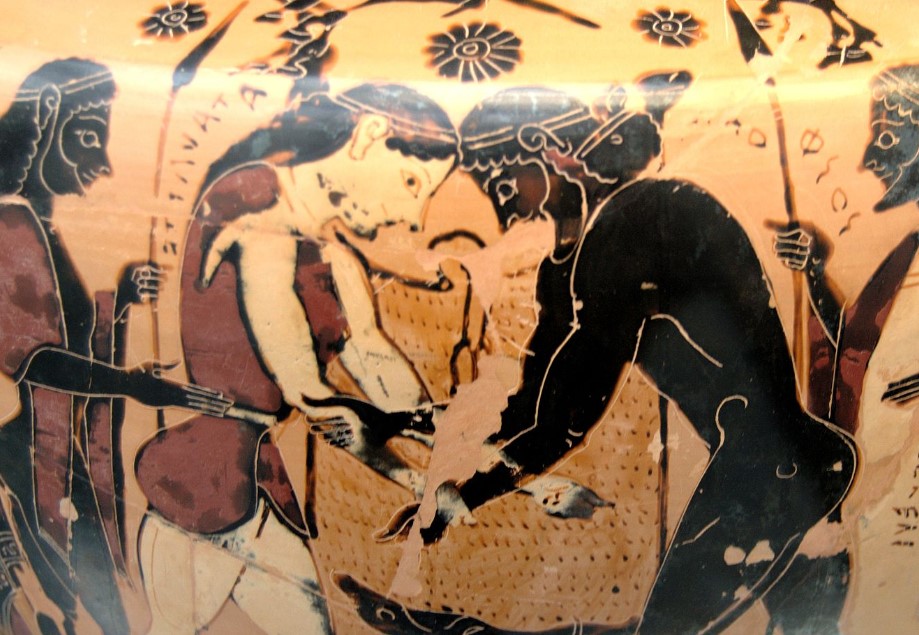
Atalanta intrigues me. She is the only female to compete among the heroes on their terms.
There are female warriors, of course, the Amazons, and Medea, a constant reminder of the older, earthbound powers women can summon. But Atalanta stands not as an opponent or enchantress, but as a peer.
Who is Atalanta?
She is born unwanted, abandoned on a mountainside because her father desired a son. Traditions differ as to her father, Iasus or Schoeneus, but all agree she was unwanted. A she-bear nurses her. Hunters raise her. She becomes a devotee of Artemis and swears virginity, placing herself deliberately outside the web of human dependency. She refuses dependency or integration.
Her early trials are violent. Centaurs attempt to overpower her. She kills them. She hunts as heroes hunt. In her we see both arete and parthenos: masculine excellence and feminine inviolability fused.
Atalanta moves within the orbit of the generation before Troy. She belongs to the heroic generation of Jason. Older stories and mythographers include her in the lists of heroes who sail on the Argo. Apollonius, however, explicitly excludes her saying Jason feared discord among men if a woman sailed (Argonautica 1.769–773).
When Jason returns with the Golden Fleece, Pelias refuses to yield power. Medea, inevitably Medea, persuades Pelias’ daughters that their aged father can be restored. A lamb is butchered and boiled and emerges renewed. They repeat the act on their father. Medea withholds the pharmakon. Pelias dies.
Funeral games follow, likely held by his son Acastus. Even failed kings occasion ritual; heroes gather where honor may be tested. Atalanta challenges Peleus to a wrestling match, the most honest, clearest test of merit and might that the Greeks recognize. And she throws him. It is almost a throw-away comment by Apollodorus (Lib. 3.9.2), but that throw will be remembered. The man who would later grip a sea-goddess could not hold a huntress.
Peleus and Atalanta meet again at the Calydonian boar hunt. There, she draws first blood and receives the hide. Her excellence becomes the spark of tragedy, yet she remains blameless. Still parthenos, still unclaimed, inviolate, and unyielding.
But eventually a test comes.
Atalanta is sought after, but like the hero she is, she insists on a test of excellence. Only a man who can best her in a footrace can win her and those who fail will be slain. Yet they come with a mixture of ardor and arrogance. Atalanta has never lost a race.
The Greeks call him Melanion; Ovid prefers Hippomenes (Metamorphoses X.8). Knowing he cannot win by speed, he prays to Aphrodite. She gives him three golden apples.
Each time Atalanta closes the distance or speeds ahead, Hippomenes throws an apple to distract her. Golden, burnished, round, perfection. She must stop. Distracted by the irresistible, Atalanta gathers the apples and loses. Apollodorus and later mythographers record the outline, but Ovid gives the story flesh.
Ovid wasn’t content to let a good lascivious story end with simple sanctified marriage. He has the couple salaciously have sex in Cybele’s temple.
Within the shadows of that place, a priest had stationed many wooden images of olden gods. The lovers entered there and desecrated it. The images were scandalized, and turned their eyes away.
Ovid, Metamorphoses, X.8:687
Even the iconography is shocked. As punishment for their transgression, they are transformed into lions.
I suspect Ovid liked the sex and thematic continuity (yet another metamorphoses), but I think Artemis smiled knowing her most devoted huntress, in the end, was never domesticated. Atalanta returned to the wild.
I am giving Atalanta a greater presence than most of the mythographers allow. In the Greek sources she appears briefly, in quick counterpoints, almost fragmentary flashes, yet she stands as a defining presence. Her arete does not merely compete with her male peers; it clarifies them. In her presence their excellence is either confirmed or exposed. She humbles without humiliation, legitimizes without sanction. By tossing Peleus to the earth, she reveals what the future bridegroom of a goddess must first learn: strength is tested before it is rewarded.
Peleus, father of Achilles. That really is his singular purpose. But his role is subordinate to Thetis, the mother of Achilles.
Thetis drives the action. In later traditions, she dips Achilles in the Styx, making him invulnerable except for the tendon she held him by. In the Illiad, she pleads his case for new armor from Hephaestus after Patroclus dons the first panoply and enter the field only to be slain by Hector. Thetis, the daughter of Nereus, the Old Man of the Sea. She is not among the Olympians but they treat her as an equal.
How did Peleus come to marry Thetis? Prophecy (Pindar, Isthmian 8).
An oracle declared that any son born to Thetis was destined to be greater than the father. A prophecy like that was the only warning Zeus ever heeded. Knowing that Thetis was too tempting, he had to ensure she was married off, and Peleus fit the mold. He was worthy, a noble and good hero, a rare paragon of virtue. Accomplished but uncontroversial.
But to marry Thetis, first Peleus had to capture her.
Approaching with stealth, he spied Thetis in a pool, her divine domain. He grabbed her and held her fast. She transformed to fire, water, a serpent, a lion, some say even a tree. But Peleus was steadfast and held firm. Peleus, whom Atalanta had bested, wrestled Thetis to submission.
Catullus records the marriage of Peleus and Thetis was a grand event: the gods themselves attended (64). Zeus, relieved and pleased with himself was there along with Hera, Aphrodite, and Athena. But Eris failed to get an invitation. And another apple was thrown to the ground, this one labeled, for the fairest. An apple to force an adjudication, the first beauty contest. Zeus demurred, made an unknown prince in exile as a shepherd award the prize. Aphrodite promised the most beautiful woman in the world as a reward. And the Trojan War follows.
Aphrodite: giver of apples and cupidinous of the one Golden Apple. Later Greeks tried to seat her among the daughters of Zeus, to make her orderly, civic, subordinate. But Hesiod remembered: she rose from the inseminated sea, born fully formed – before councils, before law, before restraint.
 Protective Arts
One thought on “Atalanta”