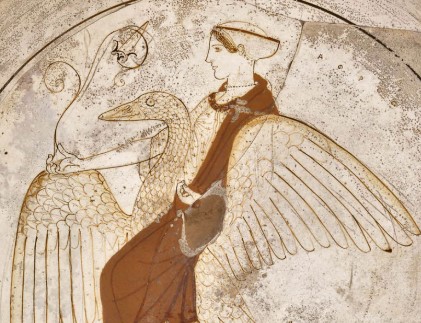
Aphrodite born of inseminated sea foam. Her name evokes the froth (aphros) and hints at deep currents. Sailors would intuitively know how they are moved by the unseen.
The Twelve Olympians that appear as the definitive powers holding dominion were not the first. Like all Greek myths, they hold power only after family drama and violent contest. In Greece, sovereignty is always the residue of struggle.
The Greeks knew it all started with Chaos, then wide-bosomed Earth. Earth does not solve Chaos, Chaos remains omnipresent. Earth merely provides the grounding context for all action. Next comes Eros, love incarnate. The first divinity with agency, the fairest of the deathless gods who unnerves the limbs and overcomes the mind and wise counsel. Hesiod has Eros emerge sui generis, he simply is, like Chaos and Earth. Eros is not born from conflict; he is the condition that makes union possible.
Erebus and black Night emerge from Chaos, and Night begets Aether and Day from her union with Erebus. Primordial concepts creating the order of the perceived universe. Starry Heaven comes next, blanketing and equal to Earth.
From the union of Earth and Heaven monsters and the earliest gods are born: Oceanus, Coeus, Hyperion, Rhea, Tethys, and the youngest born is Cronos. Heaven continued to press upon fecund mother Earth. She then gave birth to monsters, the Cyclopes, hundred armed and fifty-headed Cottus, Briareos, and Gyes. Heaven hated them and shoved them back inside Earth and he would not suffer them to come into the light. Vast Earth groaned. Suppressed fertility becomes violence.
Earth made adamantium and shaped from it a great jagged sickle and asked her sons to use it against their father Heaven. Only wily Cronos accepted her cry. He ambushed Heaven and emasculated and castrated him. The blood falling on Earth spawned the Erinyes, Giants, and the Nymphs. Cronos flung the members into the surging sea:
and a white foam spread around them from the immortal flesh, and in it there grew a maiden. … gods and men call Aphrodite, and the foam-born goddess …
Hesiod, Theogony, 183
Aphrodite, born of the generative member of the first generation of gods. She emerges not from Chaos directly, but from the first act of divine violence: from the severing that makes generational succession possible.
Aphrodite, her domain and pre-eminence is evident:
And with her went Eros, and comely Desire followed her at her birth at the first and as she went into the assembly of the gods. This honour she has from the beginning, and this is the portion allotted to her amongst men and undying gods, — the whisperings of maidens and smiles and deceits with sweet delight and love and graciousness.
Hesiod, Theogony, 189–
The Olympians follow generations, epochs later. And they are all subject to her domain. Even Zeus cannot fully escape it.
There is a persistent interpretive tension in modern scholarship when mythic female power is set against the documented political subordination of women in the polis which strikes me as anthropologically naïve. Later tradition (but as early as Homer) places Aphrodite as daughter of Zeus and Dione, a move that reads less like contradiction and more like domestication.
The textual discussions of the place women held in ancient Greece, that they were subordinated, held no franchise, were deemed dangerous or disruptive, all somehow lesser than, all seem anachronistic to me.
That Greek women in classical Athens were excluded from formal political power, lacked legal independence is historically secure. But reading that social reality back into the mythic imagination as a total index of value risks flattening the symbolic, the cultural register. Greek society may have constrained women politically, yet myth makes female sexuality cosmically foundational.
The absence of political power did not mean devoid of power. Women preside over crucial cultic rites, steward the oikos, and secure legitimate lineage; the very continuity upon which the polis depends. In tragedy, the poets knew and dramatized female agency which repeatedly destabilizes or redirects political order. The city is governed by men; its survival depends on women.
As Hesiod records definitively, sexuality is the single most generative and powerful force. And Hesiod is clear, that power resolves in the female, the whisperings of maidens. Sweet delight and love drives all the most powerful action of Greek myth. She is the compulsion that draws beings together before any law exists.
Wherever men and women meet, wherever alliances are sealed, betrayals conceived, lineages begun, or cities undone by private longings, she is present. She does not command; she inclines. She does not decree; she insinuates. She is the reminder that beneath every structure lies an undercurrent, the soft turbulence that no law can fully still. Echoes of sea-birth.
Zeus’ infidelity births heroes. Paris’ lust launches the greatest war Greece knows. Hippomenes catches the fleetest runner. Aphrodite is rarely named explicitly, but her domain, her whisperings start the action.
Homer reframes Hesiod. Homer has her behave like a younger Olympian, allows a mortal to wound her. She withdraws to the company of the gods. Zeus receives her not with outrage but with a certain weary amusement, as though reminding her that war is not her domain. It is a curious scene: the ancient force of attraction, older than kingship, treated as though she were a daughter who has strayed into unsuitable company.
But something deeper is disclosed.
The wound does not diminish her. It clarifies her nature. Aphrodite is not omnipotence; she is necessity of a particular kind, the inevitability that binds beings together, even when they are bent toward conflict. She governs union, not victory.
Ah, but who was she protecting? Aeneas.
We have seen him survive Troy and found Rome, but who precisely was Aeneas to Aphrodite?
He is her son. A mortal born of a goddess.
The archaic Hymn to Aphrodite, attributed to Homer, tells the story.
Zeus, irritated that Aphrodite delights in making gods fall in love with mortals, decides to turn the current back upon her. He sends into her heart a longing for the Trojan prince Anchises, who tends cattle on the slopes of Mount Ida. This is crucial: Aphrodite does not merely choose; she is made to feel what she causes in others.
She adorns herself as a maiden and descends. The hymn lingers on the preparation: garments, fragrance, radiance. Desire requires form.
Anchises sees her and is struck silent by the recognition that something beyond ordinary measure has entered his world. They lie together. Afterwards, Aphrodite reveals herself. Anchises trembles, fearing destruction. For to sleep with a goddess is to cross a boundary few survive. She reassures him.
And here comes the decisive moment: She will bear his child.
Not metaphorically. Literally. The hymn is explicit: she has conceived.
The poem does not dramatize labor in the way later myth sometimes lingers over mortal births. Instead, Aphrodite withdraws to the mountains, to the liminal zone between divine and human, where the child is born. This detail matters enormously: Aeneas is born in a threshold landscape.
Aphrodite then entrusts the infant to these nymphs for rearing until he is strong enough to be brought to his father.
Aphrodite experiences what it means to be bound, to be subject to Eros, and to have her power localized in a child who will live under risk. Motherhood becomes her first vulnerability. A divine mother cannot abolish mortality; she can only delay it.
Later, when she is physically wounded by Diomedes, the resonance deepens: she is now a goddess who has already known vulnerability giving birth to Aeneas and suffered again in protecting him.
Her love protects him long enough for him to found Rome. Roma and Amor mirror one another, whether by design or poetic hindsight, as though the city’s name preserves the force that first set it in motion.
 Protective Arts