I am suffering a sinus infection that is giving me a pounding headache. The phrase is overplayed but accurate. The pain behind my eyeballs is impossible to ignore; it pulses with a dull insistence. A steady, hammering rhythm.
One imagines Zeus felt something like this.
Zeus had taken Métis, the goddess of cunning intelligence, as his first wife. Métis is not merely wise, she is mêtis itself; the Greek word for strategic intelligence, the cunning mind (Theogony: 886–900).
But prophecy intervenes with a precise warning: Métis would bear a daughter equal to her father, and then a son greater than him – the familiar pattern of divine succession.
Zeus remembered his own history. His father Cronus had swallowed his children to avoid overthrow. Zeus himself had been saved only because his mother Rhea offered Cronus a stone wrapped in swaddling cloth.
Zeus adopted the tactic, but improved it.
When Métis was heavy with child, Zeus coaxed her into becoming small – some say a drop of water, others a fly – and swallowed her whole. The Greeks likely enjoyed the irony: the king of the gods wins by embodying the very quality he is trying to control.
Métis vanished into Zeus and remained there, alive within him. Hesiod tells us that from inside she continued to advise him, whispering counsel from within the king of the gods. Wisdom now lived inside Zeus.
But divinity does not dissolve quietly.
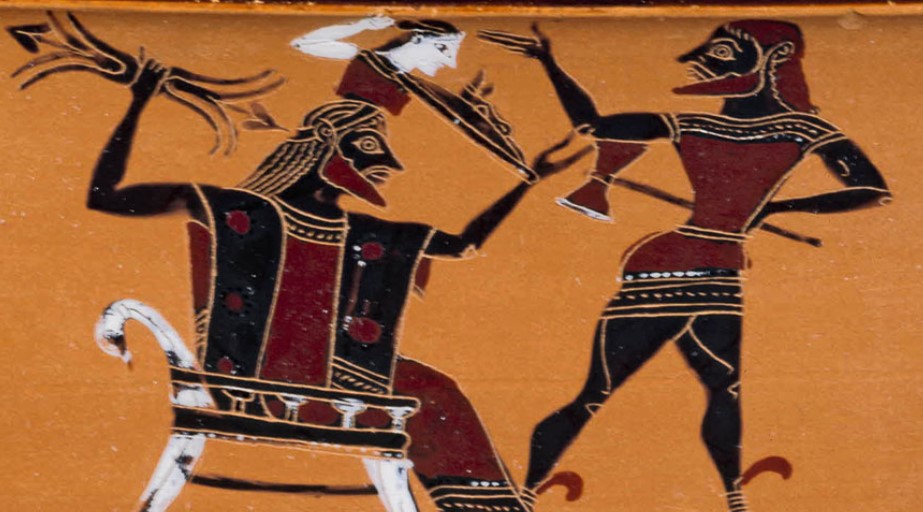
Soon Zeus felt a pressure building inside his skull. A pounding. A relentless hammering from within. The king of gods was afflicted with a headache. The pain became intolerable. Zeus summoned Hephaestus, the divine smith, and ordered him to strike. An axe blow split the skull of Zeus (Pindar Olympian Ode 7:35-38).
The Greeks knew nothing of neurosurgery, yet the image is strangely familiar. The skull split to relieve unbearable pressure is one of the oldest medical procedures known to humanity; trepanation, practiced thousands of years before Zeus’ story.
From the fissure sprang Athena. She leapt fully formed into the air, armored, spear in hand, shouting a war cry that shook Olympus.
Athena is the only Olympian who arrives already in armor. The others become gods. She appears as one.
Athena has no childhood. She arrives complete. A daughter born not from the womb but from the mind of Zeus. The Greeks did not miss the symbolism. Intelligence that emerges not from fertility but from cognition. Strategy rather than desire. Calculation rather than seduction.
Where Aphrodite rises from sea foam, Athena bursts from a skull. One governs longing. The other governs thought.
Hesiod provides the earliest version, Homer introduces details that intrigue. Homer gives her the epithet Pallas. Scholars have long debated the reason. Linguistically oriented scholars suggested pallein, “to brandish,” thus “spear-brandishing Athena.” In the Gigantomachy she defeats the giant Pallas and takes his skin for her aegis.
Later mythographers could not accept that Athena had no childhood. They invented one. The Pseudo-Apollodorus give us the most tragic version where she accidently kills her childhood friend Pallas:
They say that when Athena was born she was brought up by Triton, who had a daughter Pallas; and that both girls practised the arts of war, but that once on a time they fell out; and when Pallas was about to strike a blow, Zeus in fear interposed the aegis, and Pallas, being startled, looked up, and so fell wounded by Athena. And being exceedingly grieved for her, Athena made a wooden image in her likeness, and wrapped the aegis, which she had feared, about the breast of it, and set it up beside Zeus and honored it. But afterwards Electra, at the time of her violation, took refuge at the image, and Zeus threw the Palladium along with Ate into the Ilian country; and Ilus built a temple for it, and honored it. Such is the legend of the Palladium.
(Bibliotheca 3.12.3)
The recursive nature of Greek myth, the variants and tangled skein they create, make this version key to understanding the Trojan War.
Triton, a sea divinity whose dominion lay not only in the rolling waters but also in a strange inland sea at the edge of the known world: Lake Tritonis in Libya. Triton had a daughter named Pallas. She and Athena grew together.
The Greeks did not imagine their companionship as childhood in the soft sense. The two girls trained together in contests of martial skill. They learned distance, timing, the geometry of bodies in motion; how to recognize kairos.
Athena would one day teach heroes. But first she had to learn.
The mythographers insist the killing was accidental. Athena had not meant the blow. Zeus himself had altered the moment. But the result remained. The poets say that from that day forward she took Pallas’ name as her own, binding her identity to the memory of the friend she had lost.
As a memorial, she carved an image of Pallas. Some say from olive wood, others from ancient timber whose origins were already forgotten. The figure stood upright, bearing a spear. In some tellings, the aegis hung upon its chest, the same shield that had startled Pallas at the fatal moment.
The statue became known as the Palladium.
It was three cubits in height, its feet joined together; in its right hand it held a spear aloft, and in the other hand a distaff and spindle.
The Greeks understood that certain objects retain the presence of the divine act that created them. The Palladium held Athena’s grief and acted as a promise of resolve: where the statue stood, the city that sheltered it could not be taken.
The icon of Athena’s grief becomes Troy’s protection. That is a detail to remember. Odysseus and Diomedes will later infiltrate the city and steal the Palladium. And Virgil will have Aeneas carry it to Italy.
While not in the earliest Greek telling of Athena, the Libyan connection is recorded by Herodotus (Histories 4.180–189). Robert Graves will push theory beyond accepted evidence, but Athena certainly contains pre-Greek elements, likely Mycenaean or Minoan. The most powerful female figures in Greek myth follow a similar archeology.
Aphrodite and Athena share deep archaic origins, but Hesiod only makes Aphrodite’s canonical. Athena is cleanly adopted into the Olympians as a daughter of Zeus. But the mythic tension between these two goddesses is unmistakable and becomes direct competition in the Judgement of Paris.
________________________________
Hesiod shows Zeus as a serial monogamist and gives a sequence of wives: Metis, Themis, Eurynome, Demeter, Mnemosyne, Leto, and finally Hera.
Even though Hera is seventh in Hesiod’s genealogical order, she becomes the primary queen of Olympus in myth and cult, even though genealogically she is not the first.
The mythic logic of Hesiod’s narrative is not merely genealogical. It explains how Zeus secures permanent rule and avoids dethronement: Uranus is overthrown by Cronus; Cronus is overthrown by Zeus. Zeus breaks the cycle.
Instead of destroying his child, he absorbs the mother. Zeus neutralizes succession by incorporating Metis into himself and by birthing a female who remains virginal, no son will ever be born of Metis. There is no possible successor. Athena is father-born, has no mother and will birth no children.
The Greeks travelled widely. Herodotus was both ethnographer and historian. Where myth places much activity at the edges of the world, Herodotus grounds it geographically. The Greeks knew Libya as a land of great antiquity (along with Egypt). The Greeks colonized North Africa around 630 BCE and modern scholars like Walter Burkert suggest that the Greeks may have adapted foreign rituals into Athena’s cult. Specifically, items like the goatskin, martial dances, and shield rituals. As Herodotus records that the contest between Pallas and Athena had contemporary salience: “They celebrate a yearly festival of Athena, where their maidens are separated into two bands and fight each other with stones and sticks, thus (they say) honoring in the way of their ancestors that native goddess whom we call Athena. Maidens who die of their wounds are called false virgins.”
Poseidon also had a strong Libyan connection: Anteaus was a giant king of Libya and the son of Poseidon and Gaia. (He is the same giant who challenged travelers to wrestling matches and killed them, only to be defeated by Heracles, who realizes Antaeus draws strength from the earth and lifts him into the air before crushing him.)
Some ancient writers claimed that Poseidon himself first introduced horses to Libya before they appeared in Greece. That detail may help explain why both Athena and Poseidon rival for Athens; they share early mythic associations with the Libyan frontier.
Among all Greek poleis, Athens is the only major city whose patron deity is explicitly female and the only with such a direct correspondence of city and patron name. That fact becomes symbolically powerful once the city becomes the intellectual center of Greece; a civilization guided, at least mythically, by a goddess of intelligence rather than a god of war or kingship. The plural form Athēnai suggests that the city originally consisted of several villages unified under Athena’s cult. This fits the tradition of Theseus uniting Attica (synoikismos). So the goddess may have served as the symbolic glue that unified early settlements.
 Protective Arts