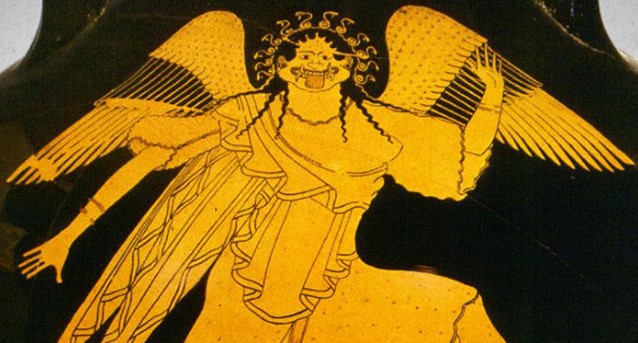
The power of sight. Aristotle captures is succinctly:
All men by nature desire to know. An indication of this is the delight we take in our senses; for even apart from their usefulness they are loved for themselves, and above all others the sense of sight.
Metaphysics 980a:21
Sight is superior because it reveals the greatest number of distinctions; shape, motion, color, proportion. It is therefore the sense most closely aligned with knowledge.
Greek tragedy depends on the power of sight. The theater itself is built around spectacle (opsis). Aristotle notes in Poetics that spectacle is the least intellectual element of tragedy, but it remains powerful because humans respond immediately to what they see (Poetics 1450b16–17). Which is why Plato distrusted it (Republic 595a–608b).
But Greek literature repeatedly shows the danger of that very power. Sight gives knowledge. But it also produces seduction, illusion, and paralysis.
Hesiod described the danger early as embodied in Aphrodite, whose power of beauty:
loosens the limbs and overcomes the mind and wise counsel.
Theogony 201–206
Beauty literally dissolves rational control. This is not metaphor. It is a cosmic principle.
The Greeks therefore understood beauty as something dangerous and destabilizing.
The story of Narcissus dramatizes the destructive power of sight. He sees his own reflection and cannot look away. Vision becomes self-consuming. The tragedy lies not in vanity alone but in the inability to detach from the image. Sight enslaves him (Ovid, Metamorphoses 3.339–510).
I am building to the Trojan War by providing the layered context and concepts that drive the inevitability of the action; its structural inevitability.
In The Iliad, Helen appears before the elders of Troy. They say:
Small blame that Trojans and well-greaved Achaeans should for such a woman long time suffer woes; wondrously like is she to the immortal goddesses to look upon
Iliad 3.154-158
Her beauty justifies the war.
When Menelaus finally confronts Helen after the fall of Troy, he raises his sword to kill her. But when he looks at her, he cannot. Her beauty dissolves his rage.
Later mythographic traditions elaborate this moment. Euripides in The Trojan Women includes a warning from Hecuba: Do not look at her. The warning recognizes something the Greeks understood well: Once you see beauty, reason may no longer govern.
The Romans inherit a Greek understanding of the power of vision. Much Roman art, especially sculpture, is a copy. Much Roman sculpture preserves Greek artistic models, often as marble copies of earlier Greek bronzes now lost. A severe critic might call this imitation; the Romans themselves regarded it as homage.
Nevertheless, I turn to Ovid for a retelling of Medusa to highlight the tension beauty creates.
In his version Medusa was beautiful, not monstrous. Poseidon seduced her in a temple of Athena. For that transgression Athena punished Medusa, transforming her hair into snakes, giving her the petrifying gaze. Anyone who looked at her directly turned to stone (Ovid, Metamorphoses 4.790–803). One suspects Ovid appreciated the irony: her power had not changed. In either form she could arrest a man instantly.
The earliest surviving description of Medusa appears in the Archaic Greek period, especially in Theogony by Hesiod. In this earliest form, Medusa is not yet the tragic figure many modern readers imagine. She is simply one of three monstrous sisters known as the Gorgons. Only Medusa is mortal (270–294).
Modern scholars have suggested that the Gorgon image may preserve far older ritual forms. Robert Graves and later scholars saw archaic and archaeological cognates: ancient apotropaic masks, protective demon figures from the Near East, and snake goddess cult imagery.[1]
There is a thematic continuity in Ovid’s inversion; in making Medusa originally beautiful and transformed by Athena for sexual transgression we have a reason for Athena’s support of Perseus.
But who was Perseus?
A wooden chest sealed against the sea. Inside it, a woman and a child drift across the water. The woman is Danaë. The child is Perseus.
Danaë had once been locked in a bronze chamber by her father Acrisius, who had heard the oracle: the daughter’s son would kill him. But oracles have the patience of time. Zeus entered the chamber as golden rain, and Perseus was conceived (Apollodorus, Bibliotheca 2.4.1; Pindar, Pythian Odes 12).
Danaë had once been locked in a bronze chamber by her father Acrisius, who had heard the oracle: the daughter’s son would kill him.[2] But oracles have the patience of time. Zeus entered the chamber as golden rain, and Perseus was conceived (Bibliotheca 2.4.1; Pythian Odes 12).
The king placed mother and child in the chest and cast them into the sea. It is an old solution to prophecy. The sea received them and delivered them safely to the island of Seriphos. There the fisherman Dictys drew them from the nets. He raised the boy.
Years passed.
The boy became strong, and his mother became beautiful. This caused trouble.
The ruler of the island, Polydectes, desired Danaë. But Perseus stood near her always. The king therefore devised a way to remove him. One day he announced a wedding. Each guest must bring a horse. Perseus had none. In pride, he said he would bring something greater.
“What?” asked Polydectes.
“The head of Medusa.”
The king agreed immediately.
Thus the youth promised the impossible. She lived beyond Ocean, at the edge of the world, where night and day exchange their breath. Whoever looked upon her face turned to stone.
Perseus did not know how to reach such a place. But the gods already knew him. Athena came first. She gave him a polished shield that held the world as a mirror. Hermes followed with a curved sword, a harpē.[3]
At the edge of the world he found the Gorgons sleeping. Even asleep they were dangerous. Their hair moved with serpents. Their breath turned the grass gray.
Perseus watched their reflection in the shield of Athena.
The sword moved once. The head fell.
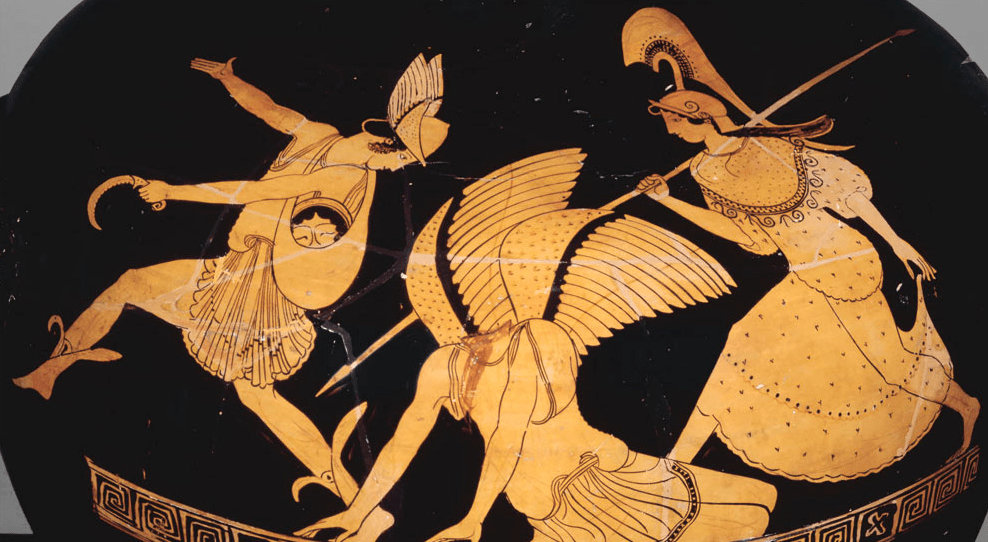
From the open neck of Medusa two beings leapt forth: Pegasus, white and terrible. And Chrysaor, the golden warrior. They were children of Medusa and Poseidon, born only at the moment of death (Hesiod, Theogony 280–283).
The immortal Gorgons awoke and screamed, but he was already gone.
He made good use of Medusa’s head to bring up his monster killing score. On the Ethiopian shore he saw Andromeda chained to a rock, saved and married her, then returned to Seriphos and turned Polydectes to stone.
Then he gave the head to Athena who set it upon her aegis, where it remained forever. Athena appropriated Medusa’s power (Metamorphoses 4.794–803; Apollodorus 2.4.3).
But critically, which power? Beauty or terror?
The Greeks recognized they were the same. The ability to arrest action because of a visual input, regardless of its cause, is the power. Athena perfectly embodies both, beauty and terror.
Her martial prowess is uncontested. She easily drives Ares from the battlefield. She bests him in his own domain (Iliad 5.840–861).
Ah, but beauty is contested.
And Paris judges.
And finds her second to Aphrodite.
_________________________
[1] In Mesopotamia centuries before the Greeks carved their first gorgoneion, the face of Humbaba, the terrifying guardian defeated by Gilgamesh in the Epic of Gilgamesh, was common on clay plaques across the Near East. It is unmistakable.
Bulging eyes. A gaping mouth. A grimace that seems both human and monstrous. The face is frontal, staring outward, confronting the viewer directly.
The Greeks would later place a similar face on their temples, shields, drinking vessels, city gates.
Both faces share the same purpose. They guard thresholds. Humbaba plaques were placed in houses and walls to repel evil. The Gorgon’s face appears on armor, temples, and city defenses.
In both cultures the logic is identical: to repel terror, display a greater terror. The psychology is ancient and nearly universal. Polynesian war dances preserve the same principle today. When Māori rugby teams perform the haka before a match, bulging eyes and extended tongues recreate an intimidation ritual once used before battle: the enemy should see a ferocity greater than his own.
There is another parallel.
In Mesopotamia the hero Gilgamesh travels to the Cedar Forest to confront Humbaba. The monster is not wandering the world destroying cities. He is a guardian. He protects the forest appointed to him by the god Enlil.
But heroes do not seek justice alone. They seek glory (kleos).
Gilgamesh kills Humbaba and cuts down the sacred cedars. The act is heroic and troubling at the same time. The epic itself seems uneasy about the violence.
The Greek story echoes the same structure. Perseus travels to the edge of the world to kill Medusa.
Like Humbaba, Medusa is not attacking cities. She lives in a distant place beyond Ocean. The hero seeks her out.
The act is framed as heroic necessity, but structurally it resembles Gilgamesh’s expedition. Both heroes: travel to the outer edge of the world, confront a guardian monster, sever its head, return with proof of victory.
In both myths, the head retains power.
Perseus uses Medusa’s head to turn enemies to stone.
The terrifying face of Humbaba continues to appear in protective ritual imagery.
[2] The focus of this essay is Medusa, not Perseus, but understanding the arc of his prophecy is enlightening:
The king of Argos, Acrisius, is told that his daughter’s son will kill him. To prevent this fate he imprisons his daughter Danaë. As the story unfolds, the prophecy eventually fulfills itself, but in an accidental and almost mundane way.
Years after Perseus becomes a hero, he attends athletic games in Larissa. During the discus competition he throws a disk that veers off course and strikes an elderly spectator.
That spectator is Acrisius. The prophecy is fulfilled without intention.
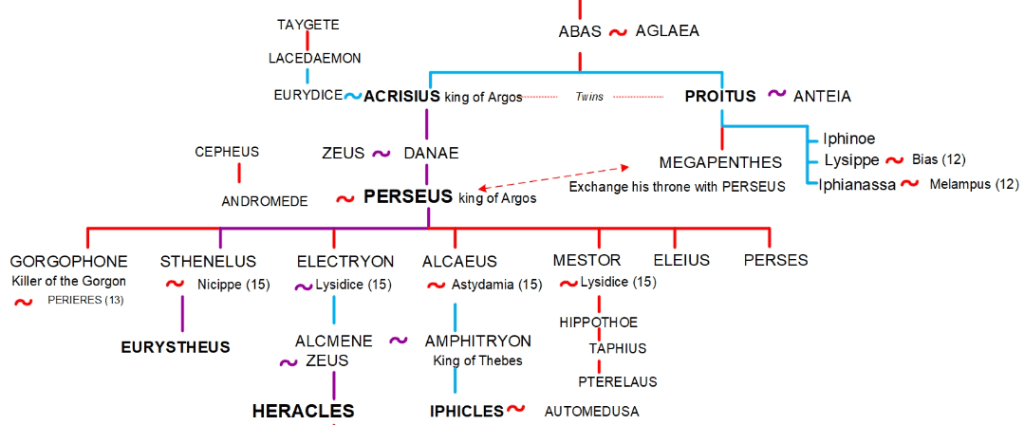
After the death of Acrisius, Perseus refuses to rule Argos because the prophecy has now been fulfilled there. Instead he exchanges kingdoms with Megapenthes and becomes ruler of Tiryns.
Later traditions attribute to Perseus the founding of Mycenae, one of the most powerful cities of the Mycenaean world (Pausanias, Description of Greece 2.15–16). He lives a long reign with Andromeda and produces a large royal lineage. From this line eventually come: Electryon – Alcmene – and Heracles. Perseus therefore becomes the dynastic ancestor of Heracles.
The sources say remarkably little about Perseus’ own death.
The tradition generally holds that he dies peacefully after a long reign and is later honored as a hero in cult.
A most singularly unusual fate for a hero.
[3] The Met provides a useful summary of “Medusa in Ancient Greek Art,” and shows the various representations of the sword Perseus uses. The Greek word is ἅρπη (harpē) meaning a “sickle, reaping hood, or sickle-shaped sword” so of agricultural rather than martial origin. Some traditions have this being the very same sword Gaia gave Cronus to castrate Uranus.
 Protective Arts