Medusa reveals something the Greeks already suspected. Beauty and terror are not opposites. They are twins.
Both arrest the mind through the eye. A man who sees Medusa cannot move. A man who sees Helen often cannot act. The mechanism is identical.
The Greeks understood this long before philosophers explained it. The eye commands the will. And once the eye is captured, events follow with a logic that feels less like choice than inevitability.
So before the apple appears and before Paris is asked to judge, the Greeks must first explain Helen. Because if beauty is a force powerful enough to move armies, then the most beautiful woman in the world cannot simply exist. She must generate consequences.
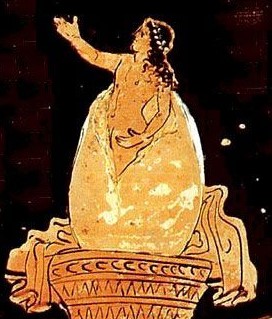
She is born from an egg.
Daughter of Zeus and Leda, conceived when Zeus approaches Leda in the form of a swan (Apollodorus, Bibliotheca 3.10.7; Euripides, Helen 17–21). From the egg come not only Helen but also her twin brothers, the Dioscuri, and her sister Clytemnestra.
Helen therefore enters the world already carrying the divine signature of Aphrodite. Not because Aphrodite bore her, but because Helen manifests Aphrodite’s domain in mortal form.
Medusa showed the Greeks the terrible power of the eye to arrest action. Athena revealed intelligence as the capacity to direct it. Helen demonstrates the third element: the power of beauty to compel action before thought can intervene.
Where Medusa freezes the will, Helen inclines it. Where Athena calculates, Helen attracts. In her the Greeks recognized eros made visible. Homer repeatedly calls her λευκώλενος, “white-armed Helen,” a phrase that signals not only beauty but radiance, visibility. She is not merely seen; she compels seeing.
Helen is born of the same instability that the Diosuri solve only in death; their paternity mixed with mortal blood. She also is a creature of threshold, the limen embodied. Neither entirely Olympian nor entirely bound. Greek myth rarely tolerates such ambiguity for long.
She is abducted young by Theseus. Already desired. Already contested. Her brothers march on Attica and recover her. She is returned to Sparta. The lesson is quiet but decisive: Helen generates conflict simply by existing. Not by choice. By structure.
When Helen comes of age, suitors flood Sparta. The most powerful men in Greece, including: Ajax the Great, Diomedes, Menelaus, and Odysseus. Each embodies a different mode of Greek aretē: Ajax: brute force; Diomedes: disciplined ferocity; Menelaus: dynastic legitimacy; Odysseus: cunning restraint.
Her father Tyndareus faces a genuine problem. If one is chosen, the others will turn on him. The Greeks understand something about honor: men who lose face rarely leave quietly.
Odysseus, ever strategic, is not there for Helen. He always desired Penelope. To be Odysseus is to be the husband of Penelope. Long suffering Penelope. So he offers Tyndareus a solution. But only if Tyndareus supports his claim to Penelope (Apollodorus, Bibliotheca 3.10.9). The solution is simple. Each suitor must swear an oath: They will defend whichever man Helen selects as husband. The Oath of Tyndareus is not romantic. It is strategic. A proto-collective defense pact.
The legal framework of war begins here. The apple is still in the orchard. But the ships are already pledged.
Menelaus is chosen. Whether by political calculation, inheritance logic, or Helen’s preference matters less than the result. The strongest coalition in Greece is now structurally committed to a future conflict not yet named.
The Greeks have created a machine whose purpose they do not yet understand.
At roughly the same moment another birth is being prepared, though the Greeks will only later recognize its significance.
The sea-nymph Thetis is compelled to marry the mortal Peleus, for prophecy has warned that any son she bears will surpass his father. Zeus, unwilling to risk producing a rival greater than himself, gives her instead to a mortal king. From this union will come Achilles, the greatest warrior the Greeks will ever field (Homer, Iliad 1.352–356).
The wedding itself becomes one of the great gatherings of the gods. Every Olympian attends. Every Olympian except one. Eris, Strife, is not invited. The omission proves decisive. Into the feast she throws a golden apple inscribed: tē kallistē, “to the fairest.”
The quarrel that follows will soon be given to Paris to judge. But notice the deeper structure already at work. The same wedding that produces Achilles also produces the apple that will lead Paris to Helen.
The Greeks therefore place the greatest warrior of the war and the cause of the war within the same originating moment. Before Helen leaves Sparta, the man destined to avenge her dishonor has already been conceived.
Now we must step away from Sparta.
In Troy a child is born. Paris, son of Priam and Hecuba. Before his birth, Hecuba dreams she gives birth to a burning torch that sets the city ablaze (Apollodorus, Bibliotheca 3.12.5).
Prophecy intervenes again. As with Thetis. As with Perseus. As with Oedipus.
The infant is exposed on Mount Ida to die. He does not die. A shepherd finds him. He grows up among livestock. This matters.
Paris grows not as warrior but as herdsman. He learns to judge cattle. Ancient sources repeatedly note his skill in livestock contests (Hyginus, Fabulae 92). But his heroic lineage is revealed early. While still a child he routed a band of cattle-thieves and restored the stolen herd, and for this deed he received the name Alexandros, “protector of men.” But he does not yet know he is a prince. He stands outside the political order. Like Atalanta, raised apart.
So when the moment arrives, the choice seems almost accidental.
Zeus needs to quiet a family squabble he wants nothing to do with: award the Golden Apple to the most beautiful divinity. Hera claims it. Athena claims it. Aphrodite claims it. Zeus, smartly, refuses to judge (Apollodorus, Bibliotheca Epitome 3.2). Instead, Zeus chooses Paris.
Why? Some traditions assert Zeus selects him because, among the shepherds Paris became known for fairly judging contests and disputes, especially in livestock competitions. He rendered fair decisions. The shepherd who could judge the finest bull among cattle is soon asked to judge the most beautiful among goddesses. The Greeks understood the irony. A skill suited to livestock will soon decide the fate of cities.
A cynical read of the myth suggests perhaps the reason is that by standing outside the political order he can therefore be manipulated. This is Aphrodite’s domain.
The goddesses stand before him. He cannot decide. So the goddesses make their offers. Hera offers empire. Athena offers victory in war. Aphrodite offers the most beautiful woman in the world.
The apple is not about beauty. It is about leverage. Aphrodite does not create desire. She weaponizes it. She understands what the Greeks already know: beauty governs men more reliably than power.
Paris chooses Helen. He does not yet know the oath sworn in Sparta. He does not yet know the coalition already pledged. He does not yet know he is the torch his mother dreamed.
The apple activates a preexisting structure.
Homer allows the reader one moment of clarity before the catastrophe unfolds. When Helen appears on the walls of Troy, the Trojan elders watch her pass. These are not young men driven by passion. These are the old counselors of the city, men who have already seen too much war. And yet even they recognize that beauty of this order carries consequences beyond moral judgment.
The Greeks do not say the war is justified. They say it is understandable. Helen stands there not as a villain but as a phenomenon.
Yet Helen herself does not see what the elders see. When she speaks, her voice carries none of the pride that later tradition sometimes projects onto her. Instead she condemns herself with almost ritual severity. Early she says to Priam:
Would that evil death had pleased me when first I followed your son here, leaving my bridal chamber, my kinsmen, and my child.
Homer, Iliad 3.173–175
And later, when she stands on the walls of Troy and looks upon the Greek army, she says quietly:
Dog that I am, evil-minded—would that on the day my mother bore me a storm wind had swept me away to the mountains.
Homer, Iliad 6.344–346
This is the paradox Homer quietly preserves. The men who look upon her see a figure almost divine. Helen sees only the ruin she believes she has caused.
Helen is already both cause and witness. To a modern reader Helen appears to be expressing self-loathing, or worse perhaps false humility. To the Greeks her pronouncements are anti-hubristic. It is less that Helen misunderstands her own beauty and more that mortals rarely understand the gods acting through them.
Helen’s humility therefore becomes evidence of something larger: Aphrodite moves the world while mortals think they are acting freely.
When Paris arrives in Sparta – whether seduction or abduction – the oath springs closed like a trap. Odysseus’ cleverness ensures the war he will later try to avoid. Constraint generates consequence.
The Greeks understood the prophetic irony: the man prophesied to destroy Troy is given the choice that ensures it.
And Helen herself knows this too. In Euripides she asks bitterly:
Was it my beauty then that brought the ruin? Or the judgment of Paris?
Euripides, Helen 36-37
Even she cannot decide whether she is cause or instrument.
The structure of the myth demonstrates a depth of psychology and anthropological sophistication that the passage of time and the layers of philosophical refinement have not improved upon.
The inevitability of war driven by the complex interaction of oaths, pacts of mutual support, contested scarce resources, elite rivalry, past wrongs, and violations of custom (xenia), all coalesce in a single fated act: The Judgement of Paris.
The preconditions are manifold. Helen must be born, half divine, an embodiment of eros. Her power must be proven effective on the earlier generation of heroes, demonstrating her enduring structural impact. Eris, spite itself, must be spited, forgotten like Artemis once was, not invited to a wedding. A wedding that must produce Achilles, the man destined to slay Troy’s greatest guardian. Athena must slay Pallas, carve her protective effigy, so that Zeus can throw it down to Illion – only so Diomedes and Odysseus must steal it to remove its protection. But foremost, Helen must appear.
For the Greeks knew something simple and dangerous: before war there is oath, before oath there is rivalry, before rivalry there is desire.
The power of Aphrodite is the first motion.
 Protective Arts