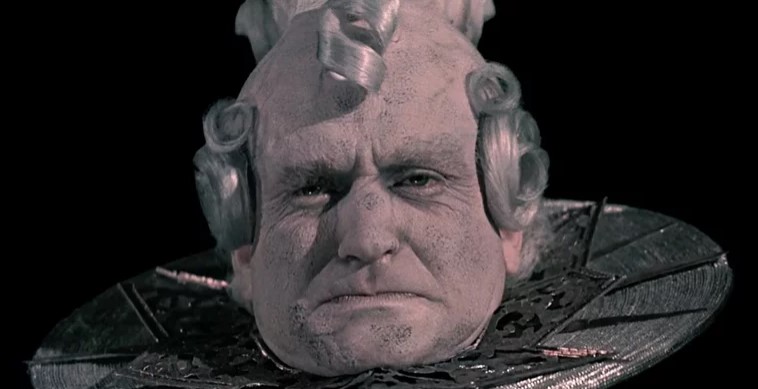
The funniest critique of Cartesian dualism ever put to film occurs on the moon.
In Terry Gilliam’s The Adventures of Baron Munchausen (1988), Robin Williams plays the King of the Moon: a giant disembodied head floating serenely above his own detached body. The head is refined, articulate, and philosophical. The body, meanwhile, rampages below: lustful, impulsive, and chaotic. Periodically the two must be reassembled so the king can function.
The scene is comic precisely because it exaggerates an idea that Western philosophy took deadly seriously: the notion that mind and body are separate substances.
René Descartes formalized the idea in the seventeenth century with the famous distinction between res cogitans (thinking substance) and res extensa (extended matter). The mind, in this scheme, is a non-material entity that somehow pilots the body like a captain steering a ship. The body itself is merely a mechanism.
This radical dualism proved enormously influential. And deeply misleading. Western thought would spend centuries attempting to reconcile a split that had never existed in the first place.
The archaic Greeks never made this mistake. They understood action begins in the body.
In Homer there is no unified “mind” hovering above the organism like a disembodied pilot. Instead, cognition is distributed across several bodily centers.
The Greek language contains multiple terms for interior life, each tied to a specific part of the body:
| Greek Term | Bodily Location | Function |
|---|---|---|
| Thumos (θυμός) | chest | spirited impulse, anger, courage, desire |
| Phrenes (φρένες) | diaphragm | deliberation and reflection |
| Kardia (καρδία) | heart | emotional center |
| Noos (νόος) | perception | awareness and insight |
These are not metaphors. They are literal anatomical sites where thought and emotion occur (Bruno Snell, The Discovery of the Mind, 1953).
When Achilles debates whether to kill Agamemnon, Homer writes:
The son of Peleus felt grief [akhos], and his heart within his shaggy breast was divided
Illiad, 1:188
Elsewhere heroes speak directly to their own thumos. They argue with it, encourage it, restrain it. The psyche, meanwhile, is not the thinking self at all. It is simply the life-breath that departs at death. Homeric man does not possess a centralized mind. Interior life is a chorus of bodily impulses negotiating action.
In this worldview, agency emerges from the organism as a whole. The body does not merely carry out decisions. It participates in them.
This becomes immediately obvious in combat. A warrior does not reason his way through danger. He acts before reason can assemble its arguments. Homer understood this. The battlefield is the natural theater of thumos: the surge in the chest, the tightening of the breath, the sudden clarity that precedes action. Achilles does not consult a detached intellect hovering above the body. His thumos rises, his heart divides, his limbs answer. Thought follows action like a historian reconstructing a battle already fought.
Anyone who has trained seriously in a martial discipline recognizes the same mechanism. In Aikido, for example, effective technique cannot be produced by analytical calculation. The body must perceive, adjust, and respond before conscious reasoning intervenes. Timing, distance, balance are not intellectual abstractions but bodily recognitions. The mind does not command the body. It discovers what the body has already begun.
Plato did not abolish this older anthropology, but he reorganized it and in doing so introduced a hierarchy that would shape Western philosophy for millennia.
In Republic Book IV he introduces the famous tripartite soul:
| Soul Component | Function |
|---|---|
| Logos | rational thought |
| Thumos | spirited will |
| Epithumia | appetites |
And while thumos survives, Plato subordinates it. The rational faculty, logos, must rule the others.
The political analogy is explicit. His fictional Philosopher King embodies logos, the Guardians embody thumos, and the producers satisfy appetite. The philosophical shift is decisive. Where Homer described a distributed psychology, Plato installs a hierarchy.
Reason becomes sovereign.
Plato’s move emerges from historical trauma. And to be fair, Plato was not speaking as an armchair philosopher. He had fought in the Peloponnesian War himself. But the devastation of that conflict seems to have convinced him that the impulsive energies Homer celebrated were precisely what had destroyed the Greek world. His philosophy therefore attempts something unprecedented: the political domestication of the warrior’s body by the rule of reason.
Plato also gives us a poignant image of his idol: his teacher Socrates was famous for battlefield endurance. At Potidaea he reportedly stood motionless in meditation for an entire night before battle (Symposium 220c). Logos ruling Thumos. And Athens sentenced him to death.
Christian theology inherits this Platonic hierarchy and amplifies it.
In Augustine’s writings the body becomes morally suspect. Reprobate libertine that he was, he knew precisely what he preached: salvation increasingly appears as liberation from the flesh.
The unity of Homeric anthropology dissolves into a metaphysical tension between spirit and matter.
The Greeks themselves were not immune to physiological speculation.
Aristotle famously argued that the heart, not the brain, was the seat of thought. The brain, he believed, functioned primarily as a cooling organ moderating the heat of the blood.
The brain, then, tempers the heat and seething of the heart.
Parts of Animals Bk2 P7:652b
In this sense Aristotle preserved an older intuition. Emotion visibly alters the heartbeat. The brain appears inert and cold. His biological explanation was wrong, but his instinct that cognition is inseparable from the body’s physiological state was not entirely misguided. Ironically, later science would circle back toward this insight.
The illusion that reason operates independently of embodied reality has also produced some of the most destructive political theories ever devised. Marxist utopian schemes assume the possibility of centralized and rationally optimized organization of society: the primacy of reason abstracted from lived information.
The Austrian economist Friedrich Hayek famously dismantled this assumption. Knowledge in complex systems, he argued in The Use of Knowledge in Society (1945), is distributed. No central planner can possess the information necessary to coordinate an entire economy.
Human cognition appears to follow the same principle. Modern neuroscience increasingly shows that intelligence is not confined to the brain alone. Decision-making depends on distributed feedback systems: hormonal signaling, sensory-motor loops, the enteric nervous system (“gut brain”). Without bodily signals, the mind cannot assign value.
The body is not merely executing commands. It is providing the data necessary for action.
Aikido operationalizes this principle in training. Through partnered practice and the cultivation of ki-musubi practitioners learn that action emerges from relational awareness within the body, not detached cognition.
Artificial intelligence research is discovering the same constraint.
Early AI attempted to construct intelligence purely through symbolic reasoning; software operating in isolation. The results were limited. Robotics research has since moved toward embodied cognition.
Machines learn far more effectively when they interact physically with their environment. Balance, touch, and motion dramatically simplify computational complexity. The body, in effect, acts as a distributed sensor network feeding real-time information into the decision system.
Homer would not have been surprised.
The arc of Western thought thus performs a curious loop. Homer describes cognition as embodied and distributed. Plato elevates rational control. Christianity moralizes the split. Descartes formalizes dualism. Modern science rediscovers embodiment.
The detachable head of the Moon King suddenly appears less absurd than prophetic. Separated from its body, intellect becomes ridiculous.
Humans clearly possess symbolic reasoning capacities that transcend immediate impulse. Mathematics, law, and philosophy require abstraction.
But abstraction does not replace the body. It depends on it. In this sense the Greeks were closer to the truth than the early modern philosophers who claimed to inherit their legacy.
Action does not originate in thought. Thought is the afterimage of action already underway in the body.
 Protective Arts
One thought on “The Locus of Human Action”