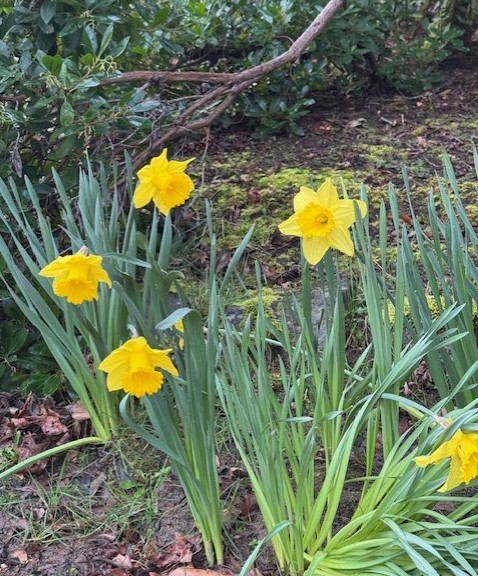
The daffodils have begun to flower. Narcissus emerges from the ground.
The Greeks named the flower for a boy who could not look away. The myth remembers something about spring that the botanical name preserves without explaining: that the eye, given something sufficiently beautiful, stops. The will follows the gaze. The season announces itself through sight.
But before the pool there was a refusal. Narcissus rejected Echo, who could only return his own words back to him. He rejected the nymph Ameinias, who loved him. He rejected, in the Greek understanding, the domain of Aphrodite entirely: desire as an outward force, the eye drawn toward another rather than toward itself. Nemesis responded not with punishment but with proportion: the eye that refused to be caught by another was turned inward until it could see nothing else. The capacity for full attention, which should bind a man to the world outside him, became the instrument of his disappearance from it.
The myth is not about vanity. It is about the eye losing its proper object.
In the Pacific Northwest the signal comes weeks earlier than the calendar habits I grew up with in New England. There, spring arrived with more hesitation. The woods stayed gray and bare until late April.
But the serviceberry was always among the first to appear. The name itself carries a small piece of forgotten history.
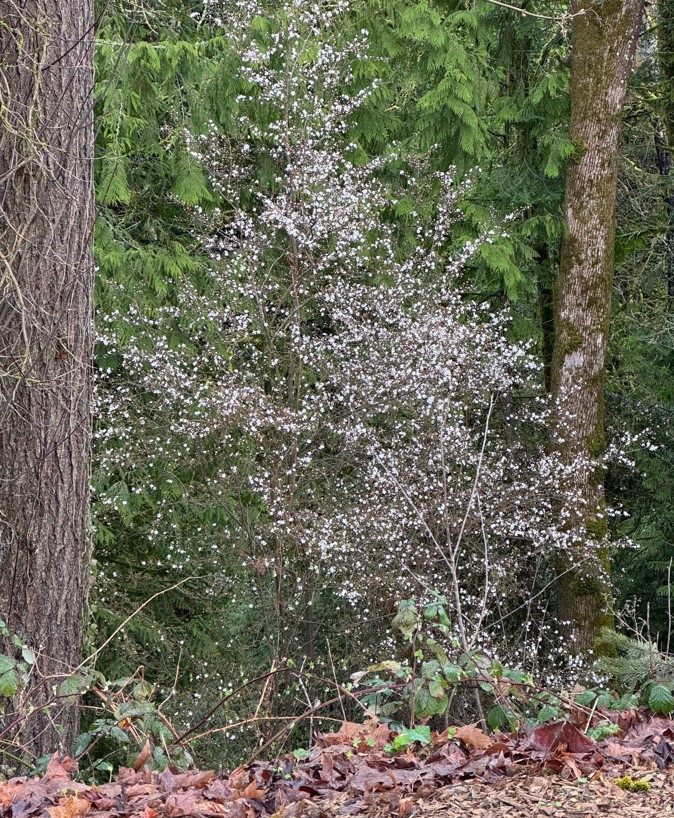
There is a popular explanation that the flowering of the serviceberry marked the time when ministers could finally travel again after the winter snows, allowing delayed funeral services to be held for those who had died during the frozen months. Historians are skeptical of this etymology. But the story persists because it feels true to the conditions of an earlier world.
I have a reason not to dismiss it entirely.
My grandmother’s house had been in the family since the early 1800s. In the basement stood an unused headstone. Whose name and dates I can no longer recover – only the fact of it, waiting there in the dark. The explanation was simple and practical: winter ground in New England freezes hard. Digging graves is difficult. Burials were sometimes delayed until the thaw.
The dead waited for spring to be planted.
Whether or not this is the true origin of the word, the story captures something real about the seasonal structure of life in colder climates. Winter interrupts the normal rhythm of things. Spring restores it. The bloom of a particular tree marks the moment when both the living and the dead resume their proper order.
The Greeks understood this not as metaphor but as fact. When Persephone descends, the earth grows barren with Demeter‘s grief. When she returns, the fields grow again. Each year initiates gathered outside Athens for the Eleusinian Mysteries, rituals tied directly to the agricultural cycle. They reenacted the loss and return of Persephone, symbolizing the burial and rebirth of seed in the soil. The sacred calendar and the farming calendar were the same calendar.
If we follow the lineage of seasonal knowledge backward far enough, it leads to archaic Greece. To Hesiod.
Around 700 BCE Hesiod composed Works and Days: part moral lecture, part agricultural manual. He does not instruct the farmer by calendar dates. He instructs him to watch.
The poem encodes seasonal intelligence in observation. Always the primacy of sight. A farmer who cannot read the sky, the birds, the particular quality of light in a given week is a farmer who will plant late and harvest poorly. The knowledge is not abstract.
The serviceberry had been flowering for days before I noticed it. Not because it was hidden. Because I was not looking. Hesiod would have known the date by the tree. I had to check my phone to find out what week it was.
The practical need to watch the land carefully has largely disappeared. Food arrives from distant continents regardless of what grows locally. The rhythms continue. We moderns have simply stopped being the kind of creatures who are bound by them. Most of the time.
Hesiod addressed farmers facing precarious harvests in an age still recovering from the Bronze Age collapse; a world in which missing the planting window was not an inconvenience but a sentence.[1] The instruction carried that weight. It still does, though we have arranged our lives so that we rarely feel it.
The forsythia spring-bursts yellow. The daffodils open. The serviceberry stands white at the forest edge.
The season has been visible all along. The question is whether we still know how to look.
______________________________________
[1] Archaeological and paleoclimate evidence suggests that Hesiod lived in a world still recovering from several centuries of environmental stress following the Late Bronze Age collapse (ca. 1200 BCE). Climate reconstructions from pollen cores, lake sediments, and dendrochronology indicate prolonged drought conditions in parts of the eastern Mediterranean that contributed to agricultural instability and societal disruption. Scholars have suggested that Hesiod’s intense concern with seasonal timing and agricultural discipline reflects the precarious farming conditions of this period. (See: Brandon L. Drake, “The Influence of Climatic Change on the Late Bronze Age Collapse,” Journal of Archaeological Science 39, no. 6 (2012): 1862–1870; and Martin Finné et al., “Climate in the Eastern Mediterranean During the Past 6000 Years,” Journal of Archaeological Science 38 (2011): 3153–3173.) The environmental stresses faced by early Iron Age Greek farmers differ from the cooling conditions associated with the early modern Little Ice Age that affected Europe and North America when English settlers arrived in New England in the seventeenth century.
 Protective Arts