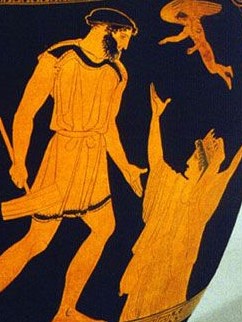
Before Zeus ruled, there were Titans.
Prometheus belongs to that earlier generation, a survivor of the war that placed Zeus on the throne. When the Olympians overthrow Cronos and the Titans in the Titanomachy, Prometheus does something unusual: he aids Zeus (Hesiod, Theogony 617–720). At first glance the decision appears pragmatic. The new regime is winning. But the relationship deteriorates quickly for a deeper reason. Prometheus takes the side of mankind (Hesiod, Theogony 535–616). That alignment places him permanently at odds with Zeus. Cosmic order does not imply benevolence. Zeus maintains the hierarchy of the world. Human flourishing is incidental to that project.
The first conflict occurs at Mecone, where the relationship between gods and humans is being formalized. Prometheus prepares a sacrificial ox and divides it into two portions. One pile contains bones wrapped in shining fat. The other contains edible meat concealed inside the stomach. Zeus is invited to choose. He selects the gleaming pile and discovers he has been tricked. From that moment forward Greek sacrificial ritual reproduces the outcome of the deception: the gods receive smoke and bone while humans keep the meat.
Zeus responds by withdrawing fire from mankind. Without fire there can be no metallurgy, no cooking, no craft, no durable civilization. Humanity is reduced to helplessness. Prometheus answers by stealing fire from Olympus and restoring it to humans, concealing the flame in a hollow fennel stalk (Hesiod, Theogony 561–569).
Zeus orders Prometheus chained to a cliff in the Caucasus. Each day an eagle descends and devours his liver. Each night the liver grows back. Regeneration and destruction, forever locked together. (Hesiod, Theogony 521–534; Apollodorus, Bibliotheca 1.7.1).
Zeus also punishes humanity. The gods fashion Pandora, the first woman. She carries a sealed jar. When it is opened, disease, labor, and suffering spread across the world. Only hope remains trapped inside (Hesiod, Works and Days 60-105).
The logic of these events becomes clearer when placed within the sequence Hesiod describes as the Ages of Man. The first humans lived in the Golden Age under Kronos. Life required little labor and ended peacefully (Hesiod, Works and Days 109–126). The Silver Age followed, in which humans grew arrogant and neglected the gods. Zeus destroyed them (Hesiod, Works and Days 127–142). The Bronze Age produced a violent race devoted entirely to war. Hesiod describes them as lovers of the spear and the works of Ares. Their houses were bronze, their weapons bronze, their thoughts fixed on conflict. They destroyed themselves through their own aggression (Hesiod, Works and Days 143–155).
The Greeks embedded another idea in the story of Prometheus and his brother Epimetheus. Prometheus means forethought. Epimetheus means afterthought (Hesiod, Theogony 507–616).
John von Neumann, one of the founders of game theory, once remarked that real life consists of bluffing and small deceptions, constantly asking what the other man thinks you intend to do. Game theory attempts to formalize that anticipation. But most human beings experience the logic of strategy the way Epimetheus does: only after the fact.
The Greeks understood the nuances of intelligence. Mētis is adaptive cunning, the ability to read a shifting situation and exploit opportunity. Technē is practiced skill, the reliable competence produced by repetition and craft. One anticipates deception, the other executes technique.[1]
Skill develops differently. Mastery emerges through repetition rather than calculation. Malcolm Gladwell popularized the observation that expertise requires thousands of hours of deliberate practice (Outliers, 2008). The precise number has been debated in later replication studies, but the broader insight holds: through repetition the body learns patterns the mind cannot fully articulate. The Greeks called this technē; knowledge embedded in the body (Aristotle, Nicomachean Ethics VI).
In Ridley Scott’s film Prometheus (2012), the Engineers transport a biological agent capable of dissolving human bodies into the raw material of new life. The containers holding the substance resemble ancient amphorae. Greek artists often depicted Pandora’s jar in exactly this form. Pandora carries an instrument created by the gods to undo what the gods themselves allowed to flourish.
Scott pushes the idea further in the figure of David, the android who conducts biological experiments on human subjects with clinical detachment. David embodies a form of intelligence the Greeks would have recognized immediately: technē without restraint and mētis without sympathy. He possesses craft and cunning, but no limit governs their use.
The Delphic tradition warned precisely against this condition. Greek wisdom repeatedly returned to the idea of metron (μέτρον), measure, the proper limit that governs action. Intelligence without measure becomes indistinguishable from divine prerogative. To create life is one form of power. To erase it is another.
The flood of Deucalion follows the violence of the earlier ages. Zeus becomes disgusted with the corruption of mankind and decides to destroy the race entirely. Only two people survive: Deucalion, son of Prometheus, and Pyrrha, daughter of Epimetheus and Pandora (Apollodorus, Bibliotheca 1.7.2; Ovid, Metamorphoses 1.318–415). Prometheus warns his son. Deucalion constructs a chest and survives the deluge as waters cover the land for nine days and nights. When the waters recede, the couple consult the oracle of Themis to learn how humanity might be restored. The oracle answers with a riddle: throw the bones of your mother behind you. They eventually understand that the mother is Gaia, the Earth. The stones they throw over their shoulders become the new race of men and women. Humanity begins again.
Prometheus gave humanity fire. But fire alone does not guarantee survival. The ability to use it requires both cunning and craft: the union of mētis and technē.
The Greeks would later give that union a human form.
His name was Odysseus polytropos, the man of many turns.
____________________________
[1] Modern European languages preserve distinctions in knowledge that parallel the Greek vocabulary of intelligence.
French separates savoir and connaître. Savoir refers to propositional knowledge; knowing that something is the case, or knowing a rule or method that can be stated explicitly. It is the kind of knowledge a text can transmit. Connaître, by contrast, is knowledge through acquaintance. One comes to know something by prolonged exposure, familiarity, or lived experience. You savez the rules of chess. You connaissez your opponent.
The distinction maps closely onto Greek categories. Epistēmē corresponds most closely to savoir: articulable knowledge that can be stated and taught. Technē and mētis, however, operate closer to connaître. They cannot be possessed without accumulated exposure and practice. One may read about archery indefinitely, but the bow is not understood until the body has drawn it repeatedly.
There is also a third term worth noting: reconnaître, to recognize, to know again. A very Platonic understanding of knowing as discovery. Expertise under pressure often operates through recognition rather than deliberate reasoning. The chess grandmaster does not calculate every possible move; he recognizes the position. The boxer who punches before consciously identifying the opening is responding to patterns stored through repeated exposure.
The Prometheus cycle contains examples of each form. The method of concealing fire in the fennel stalk is a form of savoir, a transmissible technique.

Reading Zeus’s psychology at Mecone belongs to connaître, familiarity with how power behaves when its attention is elsewhere. Deucalion’s solution to the oracle’s riddle approaches reconnaître: once the frame shifts, the meaning of “the bones of the mother” becomes visible at once.
These distinctions become even more important in the figure of Odysseus, whose intelligence repeatedly moves between cunning improvisation, practiced skill, and rapid recognition of unfolding situations.
 Protective Arts