Troy is not the beginning of the heroic age.
It is the point where the heroic age destroys itself.
The Greeks understood this. Their myths do not describe a long golden era stretching indefinitely backward into legend. The heroic age is startlingly brief. From the first monster-slayers to the sack of Troy spans only a handful of generations. It is the length of a family’s living memory, if the family paid attention to what it inherited. Your great-great-great-grandfather could have fought the Gorgon. Your father died at Troy.
This compression is not accidental. It is structural. The Greeks are not describing a remote mythical time in the way the Norse sagas describe the age of gods and giants. They are describing something almost recent. The obligations still bind. The oaths still hold. What Perseus did three or four generations earlier is still working itself out in what Achilles does on the plain of Ilium.
The genealogy is not decorative. The genealogy is the argument.
Consequence does not dilute across generations. It concentrates. Troy is where four generations of accumulated obligation, violated oath, and inherited excellence arrive simultaneously at a single shoreline.
The sequence begins with the figures who make the world habitable. Perseus kills the Gorgon and takes her head as a weapon (Apollodorus, Bibliotheca 2.4.2). Cadmus slays the dragon of Ares, sows its teeth into the earth, and produces the first warriors of Thebes (Bibliotheca 3.4.1). Bellerophon kills the Chimera on the plains of Lycia (Iliad 6.179–183). These are not kings administering cities but founders confronting monsters. The violence clears the ground on which cities can exist at all.
The next generation consolidates what the founders created. Heracles moves through the Greek world like a storm, clearing the remaining terrors: the Nemean lion, the Lernaean hydra, the Augean stables, the Stymphalian birds (Bibliotheca 2.5.1–12). Theseus kills the Minotaur and gathers the scattered villages of Attica into a single political body, synoikismos (Thucydides, History 2.15). Wilderness is pushed back. Roads connect the cities. The heroic energy that made the landscape habitable begins to move inside the civic order.
And once it enters the city, it becomes harder to control.
Heracles is the warning. The same force that destroys monsters kills his own family. Theseus, who unifies Athens, leaves a trail of broken alliances and abandoned women behind him: Ariadne on Naxos, Antiope the Amazon queen, Helen herself abducted as a child. The violence that was necessary outside the walls becomes crime within them. The consolidators are already transitional figures. Too powerful for the world they are helping to create.
The heroes are clearing a world that will eventually have no place for them.
The third generation forms the network that will eventually produce Troy.
At Calydon the pattern announces itself in miniature. A hunting contest over a boar’s hide destroys a royal house (Bibliotheca 1.8.2). The same mechanisms – honor contested, family fractured, violence turning inward – will operate at full scale a generation later and destroy a civilization.
Soon afterward another gathering takes place on the shore of Thessaly. Jason calls the heroes to crew the Argo in search of the Golden Fleece, and they come from every corner of the Greek world: Orpheus, Castor and Polydeuces, Peleus, Telamon, the young Heracles, and many others (Apollonius of Rhodes, Argonautica 1.20–227; Apollodorus, Bibliotheca 1.9.16).
After the Argo, the heroes will not assemble again until Troy.
The voyage creates a dense web of familiarity, rivalry, and obligation. These heroes fight together, survive together, and form alliances that will bind their children. When they return, they disperse to found families and kingdoms.
Peleus, who sailed with Jason, wins the sea-goddess Thetis in a wrestling match and becomes king of the Myrmidons (Bibliotheca 3.13.5). At their wedding the apple is thrown, the judgment is set in motion, and Achilles is conceived.
The war begins at a wedding.
The greatest warrior of the Trojan War and the cause of the war originate in the same moment. Telamon, Peleus’s companion on the Argo, establishes his house on Salamis and will father Ajax. Tydeus, son of Oeneus of Calydon, begins the violent career that ends with him devouring the brains of a fallen enemy (Bibliotheca 3.6.8), but not before fathering Diomedes. Laertes rules quietly in Ithaca and raises a son whose cunning will prove more durable than any warrior’s excellence. Atreus consolidates the Pelopid line at Mycenae. His house carries a curse that predates the heroic age itself, running back through Pelops and Tantalus to violations the Olympians have not forgotten.
These men are heroes themselves. Most of them sailed on the Argo, hunted at Calydon, fought their own wars. But their defining function is as fathers. What each house built, and what each house violated, arrives at Troy in the bodies of their sons.
Achilles inherits the speed of Peleus and the dangerous divinity of Thetis and the foreknowledge that he will die young at Troy (Iliad 1.352–356). Ajax inherits the massive strength of Telamon, the straightforward force that needs no cunning to justify itself. Diomedes receives the ferocity of Tydeus, but disciplined and sharpened by the lesson his father’s excess taught. Odysseus inherits the cunning that small kingdoms must cultivate if they are to survive among larger powers. Agamemnon inherits the Pelopid wealth, the Mycenaean armies, the command of the largest Greek expedition ever assembled – and the curse that has been working through his house since before he was born.
When the war finally begins, the compression becomes visible.
Every major house of the Greek world appears simultaneously on the same stretch of shoreline. The oath sworn at Sparta activates the entire network at once. Sons of men who hunted together at Calydon or sailed together on the Argo are now bound by legal obligation to a war none of them chose. The judgment of Paris ignites it. The structure sustains it.
But the war itself cannot begin until the heroic world pays its first terrible price.
Agamemnon’s fleet assembles at Aulis and the winds do not come. The seer Calchas delivers the verdict: Artemis requires the sacrifice of Iphigenia, Agamemnon’s daughter, in repayment for an offense against the goddess (Bibliotheca Epitome 3.21). The offense is Agamemnon’s. The price falls on his child.
Agamemnon pays it.
This is the first of Troy’s preconditions and the most terrible. The war has not yet begun and its commander has already committed the act that will destroy his house when he returns. Clytemnestra watches her daughter led to the altar by the lie that she would marry Achilles. The war’s final accounting begins at Aulis, before the first ship reaches Troy. Aeschylus understood this precisely. The Oresteia begins not with Agamemnon’s return but with the necessity that made his return impossible to survive (Agamemnon 160–183).
The war begins with a sacrifice that guarantees its aftermath.
Troy itself is protected by conditions that reach back across the entire heroic arc.
The Palladium, the sacred image of Athena, carved in grief for the childhood companion she accidentally killed, stands in the city’s sanctuary (Bibliotheca 3.12.3). As long as it remains there, the city cannot be taken. So Odysseus and Diomedes infiltrate the city at night and steal it to remove Athena’s protection from a city the goddess has already, for reasons traced back to the Judgment of Paris, decided to abandon (Bibliotheca Epitome 5.13).
The war cannot end without the bow of Heracles.
Heracles, dying on Mount Oeta, gave his bow and arrows to Philoctetes as the price of lighting the pyre (Bibliotheca 2.7.7). Philoctetes sailed with the Greek fleet toward Troy. On the island of Lemnos a serpent bit him. The wound festered and would not heal. On Odysseus’s advice the Greeks abandoned him there and sailed without him – a strategic convenience that left a man with a decade of justified grievance and a weapon the war could not conclude without.
The seer Helenus, captured by the Greeks, reveals the conditions for Troy’s fall: the city requires the bow of Heracles and the presence of a son of Achilles (Sophocles, Philoctetes 610–613). Odysseus sails to Lemnos carrying an argument Philoctetes has every reason to refuse. The man who abandoned him now needs him. Philoctetes refuses. It is Neoptolemus, the young son of Achilles, not yet old enough to have learned Odysseus’s brand of cunning, who finally persuades him, not through strategy but through honest acknowledgment of the wrong done.
The bow of Heracles arrives at Troy in the hands of a son of Achilles. Its first arrow kills Paris.
The bow has been here before. Heracles sacked Troy in an earlier generation, when Laomedon refused him the horses Poseidon had promised (Bibliotheca 2.6.4). The founding hero’s weapon returns to finish what the founding hero began. The heroic inheritance travels through injury and betrayal before it arrives at its final purpose. The bow could not have come to Troy any other way, because Philoctetes could only be persuaded by someone who had not yet learned to treat men as instruments. The son of Achilles succeeds where the cunning of Odysseus fails. But Neoptolemus arrives at Troy with nothing yet lost and nothing yet owed, which makes him the most dangerous kind of hero: one who has inherited the license without the cost that licenses it.
The Palladium is stolen. The bow has spoken. Achilles is dead. His son Neoptolemus has arrived. Every structural condition has been met.
Troy does not fall because Odysseus invents a clever trick.
Troy falls because the entire structure sustaining it has been dismantled.
The horse is not a stratagem. It is a ceremony. The Greeks construct a wooden horse large enough to hold a company of warriors and leave it on the beach with Sinon, a planted interpreter who tells the Trojans it is a sacred offering to Athena (Bibliotheca Epitome 5.15–19). The Trojans, whose city has just lost its divine protection, whose greatest defender is dead, whose prince lies killed by the weapon of Heracles, bring the horse inside the walls themselves.
They open their own gates.
The Greeks have not overcome Troy’s defenses. They have waited for the structure to exhaust itself. The horse marks the moment when the exhaustion is complete.
The sons who inherit the victory inherit a diminished world.
Neoptolemus throws Hector’s baby son Astyanax from the walls of Troy and kills the old king Priam at the altar of Zeus: violations that would have shocked his grandfather’s generation but barely register in the moral accounting of the war’s final hours (Bibliotheca Epitome 5.23). He has satisfied the conditions required of him and immediately violated the sanctity that made those conditions meaningful. The heroic inheritance is received and spent in the same campaign.
Achilles, briefly, recognizes what his son will not inherit: that an enemy father kneeling in the dust is still a father. It is the one moment in the heroic age when excellence stops and something older than excellence speaks. Homer ends the poem not with Greek triumph but with a Trojan funeral. The last dignity belongs to the enemy.
Orestes returns home to find his father murdered and is required to kill his own mother to restore order. The act is simultaneously just and polluted. The Greeks are forced to invent the Areopagus, a trial, to determine whether justice and pollution can coexist in the same action. They can, Athena decides, but only barely, and only by replacing the personal logic of vendetta with the civic logic of judgment (Aeschylus, Eumenides 681–710).
Telemachus grows to adulthood in a house full of suitors devouring his inheritance while his father struggles to return (Odyssey 1.245–251). His education in the Odyssey is the first lesson in how to live after the heroic network has dissolved, without the institutions that will eventually replace it.
The war that began over Helen ends with the collapse of the civilization that fought it.
The heroic age was not long. It was four generations of accumulated consequence arriving simultaneously at a single place. Perseus cleared the ground. Heracles and Theseus consolidated it. The Argo bound the houses together. The fathers condensed into their sons. The sons arrived at Troy carrying the cumulative inheritance: everything their houses had built, violated, and transmitted. The founding violence had only one place left to go.
Troy is where the compression reaches its limit.
Not the birth of the heroic age.
Its detonation.
_____________________
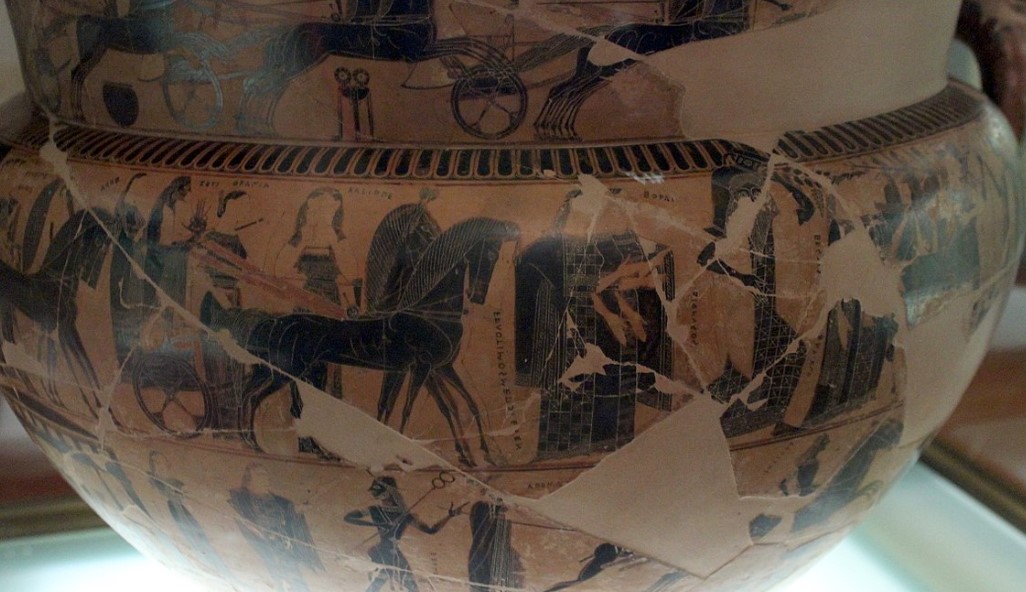
Banner image – the François Vase, the wedding of Peleus and Thetis, the moment before the apple lands.
 Protective Arts