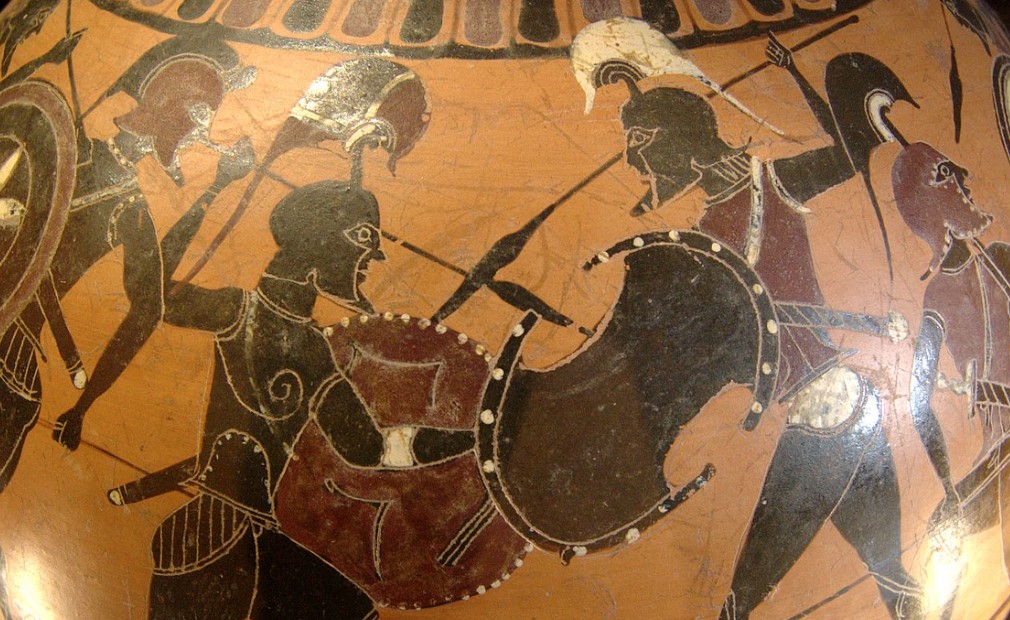
The Greeks chose, as their founding story, not triumph but rupture. The Iliad opens with epic anger: leaders divided, an army stalled, a coalition nearly undone before it reaches the walls of Troy. The ancient Greeks did not ground their civilization in harmony, but in the conditions that make order fragile; pride, rivalry, misjudgment, the thin margin between cooperation and dissolution. The poem moves, at its end, toward a moment of recognition: the meeting of Priam and Achilles, where grief suspends enmity and restores, briefly, a shared humanity. But the reconciliation is personal, not political; it does not repair the quarrel that began the war, nor secure the order the coalition requires. What the poem offers is not coherence restored, but coherence glimpsed. And shown to depend on conditions that cannot be sustained.
The epics of Homer and the genealogies of Hesiod emerge in the late eighth and early seventh centuries BCE as the consolidation of a much older oral tradition that provide frameworks of action and meaning, a code of honor, fate, and divine order. By the sixth century, likely under Peisistratus, these poems are stabilized and recited in civic festival, effectively canonized as the shared language of the Greeks. This is paideia in its civic form: not instruction, rather initiation into a shared world.
The Panathenaic recitation is a political act as much as a cultural one. Athens does not create Homer, nor possess him exclusively, but it does something more consequential: it orders him. The poems are gathered, sequenced, and performed before a common audience. Athens does not invent myth; it deploys Homer as an instrument through which the city recognizes itself in a shared story. What emerges is not ownership but coherence, achieved without central doctrine, though not without control. This is not unique to Athens. It repeats wherever a community decides that a common story is too important to leave unshaped. Reed College made the same move when it sent its incoming students a summer reading list in 1986. We were expected to arrive knowing the Iliad and the Odyssey. The implicit challenge: arrive already inside the inheritance, or do not arrive at all. I arrived ready for the anger and the glory; for Achilles at his most terrible, the aristeia, the killing, the refusal. What I was not yet able to read was Achilles at his most human: the man in the tent, at the end, undone by an old king’s grief and his own. That recognition required more life than I had. It required, as it turns out, children of my own.
This is not a departure from the poem. It is how it works. The Greeks did not treat their myths as fixed revelation, but as material to be re-seen, re-spoken, and re-ordered against the needs of the present. The tragedians did not preserve Homer; they interrogated him. What the poem gives is not a doctrine, but a structure capable of yielding different truths as the reader changes. My own reading, as a father, does not replace the earlier one. It follows it. That is a difference worth naming. A scripture demands fidelity to its original meaning. A myth demands return.
In 480 BCE, the Persians burn Athens, still largely a city of wood. The oracle at Delphi had already warned the Athenians to trust in their “wooden walls,” a phrase Themistocles interprets correctly as ships rather than fortifications (Herodotus, Histories 7.141–143). The city burns; the fleet survives; victory follows. From that ruin, Athens rebuilds within a single generation, but now in stone. Pericles redirects the Delian League’s treasury into the building program: the Parthenon rises between 447 and 432 BCE under the direction of Phidias, the gods rendered not as distant forces but as perfected human form (Plutarch, Life of Pericles). Myth takes architectural form.
At the same moment, the city turns its inherited myths upon itself in the theater. Aeschylus, Sophocles, and Euripides do not simply repeat Homer; they make visible what was never resolved within the tradition. The heroic world had always contained contradiction: honor and savagery, piety and brutality, fate and cunning uneasily aligned. Tragedy does not introduce fracture; it concentrates it. Justice becomes opaque, fate oppressive, the gods ambiguous or absent. The stories remain. The older certainty behind them does not.
Aristotle will later attempt to account for this rather than suppress it. His theory of catharsis proposes that tragedy works by ordering and discharging emotion; a process that is at once physiological, moral, and civic. But this is already the perspective of an inheritor-analyst, someone explaining a phenomenon that earlier generations simply inhabited. The gap between experience and explanation marks the same shift the tragedies themselves reveal.
As the city reaches its apex, about the mid-fifth century, within a single lifetime of the Persian Wars, it begins its intellectual unraveling. Herodotus writes his Histories within the language of myth, narrating the Persian Wars with cultural breadth and divine shading, but within a generation Thucydides removes the gods entirely and replaces them with necessity, fear, and interest in his History of the Peloponnesian War. Thucydides was himself a general, not a sophist, and his analytical coldness is not indifference; it is the posture of a man who understands he is living through the end of something and refuses the comfort of explanation. The shift does not occur across centuries but within a lifetime. Myth is no longer inhabited; it is examined.
And once examined as myth, it can no longer hold a people together in the way it once did.
The system then tests itself in war. The Peloponnesian War unfolds as both external conflict and internal corrosion ending in defeat in 404 BCE, less than seventy-five years after the Parthenon begins. The final act follows: in 399 BCE the city executes Socrates for ἀσέβεια (asebeia), impiety, the man who insists on examining the very assumptions the city had embodied.
There is a story, likely embellished, of Phryne, a ἑταίρα (hetaira) and model for Praxiteles, brought to trial on the same charge and acquitted when her body is exposed before the jury. Beauty offered as evidence; form as argument. The body is not explained; it is displayed. It does not invite inquiry; it arrests it. This is the same logic that animates the Gorgon and the face that launches a thousand ships: beauty not as persuasion, but as compulsion.
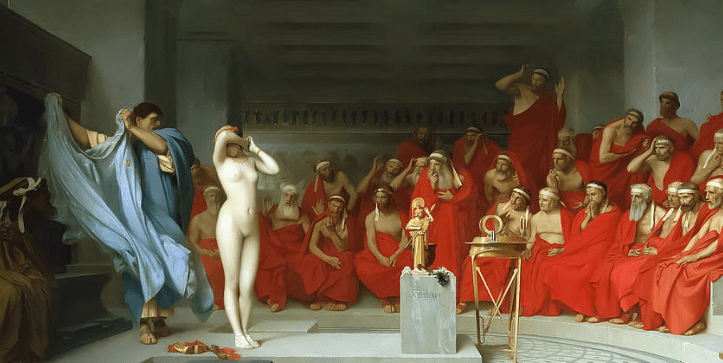
Set against Socrates, the contrast is exact. He submits everything to examination and is put to death. Phryne is shielded from examination and is set free. One dissolves inherited meaning by insisting it justify itself; the other preserves meaning by refusing that demand. Between them lies the fracture.
The jury that acquitted Phryne and the hand that shaped the gods were moving in the same direction.
What follows from that direction (the loosening of the Classical form through Praxiteles, the softening of divine composure into inhabited warmth, and, later, the full expression of strain and extremity in works like the Laocoön and His Sons, where the body registers suffering, together with Plato’s structural alarm at mimesis, his expulsion of the poets, and the Forms as a replacement myth) belongs to a longer argument about the image and its authority, one that runs forward into Rome. What matters here is the logic the fracture exposes: that the integration of myth, politics, art, and shared understanding within a single frame does not dissolve slowly. It holds. And then it does not. The stories remain. But they no longer bind in the same way.
And yet this is not the first time the structure has failed. The poem that Athens ordered already knew.
At the end of the Iliad, before the city falls, before the war resolves, there is a moment that does not belong to victory or defeat. Priam enters the tent of Achilles, not as king to warrior, but as father to son. The order that brought them there has already run its course. What remains cannot be explained by it. Achilles looks at the man he has destroyed and sees not an enemy, but a mirror: the father he will leave behind, the loss that awaits him. For a moment, the system yields to something older than itself.
Athens built its paideia on a poem whose central movement was always visible, but never fully transmissible. The audience did not need to be taught what the meeting of Priam and Achilles revealed. They lived close enough to death to recognize it: the cost of honor, the grief that survives it, the limit beyond which strength cannot carry a man. What cannot be taught is held in the poem, waiting. Paideia transmits, but never completely. Something remains.
I did not read this when I first arrived at Reed. I read for the killing. I read for Achilles in his power, not Achilles in his recognition. That misreading was not failure; it was, in its way, appropriate: the poem gives the young reader what the young reader can receive. The aristeia first. The tent, if you are lucky, later.
What the Greeks achieved was not ignorance of this truth, but something more difficult: they built a civilization around a story that revealed, at its center, something that could not be made into law, institution, or form. It could be seen. It could be enacted. But it could not be secured.
That education is what the Iliad is for. Achilles receives it last, at the cost of everything. And what it cost him, and who was finally able to give it, is what the poem has been building toward from its first word.
 Protective Arts