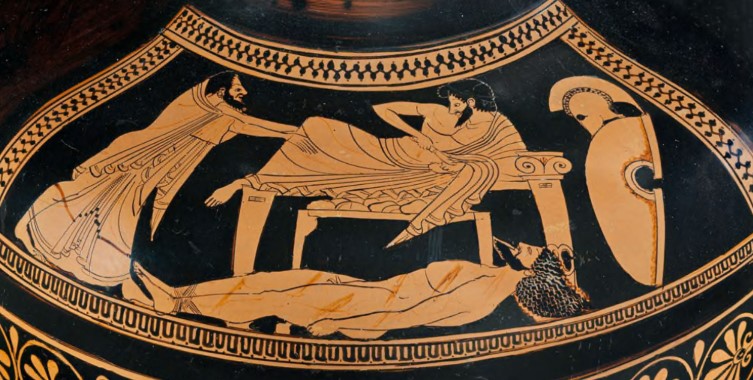
Achilles was the man who would cause his father to outlive him. Everything else follows from that.
Thetis knew first. Her son faced what the Greeks called a dilemma. A long life without a name, or a short life the singers would not let die. Both draw blood.[1]
She had been bound to that. Wrestled into marriage with Peleus, held through every shape she took until she could not change again. The divine is not arrested willingly. It is seized, and what it yields belongs to both worlds and is destroyed by that belonging.
So she acted.
There are stories.
She dipped him in dark water.
She hid him among daughters on Skyros.
Each act shares the same grammar: refusal of the terms on which he exists. It is not misunderstanding. It is refusal of a structure she understands and cannot accept.
On Skyros, Odysseus laid out gifts, cloth, jewelry, a sword, and waited. The daughters reached for what pleased them. Achilles reached for the weapon.
The sword was the mirror.
Behind Thetis stands Peleus, already receding. He belonged to the last generation that could win divine things directly: the heroes who wrestled gods, who descended and returned. What he gave could be taught: bearing, speech, the shape a man makes among other men. Peleus sends Phoenix:
…to make [him] a speaker of words and one accomplished in action.
Iliad 9.443–444
Achilles received the instruction. He did not receive the temperament.
From Peleus: measure.
From Thetis: proximity to what does not accept limits.
He arrived at Troy already divided.
The quarrel with Agamemnon reveals it.
A girl is taken. An honor-price violated. But beneath it lies something more dangerous: Achilles refuses the exchange that holds the coalition together. Agamemnon treats him as a part. Achilles refuses.
He withdraws.
The instruction of Peleus fails; not in form, but in force. Achilles knows what measure requires. He refuses it.
He turns to Thetis.
She rises, listens, carries the grievance upward to Zeus. Let the Greeks suffer until they understand what they have lost.
Zeus agrees.
Absence becomes cause.
The ships burn.
The line breaks.
Men die in the space he refuses to occupy.
Achilles watches.
Patroclus refuses to watch any longer. He asks for the armor. To stand where Achilles will not.
Achilles allows it. But draws a boundary: drive them back from the ships. No farther.
Patroclus crosses it.
He advances. He meets Hector. He dies.
Patroklos has fallen, and now they are fighting over his body which is naked. Hektor of the shining helm has taken his armor.
Iliad 18.20–27
Achilles falls to the earth. The sound he makes brings Thetis from the sea.
She comes.
She goes to Hephaestus and returns with new armor.
Not protection. Preparation.
Achilles returns, but not as before. Not for honor.
For Hector.
He finds him. He kills him. The poem marks the place of the wound with precision.
Then he crosses what is not permitted.
He drags the body.
He refuses burial.
The instruction of Peleus has gone silent.
Then the old king comes.
Priam crosses the impossible distance. Enters the tent. Kneels. Takes Achilles’ hands and kisses them.
Supplication.
And he speaks of Peleus.
…remember your father, one who is of years like mine…
Iliad 24.486–506
That is enough.
Something in Achilles breaks.
The father he left returns to him in another man’s grief.
Priam has lost Hector.
Peleus will lose him.
He sees it.
For a moment, he sees from outside himself.
…and Achilleus wept now for his own father, now again for Patroklos. The sound of their mourning moved in the house.
Illiad 24.511-512
The poem does not resolve.
It gives twelve days of truce, a returned body, a shared meal. Then it ends.
Because the recognition is real, and it is brief.
The poem named its subject at the beginning:
Sing, goddess, the anger of Peleus’ son Achilleus…
Iliad 1.1
Wrath cannot be taught out of a man. It cannot be protected away.
Thetis could not give him this. She gave what she had: proximity to the deathless.
Peleus could not give him this. He gave measure and instruction.
What reached Achilles was the cost of what he had done.
Priam knew it.
He took Achilles’ hands.
And Achilles wept.
_______________________________
[1] Dilemma (δίλημμα): a two-horned thing, from δίς (twice) and λῆμμα (the thing taken, the premise forced upon you). Both horns draw blood. A long life without a name, or a short life the singers would not let die. The horns are not equal, and they are not avoidable. You are gored by whichever one you choose.
Coda: On Sources, Layers, and What Was Added Later
The telling above compresses traditions that did not arise at the same time.
The Iliad itself does not show Thetis attempting to prevent Achilles’ fate. She does not dip him in the Styx. She does not hide him on Skyros. Those belong to later mythographers and poets, primarily Psuedo-Apollodorus (Bibliotheca 3.13.8) and Statius (Achilleid 1). The traditions that show Thetis trying to prevent Achilles’ fate reach us in full only in sources written nearly eight centuries after Homer, when myth had shifted from performance to compilation.
In Homer, Thetis shows more divine separation: She knows Achilles will die if he returns to battle. She does not attempt to prevent it, she simply equips him for it (Iliad 18.369–617).
This difference matters. The later tradition renders Thetis more recognizably maternal; she tries to make him invulnerable and hides him from participation. The Homeric Thetis is more structural: she does not alter fate; she participates in its execution.
A useful contrast is Aphrodite.
In Homer, Aphrodite repeatedly intervenes to remove her son Aeneas from danger. When she enters the battlefield to do so, she is wounded by Diomedes, who recognizes the violation, she crossed from her proper domain of love into war. Aphrodite does not learn from this. She continues to preserve Aeneas. Undying love and unconditional support for her son.
Set against this, Thetis changes register across the tradition: early, accompaniment to fate; later, attempted avoidance of fate. The movement is from structure to psychology. Homer is not less human; he is less explanatory.
The Roman tradition resolves this differently.
In the Aeneid, Aeneas carries forward what Achilles cannot. Aeneas sees loss, the burning Troy, the death of kin, and continues under obligation. This is not Homeric resolution but Roman transformation. Troy carries a costly legacy and Virgil transforms it into destiny; Homer leaves it as perception without continuation.
On Peleus:
He does not appear at Troy in the Iliad, but he is not absent in influence.
He sends Phoenix to teach Achilles how to speak and act among men and to remind him of that instruction when it fails (Iliad 9.434–605).
Phoenix’s failure is important. It confirms that Achilles’ crisis is not ignorance. He knows the code. He refuses it.
Achilles is not tragic because he dies: he is tragic because he cannot be formed by what forms other men.
The tradition does not leave Achilles where Homer does.
His son, Neoptolemus, enters the war after him and carries forward what the father had, for a moment, set down. Where Achilles stopped before the old king, the son does not. Neoptolemus kills Priam at the altar, throws Hector’s baby, Astyanax, from the walls, and sacrifices Polyxena at his father’s tomb. The recognition in the tent does not pass to the next generation. What was seen once is not taught, and not kept.
 Protective Arts
3 thoughts on “Achilles”