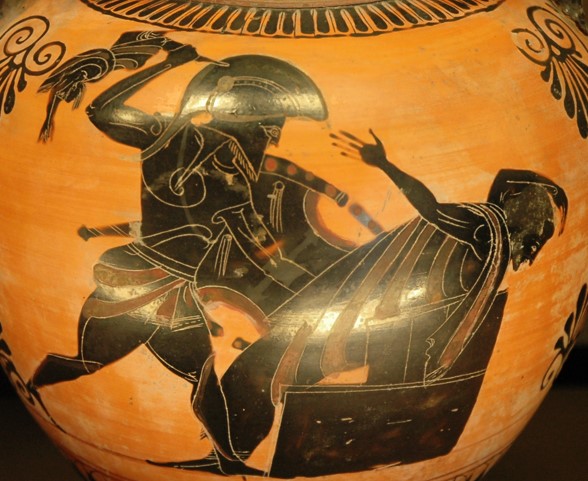
We have already met him.
Neoptolemus arrives on Lemnos as the younger man Odysseus brings to retrieve Philoctetes and the bow of Heracles. He resists the deception Odysseus requires. That is Neoptolemus at his best: resistant to manipulation, not yet corrupted by the compromises of war. Sophocles gives him dignity in that moment of resistance. He is admirable.
Then he gets to Troy.
The Iliad ends before Neoptolemus arrives. The later tradition records what Homer declined to show.
He kills Priam at the altar of Zeus. He throws Astyanax from the walls. He sacrifices Polyxena at Achilles’ tomb. The details vary. The pattern does not. His violence is not selective. It is thorough.
What the tradition preserves is the specific texture of his excess. He does not stop where stopping was possible. He possesses the authority of a tradition he did not endure, so his violence has no internal limit.
The Greeks preserved Neoptolemus as a type. Not a monster. Something more instructive: a man with every inheritance and no formation sufficient to make that inheritance safe to wield.
*
The Greeks did not begin with law. They began with the contest.
The agon was not constructed as a solution. It was embedded in how the Greeks understood excellence, honor, and recognition. Life was public. Action was seen. Standing was not claimed; it was tested.
You entered with witnesses. You did not control the outcome. The crowd was not an audience. It was a mirror. And the reflection could not be negotiated. A young man trained for years to develop judgment under pressure. He entered. He won or lost. The result was public. It could not be revised.
Aristotle’s account of virtue formation depends on this structure, though he is not always explicit about it. We do not reason our way into virtue. We are habituated into it, through repeated action that gradually shapes the disposition from which action flows (Nicomachean Ethics II.1). The habit is not mere repetition. It is repetition under conditions that produce feedback: resistance, consequence, the experience of failing and continuing. Character is the residue of repeated action under constraint, tested against reality.
Character is not declared. It is formed.
The agon provided what instruction cannot: the experience of being seen and of having that seeing matter.
My ancestors understood this. They would also have added a moral seriousness to the judgment.
The Puritan covenant performed the same function in another register. It was public, binding, witnessed. You were seen. You were held to account. You could not revise the record. Failure had consequence. Standing had to be sustained.
And they knew something else. Each generation would be less formed than the last. Jonathan Edwards preached it. Increase Mather recorded it. The fear was not greater wickedness. It was weaker formation.
I felt the echo of it returning home from a drive to have my mother announce: “So you were driving fast through the center of town.” The weight of being seen consequentially. Not by surveillance, not by law, but by a community that noticed and held you to account. That is formation’s residue. It feels like pressure. That is the point.
The covenant did not survive its own success. As conditions softened, the structure weakened. My ancestors’ fear was vindicated not by catastrophe but by comfort. The wilderness receded. The formation thinned. What remained was the language. What did not remain was the discipline that had once made the language binding.
Into that vacancy came law. Not all at once, but steadily. External regulation expanded to compensate for the thinning of internal formation. This is structural. A society that requires judgment but does not produce it must regulate behavior instead. Law can regulate behavior.
It cannot form character.
It can demand proportion; it cannot produce the person capable of proportion. And as the gap widens, the demand increases, even as the capacity to meet it declines.
The constitutional tradition captures this tension in its founding documents. The Federalist Papers, along with the less read Anti-Federalist Papers, are not declarations of settled truth. They are active arguments; uncertain, provisional, contested, written by men who disagreed with each other and knew it. They are closer in that sense to Homer than to statute. To engage them seriously required the same disposition the agon required: intellectual humility, willingness to be wrong, calibration against something outside one’s own certainties.
That mode has thinned. The United States Constitution is now more often invoked than inhabited. It is cited as authority or dismissed as obsolete, deployed as a tool for positions already held, rarely wrestled with as a problem that might revise the positions one arrived with.
We inhabit the consequence. High moral vocabulary. Low shared calibration.
There is no deficit of conviction. Conviction is everywhere: certain, loud, and abundant. What is missing is the formation that would make conviction reliable: the experience of being wrong in public, of having one’s judgment tested against reality rather than against others who share the same starting assumptions, of failing in ways that matter and continuing anyway.
We now form opinions without exposure to correction. We declare without being tested. We inherit the authority of our tradition (the language of rights, of justice, of moral urgency) without the discipline that once made that authority dangerous to wield.
And so our judgments grow more certain as they become less reliable. We display conviction more readily than we test it.
This is Neoptolemus at scale. An entire civilization that has inherited the weapons, the language of rights, the authority of tradition, the moral urgency of election, without the process that would make those things bearable to wield.
There are still places where the older structure survives. The agon did not disappear entirely. It persists in diminished but recognizable forms wherever apprenticeship remains real.
The serious martial tradition is one of them. Not the performed version, but the practiced one. You enter under authority. You do not control the outcome. You are corrected by someone who knows more than you do. You fail in front of witnesses. You continue. The form is absorbed into the body until the body knows what the mind cannot yet articulate.
This is not unique to martial arts. It is the structure of apprenticeship wherever it holds: in craft, in parenting at its best, in the disciplined transmission of skill and judgment across generations.
The teacher-student and sempai-kohai relationships preserve this structure explicitly: hierarchy not as domination, but as calibration. You are shown the form before you are permitted to vary it. You inhabit the structure before you transcend it. This is Shu–Ha–Ri: the progression from obedience to differentiation to mastery. The sequence cannot be reversed. Without the initial submission to form, what appears later as freedom is merely variation without foundation.
I did not learn this from theory. I learned it from being corrected.
In the dojo, there is no argument that survives contact. You attempt the technique. It fails. Your partner does not cooperate. Your structure collapses. The correction is immediate and physical. You cannot explain it away. You adjust, or you fail again. And you fail in front of others.
The failure is seen. And because it is seen, it matters.
Over time, something shifts. The body learns before the mind does. The correction becomes internal. What was once imposed from outside becomes habit.
Not perfection. Proportion.
That is formation.
The crisis is not moral decline in the usual sense. What has thinned is the means by which moral instinct becomes moral judgment.
A society cannot legislate the character it no longer forms. It can expand law indefinitely to compensate for the deficit, and it will. The expansion generates its own dysfunction: more rules, more categories, more adjudication, and less agreement about what any of it means – because the shared formation that once made shared meaning possible has been replaced by procedure.
Procedure is not nothing. But it presupposes the very thing it cannot supply. Procedure without virtue is pathological. It becomes either hollow or captured.
Achilles, at the end of the Iliad, briefly achieves what Neoptolemus never does. He sees from outside himself. Priam’s grief reaches him because it is his father’s grief, and for a brief moment he knows what his weapons have cost.
The recognition does not last. The poem ends twelve days later. What was seen once is not taught, and Neoptolemus is waiting.
But the recognition happened. The tent held it. The shared meal held it. Homer held it for us across three thousand years.
We are producing successors: armed, certain, and untested in the limits of what we carry. They inherit the language. They inherit the authority. They inherit the urgency. What they do not inherit is the discipline that once made those things dangerous to misuse.
Neoptolemus arrives already self-authorized. Already armed with legitimacy, and untested in the limits of what he carries.
 Protective Arts