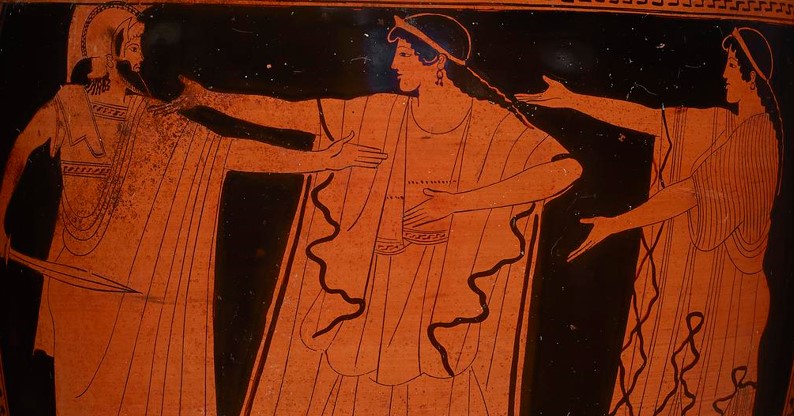
Helen is not the subject but the test case: the figure around which questions of causation, perception, agency, and the reliability of language organize themselves.
The movement runs from Homer, where she is a condition, through Euripides and Gorgias, to Thucydides – each of whom is writing within roughly a single generation of the others – where she disappears entirely and the mechanism persists.
The distance between these accounts is not centuries but decades. The transformation is not gradual. It is observed.
But it does not stop there. It continues through Aristotle, who attempts to contain it, into the Stoics, who internalize it, and finally into Ancient Rome, which institutionalizes it in law and transmits it to a religious tradition that will elevate it beyond politics.
The continuity traced here is constructed, not given; each tradition preserves tensions that resist this line of development even as they make it possible.
Before Homer, there is Hesiod. Before Helen, there is Pandora.
*
Hesiod gives two accounts. In the Theogony, Pandora is fashioned as punishment (Theogony 570–612). In the Works and Days, she becomes kalon kakon (καλὸν κακόν) a “beautiful evil” and from her jar trouble disperses into the world (60–105).
What matters is not moral accounting but design. Pandora does not deceive in the ordinary sense. She does not misrepresent herself. She is the gift that functions as intended.
Epimetheus does not deliberate. He receives. The gift arrives without visible cost and without immediate consequence. What is given is accepted before it is understood. The harm is not hidden; it is simply not yet experienced.
The structure already contains the logic later named pharmakon: what is given is both remedy and poison.
Three features carry forward. The gift is individualized. It is given to Epimetheus, not to mankind in abstraction, but to a particular recipient defined by susceptibility.
What is given cannot be recalled. The jar is opened; what escapes does not return.
The recipient’s desire completes the act. The gods do not force the outcome. They design the conditions under which acceptance becomes inevitable.
These features recur.
*
In the Iliad, Helen is presupposed. She is integral and structural.
She stands beside Priam at the Scaean Gates, looking out over the field. The old king asks; she answers. She names the men she once lived among. Agamemnon, broad, unmistakable. Odysseus, compact, deliberate, dangerous in stillness. She sees clearly. Priam listens. Nothing changes.
The knowledge is accurate. It produces no consequence. The clarity does not translate into agency.
After Paris is defeated, Aphrodite intervenes. This is reciprocity, an exchange fulfilled rather than a favor granted. Paris chose her; she enforces the terms. Helen is the promised prize; the compulsion completes the bargain.
Helen resists verbally. She goes anyway.
Speech diverges from action; the divergence is not reconciled.
With Hector, the pattern holds. She speaks with clarity; he accepts her presence as given. He does not suspend judgment. He renders it irrelevant. Helen is not a cause to be adjudicated. She is a condition to be managed.
Recognition precedes judgment. Action follows necessity. The poem absorbs her.
Pandora’s structure is already active.
*
In the Odyssey, Helen changes.
She administers nepenthe, suspending grief (Odyssey 4.220–232). The substance is uncertain. Its function is not. What matters is not what it is, but what it does. It does not alter reality. It alters how reality is borne. She recounts Troy to Telemachus; tells the exploits of his father.
She tells of the horse. And an anomaly.
She walks the perimeter of the horse slowly. The army has withdrawn. The city is quiet in the way cities are quiet when something unresolved remains inside them. Then she begins to speak.
Not as herself.
A wife’s voice. Then another. Each call precise. Each name placed exactly where it will land.
Inside the horse, silence becomes effort. Breath held too long. One of them almost answers.
Helen does not present herself as the object of desire. She presents desire in its most actionable form.
The appeal is individualized.
Pandora’s structure repeats.
At Sparta, Helen recounts these events. Menelaus recounts his. The accounts do not align. Neither presses. Acknowledgment replaces adjudication. The structure has already discharged its consequences.
*
In Helen (412 BCE), Euripides removes her. Helen is in Egypt. A phantom (eidolon) goes to Troy.
For an audience that has just destroyed itself in Sicily (cf. Thucydides 6–7), the implication is immediate: If the object was never there, what sustained the action?
The answer is now unavoidable: The mechanism does not require the object.
*
In the Encomium of Helen, Gorgias names the mechanism.
Written in the late fifth century BCE, traditionally associated with his activity in Athens after 427 BCE, the text makes the claim explicit: Speech acts upon the soul as drugs act upon the body (Encomium §14). Logos is pharmakon; not metaphorically, but functionally.
The word is not the description of the mechanism. It is the mechanism.
The visual world of epic gives way to a world governed by speech.
At some point, this becomes visible. A man can be moved not by what he sees, but by what he hears. Once that is true, the structure of action changes.
What Homer locates in the body, the later tradition relocates into speech.
*
Thucydides records the mechanism without myth, writing of events beginning in 431 BCE.
In the Sicilian Debate (6.9–26), persuasion produces catastrophe.
In the Melian Dialogue (5.84–116), rhetoric becomes assertion.
Language ceases to describe and begins to assert. The failure is no longer misrecognition; it is misalignment between word and world.
Catastrophe requires no illusion, only successful persuasion.
*
The Homeric world forms judgment through exposure: through being seen, corrected, resisted.
The world that follows removes that formation.
Neoptolemus arrives with authority already granted. He does not hesitate where others would have. The older restraints are absent in him. He has authority without having been formed under it. What he inherits is force without the experience that once gave force proportion.
The shift from being seen to being persuaded produces actors no longer formed by consequence, but authorized by language.
What appears as a change in explanation is, within a generation, a change in how action itself is understood.
*
Aristotle responds as though the problem can be contained. He classifies persuasion. He organizes ethics. He gives structure to what has already escaped structure.
Rhetoric becomes system (Rhetoric I.2).
Ethics becomes habituation (Nicomachean Ethics II).
The work is rigorous. It does not alter the mechanism.
*
The Stoics radicalize the response.
Logos becomes the structure of reality. The Stoics recognize this and move inward (Epictetus, Discourses 1.7; Marcus Aurelius, Meditations).
Logos becomes not merely speech but structure. The answer is not control of others but discipline of assent, synkatathesis as the site of resistance.
Odysseus’ rope at the mast becomes internal.
Rome operationalizes the structure. Law replaces presence. Language governs at distance. The world becomes legible not through sight, but through text.
Elsewhere, a different development unfolds.
*
In the Hebrew tradition, the word does not persuade. It creates.
God speaks, and the world is (Genesis 1).
This is not rhetoric. It is command.
The Greek word acts upon perception. The Hebrew word establishes reality. They are not the same structure.
But they will converge. In the Hellenistic world, through figures such as Philo of Alexandria, these traditions are brought into contact.
“In the beginning was the Logos” (John 1:1).
The word that compels and the word that creates become one.
*
Helen circles the horse.
Recognition fails. The gap between thing and representation is not reliably detectable under pressure.
The question fails: why does Helen act?
Homer declines. Euripides removes. Gorgias dissolves. Thucydides bypasses. Aristotle classifies. The Stoics internalize. Rome institutionalizes. Christianity divinizes.
What remains: recognition fails, desire is specific, speech compels where formation does not constrain.
*
The structure does not end.
What was once divided, the seen and the spoken, has been recombined. Image and word arrive together, inseparable, each reinforcing the other. What was once episodic has become continuous. What was once individual has become scalable.
The voice that calls is no longer singular. It is constructed, selected, and refined.
Each hears what is already his.
The mechanism has not changed. Its conditions have.
The difference is not in kind but in degree. And in speed. The mechanism no longer waits for formation to fail. It operates faster than formation can occur.
Recognition is still possible. Constraint is still available. But both must now contend with a system that adapts more quickly than the individual forms.
Helen, eidolon or real, does not disappear.
She multiplies.
 Protective Arts