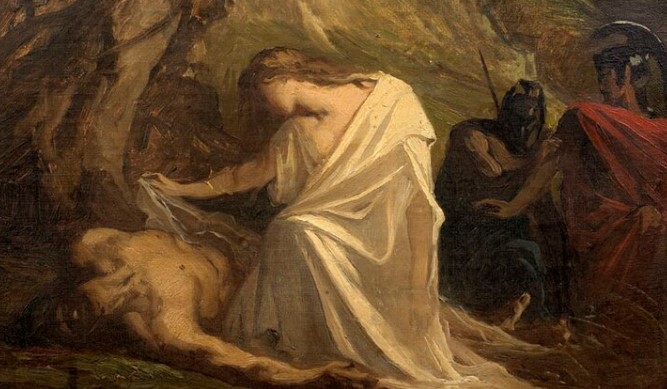
It begins with a burial.
Before Creon speaks, before Antigone defies him, before law is written or broken, a body lies outside the walls of Thebes.
Unburied.
This is where the story starts. With a fact the Greeks treated as prior to politics: the dead must be buried. The audience in the theater of Dionysus knew this with a precision we have lost. They knew it as law they enforced against themselves. Six years before Sophocles staged Antigone, the Athenian assembly had condemned six victorious generals to death. The penalty was not for losing the battle of Arginusae, but for failing to recover the bodies of the sailors drowned in the storm that followed their victory. They had won. It made no difference. The dead had not been buried. And for that, in the year 406 BCE, Athens executed the men who had saved it.
The audience watching Antigone understood what was at stake.
*
The war has already happened, but it did not begin with the brothers.
It begins earlier, with their father. Oedipus solves the riddle of the Sphinx and becomes king of Thebes. He marries the widowed queen, Jocasta, and rules successfully.
Then the structure reveals itself: the man who saved the city has killed his father and married his mother. The knowledge arrives all at once. Jocasta hangs herself. Oedipus blinds himself and goes into exile.
He leaves the city and his sons, Eteocles and Polynices, inherit the throne under an agreement to share it. Eteocles rules first. But when his year ends, he does not step down.
Polynices goes into exile to gather allies and attacks the city. The problem Antigone confronts was not invented by Sophocles. It had already been staged a generation earlier, as told in the Seven Against Thebes.
The brothers meet before the gates. And kill each other.
This is the condition Creon inherits: a city that must now decide what the difference is between defense and betrayal. Creon, brother to Jocasta, maternal uncle to the dead brothers and their sisters Antigone and Ismene, now speaks as king.
And like all restored orders, it requires definition. Creon draws the line. Eteocles, who defended the city, will be buried with honor. Polynices, who attacked it, will be left exposed. No rites. No mourning. No passage. The decree is political clarity.
A city that cannot distinguish between defender and attacker cannot defend itself. If the enemy is honored equally, loyalty dissolves. The boundary between citizen and traitor collapses.
Creon is not wrong.
The sisters face this decree together. Ismene sees the same facts as Antigone and reaches a different conclusion. She refuses to act because she accepts the power of a king. The Greeks do not present a single moral voice. They present a division. What separates Antigone from her sister is not information. It is the recognition of what cannot be made conditional.
But Antigone is sister to them both. Brothers. A structural relationship older than cities. Older than kings. Polynices lies exposed. And burial is not custom. It is obligation. Not symbolic. Necessary. To leave a body unburied is disorder. It prevents passage. The dead are denied completion. They remain in a condition neither living nor gone.
This is not metaphor. It is condition.
Antigone does not deliberate. She does not gather allies. She does not test the opinion of the city. She goes to the body.
Her position is not political. It is prior.
She does not claim a right. She recognizes a limit. A condition that cannot be revoked without altering what a human being is.
When Creon asks her directly whether she knew of his decree and defied it, she answers without appeal to grievance or rights:
Yes. Zeus did not announce those laws to me. And Justice living with the gods below sent no such laws for men. I did not think anything which you proclaimed strong enough to let a mortal override the gods and their unwritten and unchanging laws. They’re not just for today or yesterday, but exist forever, and no one knows where they first appeared.
Sophocles, Antigone, 450–457
Creon speaks as ruler.
Antigone answers as something older.
He speaks of law, order, survival. Of the necessity of obedience. Of the fragility of cities. She speaks of obligation that does not originate in the city. Of laws “not written,” not subject to decree. They are not arguing. They are not persuading. They are describing different worlds.
This is the point the modern reader may miss: Antigone is not a dissident. She is not a protestor. She is not making a claim against power. She is revealing its limit.
The distinction between them is not political. It is ontological. When Creon insists that the enemy can never become a friend, even in death, Antigone does not debate the point. She states, “I was born to join in love, not hate—that is my nature” (571-572).
She is not asserting a preference. She is naming a condition prior to preference. The verbs Sophocles uses here, symphilein, synechthein, appear nowhere else in Greek literature. He coined them for this moment. The distinction Antigone is making was precise enough to require new language.
Creon cannot yield.
If he does, the law becomes negotiable. Authority becomes preference. Every citizen becomes judge. The city dissolves into argument. He understands this.
Antigone cannot yield.
If she does, obligation becomes conditional. Kinship becomes subordinate to decree. The dead become objects of policy. She understands this.
Each position is coherent. Each is necessary. Together, they are impossible to reconcile within a single order.
When she is sentenced, she does not recant. She names what she has done and why, “Where could I gain greater glory than setting my own brother in his grave?” (502-503).
This is not the performance of suffering for an audience. It is the completion of an obligation. She has done what was required. The consequence was decreed. She accepts it.
*
The Greeks do not resolve this. They do not propose compromise. They do not offer reform. They let the system run to completion: Antigone is sealed alive. Creon’s son, Haemon, who loves her, kills himself. Creon’s wife follows. The king who preserved order destroys his house. The woman who honored obligation destroys herself.
No one wins.
The Greeks did not read this as a lesson in disobedience. They read it as a warning. There are domains that cannot be absorbed into political order without consequence. And when those domains are crossed, the system does not bend. It breaks.
The Greeks themselves did not attempt synthesis. They staged the collision. Because the lesson is not how to choose. It is where choice ends.
The Chorus names this directly, after the catastrophe has completed:
Wisdom is by far the greatest part of joy, and reverence toward the gods must be safeguarded. The mighty words of the proud are paid in full with mighty blows of fate, and at long last those blows will teach us wisdom.
1347–1353
Not a lesson. A reckoning.
Creon governs the living. Antigone answers to the dead. Neither can absorb the other.
This is why Antigone cannot be translated into modern political language without distortion. She is not asserting liberty. She is not demanding rights. She is not resisting authority as such. She is marking a boundary.
Boundaries are not negotiated. They are discovered – often too late.
The Greeks understood something simple and dangerous: before law, there are obligations. Before obligation, there are limits. And a system that forgets those limits will attempt to govern what it cannot contain.
The result is not injustice alone. It is catastrophe.
Antigone does not destroy Creon. Creon destroys himself by insisting that the structure of the city extends further than it can. Power does not fail because it is resisted. It fails because it exceeds.
The tragedy is not that Antigone disobeys. The tragedy is that Creon is right.
Until he is not.
And there is no moment, within the system, where that line can be safely drawn.
________________
Coda: Staging the Problem
The burial dispute that structures Antigone does not originate with Sophocles. It is inherited.
A generation earlier, Aeschylus had already staged the same distinction at the conclusion of Seven Against Thebes: the defender honored, the attacker denied burial. In Aeschylus, this division is not morally ambiguous. It is necessary.
Aeschylus writes as a participant in the Persian Wars. He fought at Marathon. His audience had lived through invasion, evacuation, and the destruction of cities. The memory of Thebes under siege is not distant myth. It is contiguous with Athens’ own experience of existential threat.
In that environment, the distinction between defender and attacker is civilizational. Those who held the line preserved the city. Those who defected, capitulated, or collaborated with the Persians stood outside it. The category of “traitor” was not rhetorical. It was lived.
Within that frame, the denial of burial to an attacker is not cruelty. It is coherence. The city survives because it can draw and enforce that line.
What Sophocles inherits, then, is not a question. It is an answer already justified under conditions of crisis. But by the time Antigone is staged, Athens has moved beyond survival.
Under Pericles, it has become an imperial power. It administers tribute, suppresses revolt, and projects authority across the Aegean. The logic of wartime necessity has not disappeared. It has been institutionalized.
This shift alters the problem.
In Aeschylus, the line between defender and attacker is drawn under pressure. In Sophocles, the same line is extended into law. Creon does not invent severity. He codifies it. The result is not greater clarity. It creates the conditions of collision. Because the extension of political logic into domains previously governed by custom – burial, kinship, obligation – exposes a boundary that crisis had concealed. What was necessary in war becomes excessive in peace.
The Athenian audience experienced the same tension in practice. After the battle of Arginusae, they executed their own victorious generals for failing to recover the dead. Burial remained obligatory even when it conflicted with military success. The limit was visible. But it was not stable.
Within a generation, Athens would press its authority further. In the episode Thucydides records as the Melian Dialogue, the city articulates its position with stark clarity: power determines what is done; the weak accept what they must.
This is not a departure from earlier logic. It is its continuation.
In Aeschylus, necessity justifies the distinction. In Sophocles, the distinction is formalized. In history, the formalization expands.
What tragedy provides is not instruction. It provides exposure. It isolates the structure and allows it to run to its limit. The Athenians leave the theater having seen, in concentrated form, a problem they were already enacting. That necessity, or expediency, once extended beyond its original domain, does not correct itself. It continues.
Antigone does not introduce a new principle. She reveals where an existing one fails.
The myth does not stop there.
Five centuries later, the Roman poet Statius returned to the same burial dispute in the Thebaid, his twelve-book epic retelling of the war of the Seven Against Thebes. He knew Sophocles. He knew what the collision meant. And he resolved it. Something Sophocles had refused to do.
In Statius, the women of Argos, denied burial for their dead, appeal to Theseus of Athens. Theseus marches on Thebes and compels the city to allow the rites. The irresolvable collision is resolved by a third party with sufficient force. Law, backed by the force of arms, overrides the impasse.
This is Rome’s answer to the Greek problem: administration, intervention, jurisdiction. The pre-political obligation that Antigone dies for does not disappear in Statius. But it is no longer allowed to stand as a limit on political authority. It becomes a grievance, addressed through power, by a sovereign capable of enforcing the outcome.
What Sophocles staged as catastrophe, Statius restages as resolution.
The difference between them is not literary. It is civilizational.
 Protective Arts