HUBUD AND REACTION DRILLS

“Why do you teach other drills, why don’t you stay with Aikido?” First I warned you at the onset that I am being selfish and I am experimenting. Furthermore, I am not convinced the traditional methods of monkey-see monkey-do teaching are the best.  Nor am I convinced that the exercises always get to the meat of the matter. Over the years I have watched my instructors experiment and develop and expand their understanding and I am inspired by their example (With a Chomsky-inspired linguistic bent, Mulligan Sensei once said, “Aikido should be generative”). I also warned you that I try to steal from everyone – not to create a hybrid, but rather to deepen my appreciation and understanding of the art of movement.

The art of movement. Aikido is my “mother tongue” but one should learn to speak many languages in order to explore the richness of communication. So, I introduce new phrases to make you appreciate the richness of your own lexicon.

One element in Aikido that has troubled me deeply is the ‘one hit, one kill’ premise. This premise leads to a dangerous ‘artifact of training.’ Let me explain. After I returned from Japan, I started training karate to enhance my Aikido (Okamoto Sensei disagreed with the pithy comment, ‘one lifetime, one art’). At the time I saw the arts as different yet complimentary – puzzle pieces that fit together to make a better whole. Regardless of the ultimate relationship of the arts to each other, what I realized was a limitation Aikido fostered in me – the idea that a successful hit ‘ended’ the encounter. It was in my first kumite – sparring bout – when I landed a well-timed side kick on my opponent that I reflexively stopped. In my mind I knew I had ‘won.’ However, the bout did not end and my opponent recovered and proceeded to land a series of punches. It took me a while to recognize that the fight was still on.  Training in Aikido had ‘conditioned’ me to stop after a successful technique. A conditioned reflex – an artifact of training.

It is because of this lesson that I occasionally “mix it up” by including reactive training methods. In the past I have shown this with a yokomen, gyaku-yokomen double attack sequence. Most recently I have used a very rudimentary hubud lubud drill.

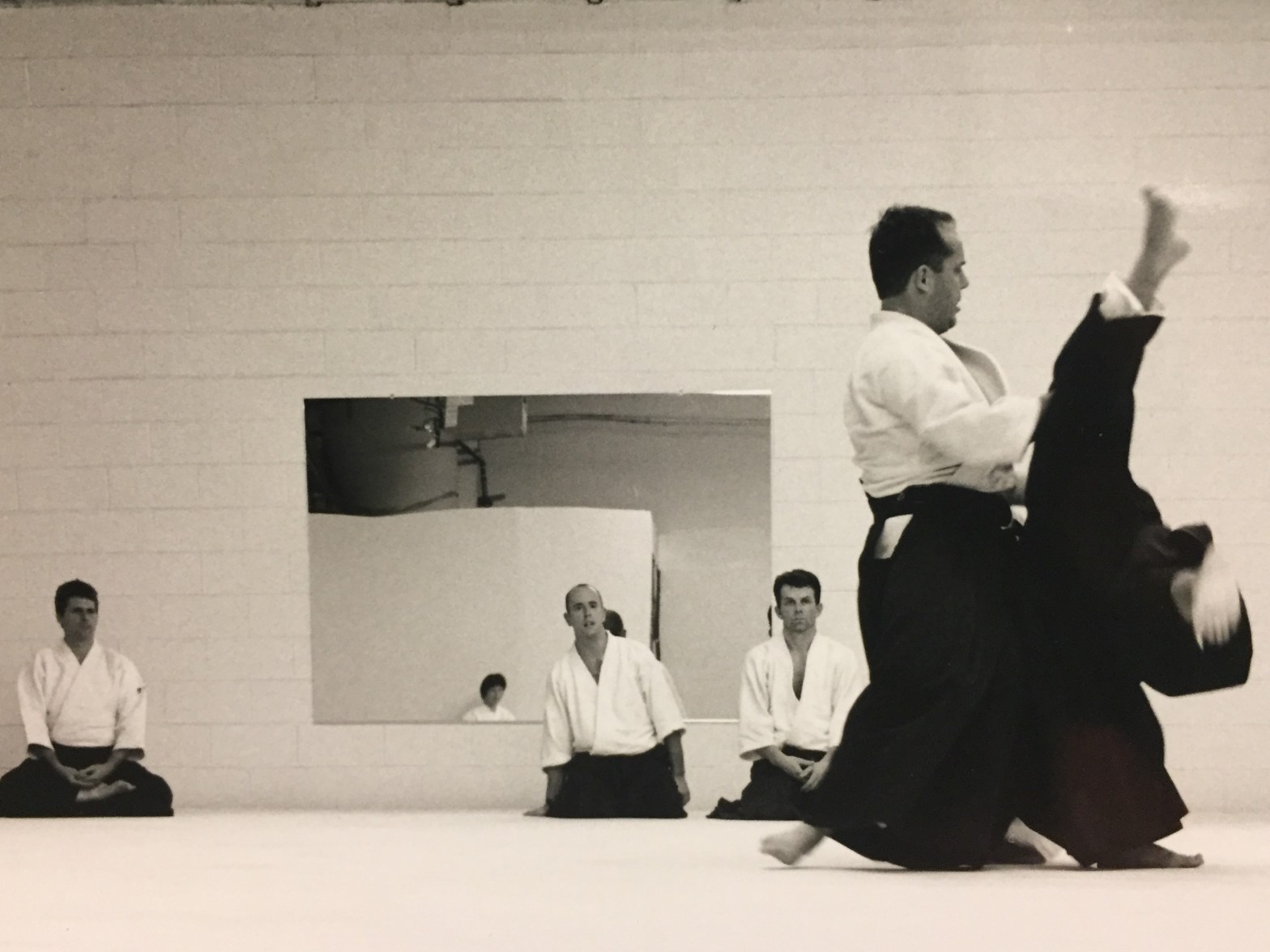
Despite being cribbed from the Filipino Martial Arts (FMA), hubud is familiar to Aikidoists as, yokomen countered with ashi-sabaki ikkyo with the added two beats of a trap and terminal punch (ask me in class if this doesn’t make sense to you). So as a drill it shouldn’t feel too strange to your body. What confuses people is the tempo of the delivery. It is a ballistic drill with a quick tempo not terribly familiar to most Aikidoists. That is because it is a reactive drill – meaning it is designed to improve your reactions. Reaction training should improve your coordination. The better coordinated you are with the specific movements, the faster you can perform them. First, however, you need to know what to look for before you can react. To develop your ability to react, you need to know what it is about your opponent’s movement that will cue you to the proper response.

Hubud starts as a simple oblique angle attack – a feed from the side (like yokomen or a haymaker punch or Angle 1). This gives you time to recognize the threat and set up the response. (Later it can become a straight thrust.) Given the set stimulus, you can focus on recognizing the cues and build on successful repetitions. Remember we are training to succeed and not fail, therefore we must always gain in proper repetitive actions.

Successful repetition is defined as increasing your ability to recognize telegraphing movements that your partners present when they are preparing or just beginning to deliver an attack. Watch for the ‘tells’ before the attack is delivered: changes of expression, movement of the eyes, shifts in balance, footwork, positioning, posture, etc. that present themselves before the actual attack. If you can see a tell in your opponent – learn how to minimize them in yourself. Further successful repetitions leading to ‘seeing’ the attack before it is delivered will increase your perceptual speed, allowing you to become ‘faster’ in the response. By recognizing the signs of an imminent attack earlier, you will have more time to process what is happening and therefore more time to respond. Hubud should allow you to readily work on the threat recognition. You know it will be yokomen(esque) so the ‘correct’ response in the drill is simple – get in an ‘intercepting’ strike (aka gyaku hanmi block). That is beat one of a four beat drill.

Strike – (1) intercept (2) redirect (3) trap (4) strike, which starts the sequence for your partner to start their 4 beat response. Notice because it is an even beat count that the pattern is right to right, or left to left. But more importantly for Aikidoists, notice that it is a 1 to 4 response pattern. You are doing four movements for every one provided by your partner. And then the sequence repeats without a ‘conclusion.’ So it is reactive – meaning a quick stimulus-response(s) – drill combined with a constant movement. No conditioned stopping point. This is a different psychology of training than most of us are used to. An “Ouroboros” loop.

ouroboros
Ouroboros

To improve on reactions – one simply adds levels of challenge (faster, more pressure, different angles of approach, etc.) but avoid adding fake movements of feints until a high level of proficiency has already been achieved. We don’t want to ingrain flinches or poor responses. I have introduced reactive drills sparingly. It is clear that transitioning from relatively slow coordinated practice (i.e. “normal” training) to reacting smoothly within fast-paced reaction drills is a challenge. Skills will break down initially when you are under pressure. However, they will improve through practice under pressure. This is a normal part of the process. Don’t let it discourage you. Training for reaction requires a structured and progressive approach. Developing sound coordination and a good understanding of the cues and proper responses involved are prerequisites – hence a ‘simple’ hubud drill as one tool to learn from. By gradually adding pressure that allows you to reach just a little above your current skill level, you will make progress quickly, and you will continue to see improvement. Going too fast and too hard can lead to sloppy results and bad habits. That must be avoided at all costs. Remember, the goal is to use drills to bridge our skills up to the level required for application.

But this is a reaction drill: didn’t you say to react was to fail (the old action is faster than reaction example)? Indeed – hubud is a way to train a reaction, but the training method is not the end goal – it is a means to a better end.

This morning I presented two interpretive entries on irimi – first from “elbow shield 2” and then from a scallop cut to the triceps. Neither should be construed as “the” entry since both are (to my mind) just training tools to show how to establish a connection to uke. They are physical metaphors. Otherwise I would simply present the “how” to do limb destruction rather that the “why” to move. I am not sure how better to stress it other than to repeat the idea that one must first know how to destroy before once has the choice to connect. We are striving to develop the higher level skill set of empowered choice.

I ended class with the simple hubud drill connection to ashi sabaki‘s exercise. It is easier to show that to write about – but I am using the exercise to remind us all to ‘trade’ multiple beats for every one we are given and furthermore to use the multiple beats tactically as rhythm disruption, ‘flinch’ training and speed augmentation. Ultimately I am hopeful that this will become ingrained so as to result in a smoother ‘flow’ (rather than a staccato) so as to ‘look’ more like a ‘one breath’ response [which I suggest semantically disguises how many actions must take place]. Sorry – not trying to be cryptic but these notes rely on the context of the classroom presentations.

And emphatically yes, I am ‘borrowing’ from other arts to enhance my understanding of Aikido. My premise is that all arts are the study of human motion and none have primacy, therefore the quest of understanding universal lines of motion can glean evidence from every source.

This is a link to Hubud training tips from JAK and reposted below for redundancy to ensure ease of reference:

_________________________________

I have made a blend of the best hubud methodologies with those skills from the Snake and Crane arts. It is a decent union, each unique aspect of each of the three arts compliment one other. There is no conflict of styles. There is only smooth, unstoppable flow. Like a river (hubud) and its tributaries (snake & crane) a great force is thus built. That which opposes it often gets swept away in the current and unseen undertow’s. This is mind boxing at it’s best when properly learned. Knowing and using jing energy with Hubud is also helpful and this skill originates from Kung Fu.

I guess the primary thing to address in this article about the ten biggest sins of hubud training is to first identify what hubud is for those lacking first hand knowledge of it. Hubud Lubud means “to tie up and to untie” and this is why some people have said it is similar to a wing chun exercise known as chi sao. Hubud lubud is the basis in the FMA (Filipino martial arts) for trapping, striking, locking and various weapon applications as well. It also values the aspect of adherence as does the afore mentioned chi sao drill of kung fu. Hubud unlike chi sao is a multi-range method. Chi sao is a close quarter method only. Hubud on the other hand can play in three ranges and with weapons added too. Personally I feel hubud has more to offer than does chisao. The entire chisao connection has been way too overrated simply due to it’s association with Bruce Lee’s passing fancy with it. Yes, Bruce used chisao during a certain period of his development, but later moved past it in lieu of faster, better methods of developing skill. To blend the skills of chi sao with those of hubud lubud should be the goal of most modern fighters who employ these particular arts in their personal matrix of defense. Where chi sao holds center, hubud gives center, ah, the best of both worlds then. Do not see these methods as being different. Instead see them as “complimentary” to one another. Ok, let us take a look at some of the more common pitfalls that a person can encounter when learning and training in the various hubud lubud methods.

1. Releasing the trap:
To trap or tie up the opponents limbs is a large part of getting to the root of hubud. But what I most often encounter is anything but a trap. Why? Because most people simply release it. You see, hubud is a four count exercise. There is the initial deflection (startle response), followed then by the “carry” done with the back of the hand, next comes the slap or lift to trap (immobilize) the arm and last is the finishing blow. One, two, three, four movements and the hubud cycle is complete. The third movement (the slap or lift) must be kept in place. To simply slap the opponents arm and then release it is to defeat the purpose of the entire drill! I have asked many people if they “know hubud.” Most say yes they do, but find little value to hubud because it is a waste of time and has no real applications. Every one of them released the trap instead of making the opponent release it. Without that critical understanding and the proper energy (pressure) the drill makes no sense. It swiftly becomes a slippity-slap pile of crap. But it’s not the Hubud system that is at fault. It is a classic case of user error once again. Doh!

2. Knowing only one way and only on one side:
Here is another pitfall that seems to plague the practice of hubud. It is a pitfall that common sense could fix but most do not catch the slip. Too many people can only do hubud on one side, usually the weapon bearing side. You see it is the weapon applications of hubud that encourages the lop-sided effect. It’s an understandable mistake that should be corrected. Hubud is most often learned in a seminar setting. The use of a knife or stick makes for a faster way of learning hubud, so it’s a one sided application. Many never go beyond that surface level introduction to the hubud family of drills.

3. Having no ability to seamlessly switch sides (going from right to left without stopping)
So let us assume that you now have both right and left sided hubud under control. Now you must have a connecting piece. Like the master link in a motorcycle chain the hubud switch element is what brings it all together. There are many ways to “switch” sides, each switch is unique and teaches us another trap, a disengagement, a counter to a counter or a means of creating opening for a strike. Without the magical “switch” the hubud matrix cannot be fully realized. In fact the ability to effectively switch is a gigantic, critical piece of the overall skill set. Yet all too often I encounter those who say that they “know hubud” yet lack any ability to link the sides and concepts from a switch.

4. Thinking that hubud is just another drill rather than seeing it as an entire sub-system unto itself:
Seminar hubud is the most commonly seen version of hubud that people are aware of. What is called seminar hubud is the medio range application. There is the long range version too. It’s called panatuken style. The closest range is the siko version of hubud. The elbow is used exclusively in this range. Hubud has three ways to engage as well. The startle response parry is simply the easiest to teach, hence the most commonly found. There are one handed versions of hubud, there are exterior and interior lines of hubud. Each is different, but still the same. Sounds wild doesn’t it? Well it is and it’s a blast to grasp the entire system versus random pieces of the system. That is why you should come train and study with us – hubud is that good and you deserve to see the true picture for what it is. Did you know that hubud can be done with the legs as well as the upper body? Hubud with the legs is very similar to the kake nempal drills of silat.

5. Use of hubud one dimensionally, a limited purpose:
When I do encounter someone who can do hubud fairly well I find that they still lack insight into the depths of this wonderful exercise. For example if they practice hubud with the single stick then that is it. They never do it with the knife or the empty hand, just the stick because that is how they were first taught the drill, so there it stays. One dimensional training with hubud is a big problem. When one cannot define the multi-level character of hubud in a real time scenario then I say “You don’t know hubud”! You know one way, on one side, at one range. Very limited stuff – again the drill may not have much to offer at that limited point. But this is user error at work again. It is not a flaw within the hubud lubud family of motion.

6. Not understanding how to untie yourself once you are tied up:
To tie up your opponents limbs and take them out of action is the purpose of hubud. This then allows you slip in a blow or two and escape unharmed. But what if it is you that gets tied up? This is why you must focus upon the escape element. The trap and the escape from the trap share a 50/50 role in the hubud training. There is a science behind the “untie” (or escape)phase part of the hubud drill. It involves torque, body mechanics and sensitivity. Listen my friends, once you learn the science (the applied physics) behind this untie-escape element you really begin to appreciate the higher levels of martial art teachings. Many things begin to make sense that you were taught years earlier. Your quest for knowledge will have came full circle. It will then be time to recapitulate and to contemplate all of the many magnificent things that you know, but didn’t know you knew. IE: “remember to forget, because if you try to remember, you’ll forget”. I most heartily concur!

7. Not integrating hubud with other existing abilities:
Hubud can be a stand alone method or it can be a very slick trick to add onto an existing art such as karate, grappling, boxing or even football. Many professional NFL teams have been taught the secrets of hubud as part of their arsenal of the defensive line. Hubud’s universal nature allows it to fit in nicely with just about any discipline you want to apply it to. To use the abilities you garner from hubud practice to enhance your other abilities is genius. Plus, it makes the hubud knowledge come alive and provides some really fertile ground for future growth.

8. To not understand and apply “quadrant play” to hubud training:
Each and every time that limbs or weapons cross that briefly forms a “quadrant”. Meaning there are four gates that appear, four quadrants. By exploring each quadrant on your own (you do not need an instructor for this) you find out what is available to you. It may be a strike or a lock or even a throw. But it is an important aspect because hubud crosses and uncrosses with each of the four moves. Just slow it down some, take time to see the quadrants at each of the four points and then have fun, explore and learn!

9. To miss the energy connection. To have the moves, but lack the all critical “feeling”:
Over the years I met men who learned hubud from a DVD or book. They have the technical lines down well. Meaning the physical movements of hubud could possibly be learned by just watching someone do the exercise. But the pressure, the force or energy in properly done hubud is a rather distinctive thing. Too many people just know the moves of hubud lubud, the energy aspect of hubud is often overlooked and misunderstood. It takes getting together with someone who does know the correct energies to fully learn the how, why and when of these energies. Yeah I know, it all sounds sort of iffy eh? Well don’t let that stop you from learning this valuable material. The reason I exist is to guide you through this phase and lock in the vital knowledge you seek and deserve. Give it a chance, step up, hubud nor myself will disappoint you I promise. Come share the moment with us in an upcoming event. I’ll make sure you understand the hidden energy of hubud lubud myself. The energy is such a big part of hubud and it needs to be brought forth.

10. To miss the double tap connection: Pitter patter or paralysis?
Many disparage hubud as a mere pitter patter slapping game. It is a misunderstood four count sequence of actions and it is done in a fast slapping manner hence the “pitter patter” term. The double tap is at the middle of the set. Bam, bam! Fast and stinging! Now see that there are blocks that use muscle and bone to stop any opposing muscle and bone based attacks. In the case of hubud the double taps block the signal from their brain to their limbs. This in turns causes a blank-out. A form a momentary paralysis of both body and mind. This effects performance, intent and more – thus allowing you plenty of time to strike or escape. The hubud application truly does go beyond the physical realm. It is a high art, science walks shoulder to shoulder with skill. Hubud can cause effects in our opponents that are profound, once we touch them everything changes for them. So to those who still think that hubud is a pitter patter drill with no real purpose, please reconsider. Perhaps you misunderstood the material or never gave it a chance. For 2016 I will be doing a special Hubud Only seminar. And a DVD as well. This is in order to more fully explain the hubud family sub-system and to shed some positive light on an incredible skill set.

Conclusion: Timing, combat applications, rhythm and footwork all improve once you understand how to employ hubud as a ballistic overtraining device. Hubud in it’s myriad of forms is an ideal “fight simulator” allowing you to really hone in on specific training goals. I will be showing how this works to those who can train hubud with me in person. Your static and ballistic skills will be greatly enhanced through this advanced training mentality which hubud supplies. The swift, sure methods of hubud bring forth the latent speed and deception you already possess. Hubud training is the key to bringing it all together in a cohesive manner. Once you reach this level, you may then discard the hubud framework proper and just flow into total spontaneity. Hubud leads you to the thresh hold of combat creativity and spontaneous ability. Hubud is a vehicle that can be used to go anywhere in your training regimen and make it better. Develop yourself and help others develop their skills by understanding how hubud fits into the teaching, growth, enlightenment triad of power. Grasp this stuff and you’ll be a good fighter and a great Guro as well!

1. Releasing the Trap (Tie-up)
2. Knowing but one way, on one side only
3. Having no connecting right-left switch to link sides (and skills)
4. Perceiving Hubud to be just a “drill” rather than a minor sub-system unto itself.
5. Using Hubud one dimensionally, for limited purposes.
6. Not Understanding “how” to un-tie yourself and Why it is done
7. Not integrating Hubud with other existing abilities
8. To not practice “quadrant play” and discover Hubud’s secrets from it
9. To miss the energy connection. To have the moves, but lack the all critical “feeling”
10. To miss the double tap connection: Pitter patter or paralysis?    

_______________________

OODA LOOP

I was introduced to John Boyd’s OODA loop when taking a defensive fire-arm class. Boyd was a successful fighter pilot in the Korean War – he also had an analytic bent and distilled his experiences in a series of briefings.

Boyd never wrote down his ideas about the OODA Loop in a formal paper; he only shared his thoughts in oral briefings. However, those briefings (which evolved over time) have been well studied, and in his Science, Strategy, and War (2005) Frans P.B. Osinga consolidates Boyd’s disparate briefs, notes, and lectures to show how the implications of the OODA Loop extend far beyond a simple four-step process. Nevertheless, the steps provide the basic framework.

The central tenant was (in good military fashion) is the acronym OODA which stands for: Observe, Orient, Decide, Act. It is a good shorthand reminder of proper strategic thinking.

The power of the concept is that it makes explicit that which is usually implicit. It takes the basic method to employ to think, decide, and operate in the world and codifies them into a strategic system that can allow you to succeed in the chaos of battle. It is a learning system, a method for dealing with uncertainty, and a strategy for winning.

At its simplest – the ODDA loop is showing how to keep adapting as information is received:

Evolving system

Boyd continued to refine and expand this concept adding greater granularity, but for our purposes, the simpler the better. The loop can help provide a framework for processing information in a rapidly changing environment. So let’s unpack the four phases.

Observe

Insert here – zanshin – or Cooper’s condition yellow – a state of relaxed heightened awareness.[1] If you are constantly observing then you remain open to new information so as not to be caught unaware. New information allows us to form new mental models. The first Jason Bourne movie (The Bourne Identity, 2002) is a great example of the continuous processing of information using excellent situational awareness. In daily self-defense, observing means things like knowing where all the exits are, noticing congregations of young males, or other statistical threats, or just noticing those elements that are out of place. Subtle cues that suggest something isn’t “normal” and therefore merits focused attention.[2]

Orient

Focused attention – you now orient on that information that piqued your attention: what is it precisely that made you look twice? At this point, the information is something to keep tabs on – we have only imperfect information but need to keep observing in case new information shows it to be a threat.

Orienting is where our mental model exists – where we ‘process’ the information and shapes how we observe. To get good at orienting you must be willing to jettison comfortable paradigms in favor of ones that match current reality. Boyd called this process ‘destructive deduction.’ One of the best examples of this process is found in the brilliant 13 Rue Madeleine (1947) where the agents are tested on their ability to distinguish a car backfire from a gunshot.[3] How we process information is largely contextual and most people are hesitant to star ripping apart their mental constructs into discrete parts in order to reform a better hypothesis. This is a continual process; as soon as you create that new mental concept, it will quickly become outdated as new information is received. So how do we not get stuck in always orienting? Have a plethora of mental models – familiarize yourself with numerous theories and fields of knowledge as possible. Have a plan and act the plan. Constantly challenge your thinking – dismiss doctrine and dogma even if you think it is correct. In short, start destroying and creating mental models. “Sensei, does this really work?” Your fluency in destroying and creating mental models will only come with practice, so start doing it as much as you can. Have others challenge your paradigm. “Does Aikido work against karate?” Try to validate mental models before operation. I have asked other instructors from other arts present on their methods so as to expand your mental models – in Kenpo they do this, in Karate that, etc., so as to break rigid thinking and to validate your new models – “So does this technique work in this environment against that opponent?”

Decide

Boyd expanded much on the decision step – it is the “component in which actors decide among action alternatives generated in the Orientation phase.” But all we can ever do is make the best decision based upon the information at hand – and we always have imperfect information of our environment. At this stage you select your action plan.  The more experience (“I have been encountered this before”), the shorter the orienting phase, the quicker the decision phase and the quicker to Act.

Act

Once you’ve decided on your action plan (strategy, technique) to implement, you must act. Action is how we find out if our mental models are correct. If they are, we win. If they aren’t we hope we get the chance to start the OODA Loop again using our new information.

In summary: You need to have a plan and execute it immediately. You must finish your loop before the bad guy does, or strategically interrupt his to gain the initiative.

In Japanese martial theory, the concept of Go No Sen describes the problem, specifically when the attacker initiates the encounter the defender must “regain the initiative after being attacked.” Most practitioners struggle to escape the limitations of Go No Sen: They are forever reacting to an encounter and fail to learn to dictate the encounter – before or after it is initiated.

Valuable lessons can be gleaned from watching video’s of the Founder. Never forget that O’Sensei entered and survived combat, his skills were battle tested. However, in post war demonstrations some accused him of staging demonstrations – ukes seemed too complicit, too responsive. Watch the footage. It is a logical conclusion for the uninitiated. However, look more closely and you should see mental combat as well as good strategy. O’Sensei uses feints, offers targets to attack (baits), he executes pre-emptive atemi, kiai, all to dominate the encounter and force uke to attack to precisely where he wanted.

Boyd provides an analytical framework to help explicate the means of taking and retaking the initiative to dominate the encounter.

___________________________

[1] Col. Jeff Cooper. Situational Awareness color codes are much discussed. We need not parse them deeply nor debate how many there are, rather recognize them for a good short-hand to prod us into better overall awareness:

Coopers-Color-Codes.jpg
Black is one level up from here

[2] The Gift Of Fear (Gavin De Becker, 1997). A good read with a simple message – trust your instincts. If a situation ‘feels’ bad, it is. Don’t prevaricate – act. Your subconscious processes more information that your awareness can filter.

[3] 13 Rue Madeleine (1947). [Colorized version >here<] I cannot remember when I first saw the movie, but it made a lasting impression on me because of the training methods depicted as well as it just being a great film. I know it isn’t the fast-paced, quick-edits we are used to now, but it remains one of the better spy movies in cinema history. One of my favorite scenes is when Cagney discusses how he discovered the German spy – a nice application of the “theory of cultural types” that Ruth Benedict (among others) was developing as an anthropologist working in the war department to better understand the psychology of the enemy – she later published her research as The Chrysanthemum and the Sword. Her earlier Patterns of Culture is still a good read.

ON THE IMPORTANCE OF WINNING

Part of the kuden – the oral history – of Aikido revolves around a story that during the US occupation of Japan some of O’Sensei’s students would test their progress through a practical application of the art – i.e., they would get into fights – (Sadateru) Arikawa comes to mind. O’Sensei would admonish them that they should not fight but would pointedly ask “Who won?” and reportedly became furious if his students lost.

Clearly O’Sensei retained a martial spirit and wanted Aikido to be an effective art. And while competition in the dojo was forbidden, that should not be taken to mean avoiding all conflict. When conflict is unavoidable, he demanded success. So what skills are necessary to prevail?

  • situational awareness
  • adequate preparation
  • the ability to quickly take action appropriate to the situation “Do whatever it takes”

Why the focus on winning? First and foremost because being able to win is the only indication of skill. But Aikido doesn’t have competition. (Hence, “Aikido attracts the losers because everyone is a winner” – a ramification of the ‘every participant gets a trophy’ mentality.) It takes more than showing up and it takes more than days on the mat – it takes productive time where you try to leave better than you were when you came in. I have seen people with decades of practice time and they still could barely execute basic movements: clearly they had experienced the same single day of practice, every day for the last decade. Time does not equal experience. So winning here isn’t competition to establish some juvenile sense of achievement or hierarchy, but rather winning to ensure progress. A crucible of honesty so that we do not become enamored with what may be a naive understanding of our ability.

“But your description of winning seems crude, perhaps brutal, certainly not very refined like good Aikido should be.” Perhaps. I would brand what I aspire to a “fighting science” rather than a spiritual path. Spiritual growth should be a consequence, but it is not my primary focus. I know nothing of Oomoto-kyo and kotodama so I demure to say nothing – following Wittgenstein’s[1] conclusion in the Tractatus.

Social confrontations, disagreements and conflicts seldom need to escalate to violence. But the very nature of our practice necessitates physical violence – or more specifically the ability to control physical violence. You must first be able to win to be able to choose how to win.

Situational Awareness

A simple term – much loved in the self-defense world – Boyd’s OODA loop, Cooper’s color codes – for we Aikidoka: zanshin (relaxed awareness). Mushin (no mind), shizentai (natural posture) and zanshin are commonplace phrases – but they are really aspirational states – meaning nothing is father from a “natural” reaction in a violent encounter than a “relaxed” awareness or a “natural” posture. Idealized stories like those of Yamoaka Tesshu (Sword of No Sword) provide a historical reminder – but I think a more recent exemplar in Aikido is Seigo Yamaguchi (see his demonstration at Meiji University).

The physiological reality is diametrically opposite of these aspirational goals. In violent encounters the brain focuses on the threat (tunnel vision) and the senses shut down (auditory exclusion is common). The muscles tense and fine motor skills diminish and grip strength increases. So clearly training is an attempt to overcome our physiological baseline – we are attempting to move beyond mere biology.

There are a number of tricks to employ here. First is simple exposure to startling or confrontational situations. The more exposure the more familiarity – the challenge is to learn to have increasing control over your own actions with every encounter (desensitization). Notice the focus on the self-awareness and the self-control. We need control ourselves first and foremost before we can control others. Try building an ever expanding level of awareness – meaning in each situation on the mat start with being aware of what you are doing. (When training I try to accelerate the learning curve by closing my eyes – get rid of the extraneous visual information and feel what is happening.)  Then once you feel confident you know how you are acting, moving, reacting, then try expand your awareness as to what your partner is doing. The next level is expand to what/who is acting in close proximity to you. Keep expanding. There is nothing mystical about situational awareness but it takes work. Paying attention to the details – noticing that which doesn’t belong – what is different? 

An oft cited example of developing awareness is “Kim’s Game” from Rudyard Kipling’s 1901 novel Kim during his training as a spy. James Bond is another easy example. His savoir faire results from hard won experience and great observational skills. Pay attention to your “6th sense” it ain’t BS – we all take in more information than we can process so when your subconscious starts signaling – listen. Better yet, be more actively aware – zanshin – than to “trust your gut.”

So you are aware of the threat – how do you respond? There are many great postures, kamae, or guards to take and each art will advocate for one over another. Aikido advocates, shizentai – a natural posture which is effectively, no guard. The theory is that by taking no kamae there is no opening, no one specific avenue for the opponent to attack, seemingly all of you is open, therefore nothing is available. Okay, enough mysticism. (But there is the perversely brilliant logic. As Okomoto sensei once told me: “If there is no solution, then there is no problem.”) However, I believe that it really works more like this: we deceive our opponent to attack along an avenue we select. A guard or kamae telegraphs, whereas we aspire to “lead the spirit” to the appropriate target. How is leading the spirit a scientific understanding of combat? 

Here is “leading the spirit” in action from the Tombstone shootout scene – watch Val Kilmer as Doc at about 1:25 forward. 

Doc Holliday draws the attack

Brilliant scene, great movie! The point is, when playing on the level of human psychology, deception becomes more than mere physical movements. We do this to each other all the time – presenting the wrist to encourage the engagement, a shift of the head to indicate which side to strike yokomen, the obsessive focus on which foot is forward. All of this conditioning will result in an “artifact of training” (meaning bad combat habits) if you allow yourself to be blindly conditioned, but if you are paying attention, you can start to minimize your motions, and start to project intent, to “psych-out” your opponent. Need other examples? Sympathetic reactions, like thoracic breathing rates to first match then slow the opponent’s breathing rate, contagious yawning, or simply looking quickly askance to direct another’s attention. Misdirection.  Using psyops so that you call the shots.

Another way to convey the same principles: The old story of a tea-master and samurai. A tea-master bumps samurai, who is offended and challenges him to a duel.  The tea-master frantically goes to a samurai buddy to get some training and is told to simply go into the duel with the same mindset as he would approach a tea ceremony. At the day of the duel, the opposing samurai notices the change in demeanor, apologizes and calls it off. Why? Mumbo-jumbo aside – it’s fake it ‘till you make it. We all bluff and deceive and it’s what we must do against any adversary. A kamae is just one form of deception – creating the illusion of an opening. In Aikido – we are aspiring to pull off the ultimate bluff – of being vulnerable so as to become impenetrable. A bit of poetic treacle – but by staying calm, controlling our emotions and our body we retain the upper hand. A more “active” version is give no signal as to intent except to provide the indication that it would be a mistake for our adversary to resort to violence. Anyone who remembers trying to approach or attack Chiba sensei can appreciate that demeanor.

Being prepared to do whatever is required

This is the single most difficult principle to teach. During training, often Aikido “doesn’t work” because uke fails to attack with sufficient intention (or targeting accuracy) so the entire encounter fails and looks silly. It only took me a few years to realize that uke’s pathetic attacks were a reflection of the beauty of the human condition: most of us are unwilling to try to harm each other. It takes conditioning to overcome that reluctance. So “doing whatever it takes” is broadly ambiguous from necessity – because you cannot chose where, when, how, by whom, or by how many you will be attacked and therefore must prevail against. But having a winning mindset involves being prepared to do what is necessary.

When Mulligan and Okamoto sensei were living in Portland, I was often at their house and recall Chris watching Michael Jordan and admiring his “winning spirit” something that made no sense to me primarily because I have no love or appreciation for basketball. However, Chris extolled Jordan’s drive to persevere and prevail and to do it with physical aplomb. More recently, I was watching my older son play in a “friendly” soccer tournament. It was Thanksgiving morning – miserably cold with a blustery and unnaturally heavy rain – and they were playing in a 3v3 format on quarter fields. It was just for fun but a minor prize was up for grabs to the winning team. My son’s team mates were not at their best and he was getting frustrated, they had been up in the first half but the game was now tied. Adin asked the coach how long before the end of the 2nd half and was told one minute, so when he challenged the next player, he took the ball and then booted it a full field length to ensure the other team could not gain possession and possibly score. Brilliant strategy – a bit overzealous I thought – but it showed me his determination to prevail. Do what it takes even if it is simply denying an opportunity.

While sardonic – Schopenhauer’s The Art of Being Right shows us that the point of public argument is not to be right but rather to win. Frighteningly, while I hope Schopenhauer wrote this as satire, his 38 ways to win now seem to be a training manual for political discourse: “Dialectic, then, need have nothing to do with truth, as little as the fencing master considers who is in the right when a dispute leads to a duel. Thrust and parry is the whole business.”

Diverse examples, but meant to show a range in responses that sum to the determination to prevail. And is an impolite truth to remember that we are all progeny of winners.

Sound too polemical? Darwin in the dojo? How can this be a truth of Aikido? I have focused on winning because you should never train to lose. If your goal isn’t to win then de facto you lose. You don’t train to miss (but in everyday practice all too often that is all I see). You must train to target vital areas. If your motions do not lead to your opponent’s incapacitation, then your actions have no purpose. Ah, you may say, but my Aikido leads to my opponent’s salvation. Remember O’Sensei dueling with the kendo master, you may say, and how O’Sensei defeated him without violence? And I reply, he could do so only because at any time O’Sensei could have resorted to violence. He had the skill to win and the skill to choose how to win. And it is precisely at the level of choice that the path to self-mastery begins.

I win
I win!

______________________________

From Ramblings of the Roach – by James A Keating

Technique is merely an outward manifestation.
It’s an action of the limbs or of the body. 
At some point it approaches the level of “monkey see, monkey do” for some schools. Not satisfactory preparation for any real brawling. Being overly focused on technique too early on in ones career can act as a brake to their development and mastery of the skills. Lacking in such regimens of technique reliant training are the critical components of spontaneity, flow, timing and sensitivity. Defending oneself doesn’t have to be something too “martial artsy.” It just has to be effective & practical. Being able to “do the right thing” in a fight is an example of spontaneity and flow at their best. It’s not just an ideal to live up, mind you it can be a reality unto itself. Remember, hurting someone in an anything goes street fight is a far different spirit and game than any “match” between experts. Put sports out of your mind when you read my stuff friend. It’s all sand and little fluff. 

SPONTANEITY: 
It occurs from the relaxed mind of one confident in their abilities. 
Confidence does not come from technique, confidence comes 
from skill and the ability to fluidly back it up. 
Spontaneity is thought & motion operating as one force.
It moves as intuition and multi-sensory instinct.

___________________________________

[1] As a diversion – more on Wittgenstein:

A Nervous Splendor

“The Wittgenstein family had a genius for misery.”

By Anthony Gottlieb

The family of Karl Wittgenstein, who was one of Austria’s richest men when he died, in 1913, may deserve some gloomy sort of prize, the Palm of Atreus, perhaps. His youngest child, the philosopher Ludwig Wittgenstein, once asked a pupil if he had ever had any tragedies in his life. The pupil, evidently well trained, inquired what he meant by “tragedy.” “I mean suicides, madness, or quarrels,” replied Ludwig, three of whose four brothers committed suicide, two of them (Rudi and Hans) in their early twenties, and the third (Kurt) at the age of forty. Ludwig often thought of doing so, as did his surviving brother, Paul. A budding concert pianist when he lost his right arm to a Russian bullet, in 1914, Paul was imprisoned for a time in the infamous Siberian fortress where Dostoyevsky had set his novel “The House of the Dead.” Ludwig later claimed to have first entertained thoughts of suicide at around the age of ten, before any of his brothers had died. There were three sisters: Gretl, Helene, and Hermine. Hermine, the eldest child (she was born in 1874; Ludwig, the youngest, arrived fifteen years later), and the guardian of her father’s flame, never married. Helene was highly neurotic, and had a husband who suffered from dementia. Gretl was regarded as irritating by most people, including her unpleasant husband, who committed suicide, as did his father and one of his aunts. Bad temper and extreme nervous tension were endemic in the family. One day, when Paul was practicing at one of the seven grand pianos in their winter home, the Palais Wittgenstein, he leaped up and shouted at his brother Ludwig in the room next door, “I cannot play when you are in the house, as I feel your skepticism seeping towards me from under the door!”

All of this was before the Nazis got to work. The Wittgenstein children were brought up as Christians, but they counted as full Jews under the Nuremberg racial laws because three of their grandparents had been born Jewish and did not convert to Christianity until they reached adulthood. (The fourth, their maternal grandmother, had no Jewish ancestry.) After Germany annexed Austria, in 1938, the family money bought the lives of the three sisters—Paul had escaped, and Ludwig was safe in England—but at the cost of estranging several of the surviving siblings from one another. A few days before the invasion of Poland, in 1939, Hitler found the time to issue an order granting half-breed status to the Wittgenstein children, on the pretext that their paternal grandfather had been the bastard son of a German prince. Nobody believed this tale, but the arrangement enabled the German Reichsbank to claim all the gold and much of the foreign currency and stocks held in Switzerland by a Wittgenstein trust. The negotiations for this exchange seem to have involved a secret pact in which Gretl and Hermine sided with Nazi officials against Paul. After the war, Paul performed with his single hand at a concert in Vienna but did not visit Hermine, who was dying there; Ludwig and Paul had no contact after 1939; nor did Paul and Gretl. This was not a happy family.

Alexander Waugh, the author of “The House of Wittgenstein: A Family at War” (Doubleday), is no stranger to family sagas. He belongs to the fourth generation of an English literary dynasty that includes the novelist Evelyn Waugh, who was his grandfather; his previous book, “Fathers and Sons,” is a memoir of the Waughs. The publishers of “The House of Wittgenstein” compare the “novelistic richness” of its style to Thomas Mann’s first novel, “Buddenbrooks: The Decline of a Family,” which was published in 1901. In fact, there are more than stylistic similarities between the Wittgensteins of Vienna and Mann’s invented north-German merchant dynasty. In Mann’s novel, the vitality and the solid businesslike virtues of the Buddenbrook family are sapped by introspection, homosexuality, loss of interest in commerce, overindulgence in art, and illness. If Karl Wittgenstein ever read it, he must have nodded in recognition. In a memoir that Hermine wrote in the nineteen-forties, she noted the “lack of vitality and will for life” that set her brothers apart from their father, and described his bitter disappointment that none of them wanted to continue his work in business. Like his wife and his children, Karl was highly musical, but he found his son Hans’s obsession with music to be morbid and strictly limited the amount of time the boy was allowed to play. Hans was a prodigy whose extraordinary musical perception became evident at the age of four; Gustav Mahler’s teacher, Julius Epstein, called him a genius. But Karl insisted that he follow a career in industry or finance. Rudi and Ludwig were homosexual, and Hans may have been, too.

There the parallels end. Thomas Mann traced the decline of the Buddenbrooks through four generations, but the Wittgensteins rose and fell within the span of two. Karl more or less built the family fortune himself. He was no stolid merchant but an audacious risk-taker, and something of a rebel in early life. At the age of seventeen, he absconded to New York, where he arrived in the spring of 1865 with a violin and no money. He worked as a waiter, then, among other things, he played in a minstrel band, a gig that came to an abrupt end when Abraham Lincoln was assassinated in a theatre and musical performances were banned. Karl was too ashamed to write to his family or answer their letters. It was only when he got a steady job as a teacher at a college in upstate New York that he recovered enough pride to agree to return.

His father was a land agent and a trader, and at first Karl was put to work on one of his rented farms. Then he briefly enrolled in Vienna’s Technical University. After dropping out, he took a series of engineering jobs. Energy and intelligence got him into management, audacious deal-making took him higher, and some capital from his wife (he married in 1874) provided the first grains of powder for an explosive entrepreneurial rampage. Waugh says that Karl Wittgenstein was a chancer, whose enormous fortune owed as much to the favorable outcomes of his gambles as to his hard work and his skills. That is implausible; nobody has quite such a consistent run of good luck. Karl was adept at swinging the odds in his own favor, and he knew exactly which chances to take—in particular, he appreciated the significance of technology more keenly than his competitors did. Announcing his death, in 1913, The Economist wrote that “the Austrian iron and steel trade owes its rapid growth and development solely to him.”

Newspaper articles by Karl Wittgenstein show that he believed in unfettered capitalism (though not in free trade) and was opposed to any legislation aimed at protecting consumers from cartels or fraud. Such laws, in his opinion, would interfere with the crucial work of vigorous entrepreneurs, who would ultimately raise the standard of living for everybody. An early master of the leveraged buyout, he no doubt cut some corners while assembling his ingeniously integrated empire of mines, iron- and steelworks, and hardware factories. He certainly reaped the benefits of monopoly wherever he could find them. In February of 1900, The Economists Austria-Hungary correspondent reported from Vienna that Herr Wittgenstein would “soon have the power of fixing iron prices in Hungary also, as he fixes them in Austria.”

Karl was no philanthropist on the scale of his American friend Andrew Carnegie. He was more of a patron—one of the main supporters of the Secession, Vienna’s Art Nouveau movement led by Gustav Klimt (who painted a portrait of Gretl, which she did not like). But the family’s cultural life really centered on the grand Musiksaal on the first floor of their main house. Brahms was a family friend. He dedicated his violin concerto to Karl’s first cousin Joseph Joachim, whose famous quartet played in the Musiksaal several times each year. Richard Strauss came and performed duets with the young Paul. Schoenberg attended the soirées several times; Mahler, whose music Ludwig later dismissed as “worthless,” once attended but was not invited again after he left before the end of the evening’s entertainment.

Music was more than entertainment for the Wittgensteins, though, and more than art. For one thing, it became a store of value. Pages from the Wittgenstein collection of autographed musical manuscripts flutter through this wonderfully told story. Scores by Brahms, Schubert, Wagner, and Bruckner are stuffed in a potting shed by a quick-thinking servant while an art historian from the Gestapo rummages through Gretl’s house. A Bach cantata, two Mozart piano concertos, a Haydn symphony, and one of Beethoven’s last piano sonatas are smuggled to Ludwig in Cambridge, where he places them in a bank safe-deposit box. Gretl’s younger son hides Schubert’s “Die Forelle,” Brahms’s “Handel Variations,” some Beethoven letters, Wagner’s sketches for “Die Walküre,” and more, under a pile of socks in his suitcase, and heads for the Vienna railway station. Music was also, Waugh writes, the only effective way in which the Wittgenstein children could communicate with their shy, nervous, and intensely musical mother. And music provided consolation and distraction from the tragedies of the family, about which they were mostly required to remain silent.

Sometime in 1901, Hans fled from his father and went to America, much as his own father had done thirty-six years earlier. In 1902, he disappeared, by most accounts, from a boat, which may have been in the Chesapeake Bay, perhaps on the Orinoco River in Venezuela, or in several other places. Wherever it was, no one doubted that he had committed suicide. Hans’s disappearance was a banned topic. Rudi was a twenty-two-year-old chemistry student in Berlin when he walked into a bar on a May evening in 1904, requested a sentimental song from the pianist, and then mixed potassium cyanide into a glass of milk and died in agony. The suicide note left for his parents said that he had been grieving over the death of a friend. A more likely explanation is that he thought he was identifiable as the subject of a published case study about homosexuality. After Rudi’s funeral, Karl forbade the family to mention him ever again. Waugh thinks that this enforced silence, which the dutiful Mrs.Wittgenstein supported, created a permanent rift between parents and children. The exact circumstances of Kurt’s suicide, which took place on the Italian front in 1918, are unknown. He was generally regarded as cheerful, but Hermine recorded that he seemed to carry “the germ of disgust for life within himself.”

Perhaps it was because Paul, after he lost his right arm, had the most tangible affliction in the family that he found the focus to remake himself. His determination to succeed on the concert stage was, in part, inspired by the example of Josef Labor, a blind organist and composer who was a favorite of the Wittgenstein family. Géza Zichy, a one-armed Hungarian count whose pianism had enthralled Liszt, was another encouraging model. Zichy wrote a self-help book for amputees, which explained, among other things, how to eat a crayfish and remove one’s underpants with only one arm. Paul worked furiously and ingeniously to develop techniques that would enable him to perform. The training began while he was still recovering from the amputation in a Russian prison hospital, tapping on a dummy keyboard that he had etched in charcoal on a crate. Later, on a real piano, he often practiced for up to seven hours at a sitting.

At the peak of his career, in the late nineteen-twenties and early thirties, Paul’s concerts drew wildly enthusiastic reviews from respected critics; the Grove Dictionary of Music describes Paul as having had “an amazing virtuosity which enabled him to overcome difficulties formidable even for a two-handed pianist.” During Ludwig’s lifetime, the pianist brother—his elder by just two years—was much the more famous of the two. It’s also true that Paul continued to perform after his abilities had declined, and his reputation declined accordingly. He made few recordings, and Waugh, who is also a composer and a music critic, remarks that most of them are bad.

His most lasting significance comes from having commissioned one-handed works from at least a dozen composers, including Richard Strauss, Sergei Prokofiev, Benjamin Britten, Paul Hindemith, and Maurice Ravel, whose Piano Concerto for the Left Hand remains widely performed. Strauss extracted a particularly large fee, and Britten, at least, affected to be in it just for the money. (“I have been commissioned by a man called Wittgenstein,” Britten wrote to his sister. “He pays gold so I’ll do it.”) Paul often insisted on changes to the music, especially when he thought that the orchestra had been overscored and would drown out his playing. (Britten groused, “The man really is an old sour puss.”) There was also a colorful dispute with Ravel, who complained for the rest of his life about his dealings with Paul. There was worse in store for poor Hindemith, who wrote his concerto in 1923: Paul couldn’t understand the composition, so he filed it away. It was discovered eight decades later, in a Pennsylvania farmhouse that had belonged to Paul’s widow, and given a belated world première by Leon Fleisher in Berlin in 2004. Paul couldn’t fathom Prokofiev’s concerto, either, and he shelved that, too. In 1950, Siegfried Rapp, a pianist who had lost his right arm in the Second World War, asked for permission to perform some of these works, many of which had been written a quarter of a century earlier. Paul usually bought exclusive performing rights for his commissions, and he said no. A few years later, Rapp obtained a copy of Prokofiev’s concerto from his widow and went ahead, anyway, infuriating Paul.

It is hard to warm to Paul’s refusal to let anyone else perform pieces that he wouldn’t play himself. (He even felt betrayed by composers who wanted to rearrange his commissions to produce two-handed versions.) And, despite giving evidence of Paul’s kindness and generosity to friends, pupils, and old retainers, Waugh makes no effort to conceal his hero’s estrangement from the compromises that lubricate everyday life. Bertrand Russell once wrote of Ludwig that no one could be more “destitute of the false politeness that interferes with truth.” This was at a time when Russell was still enraptured by the young Ludwig. Russell later grew less indulgent toward his erstwhile pupil, but he had identified a family characteristic: when they believed that an important principle was at stake—which, for them, was often—the Wittgensteins were not inclined to be nice.

Most of Paul’s eccentricities were perhaps the normal ones for a loner who had been brought up amid vast wealth. He was a fiercely private man who liked to book entire railway carriages for himself, even when travelling with his family. His wife, Hilde, who was half blind and had been his pupil, bore him two children in Vienna before their marriage; the elder child had been conceived shortly after their first piano lesson, when Hilde was eighteen years old and Paul was forty-seven. Because Hilde was not Jewish, Paul was open to charges of “racial defilement,” and in 1938 he fled Austria. When his wife and children arrived in the United States, in 1941, he set them up in a house on Long Island, which he visited on weekends from his apartment on Riverside Drive. Arriving in New York without a valet, he soon ran into trouble. When his clothes were stolen from a hotel—he had left them outside his room, presuming that someone would wash them—he sat around in bedsheets until a candidate for the post of personal assistant came up with the suggestion that more clothes be bought from a shop. She was hired. Another anecdote has him sallying forth into the street wearing a hat that was still attached to its box.

In the Wittgenstein family, it was not the philosopher who was the unworldly one. Ever since childhood, the last-born Ludwig had had a passion and a facility for mechanical things. At the age of ten, he constructed a working model of a sewing machine out of bits of wood and wire; while serving in the Austrian Army, he demonstrated a more dangerous practicality by improvising his own mortar in the field. After leaving school, Ludwig studied engineering in Berlin, specializing in hot-air balloons, and then moved to Manchester to work on aeronautical engines; in 1910, he patented an improvement in propeller technology. It was then that he heard of Bertrand Russell’s work on logic and decided to study with him in Cambridge.

Russell found him to be a tormented soul, unsure of his own abilities and unsure whether to be an engineer or a philosopher. Russell soon decided that Ludwig was the most perfect example of genius he had ever known, and persuaded him not to continue with engineering. “We expect the next big step in philosophy to be taken by your brother,” Russell told Hermine. But he feared that his new pupil was on the brink of suicide, as he explained in a letter to his mistress, Lady Ottoline Morrell. Ottoline wrote back that hot chocolate would calm Ludwig’s nerves, and enclosed a packet of cocoa tablets for Russell to give him.

If they ever reached Ludwig they did not do the trick. He continued to work with a feverish intensity on the problems of logic that he was discussing with Russell and to agonize about his life. The way those two topics were entangled in Ludwig’s mind can be seen from his “Tractatus Logico-Philosophicus,” a gnomic masterpiece that he completed as a soldier in 1918. The “Tractatus” is a mixture of logical symbols and mystical remarks in which Ludwig attempted to delineate the limits of language. Certain things could be expressed in language, and these were best understood in terms of the logical techniques developed by Russell, he maintained. But others—and these were the most important things in life—could not be expressed in language at all. Hence the book’s famous closing line: “Whereof one cannot speak, thereof one must be silent.” The problems of philosophy could thus be dispatched by being divided into those that could be perspicuously rendered into Russellian logic, and thereby answered fairly easily, and those about which nothing could be said.

Frank Ramsey, one of Ludwig’s most brilliant friends, who had reviewed the “Tractatus” in Britain’s main philosophical journal as an undergraduate, quipped that “what we can’t say we can’t say, and we can’t whistle it either.” Ramsey meant that Ludwig seemed to be cheating by trying to specify exactly what cannot be said. As it happens, Ludwig—who, unusually for a Wittgenstein, seems not to have mastered any musical instrument as a child—impressed his musical friends with displays of virtuoso whistling. Several Cambridge dons recalled hearing him whistle the solo part of an entire concerto while a pianist played the orchestral part. Whether or not Ramsey had this curious feat in mind, the Wittgensteins were certainly in the habit of using music to express what they couldn’t say in words.

After the “Tractatus,” having thus exhausted all philosophical problems, and been exhausted by them, Ludwig took a break. He worked as a schoolmaster for six years and then as an architect, designing and obsessively supervising the building of a house in Vienna for his sister Gretl. During the First World War, he had read Tolstoy’s “The Gospel in Brief” and other writings that extolled the wisdom of peasants. Resolving to lead a simple life, he gave his share of the family money to three of his siblings; since they were very rich already, he believed they could not be corrupted further by receiving his portion. Then, in 1927, his interest in philosophy was rekindled. This time, his view of language changed—the emphasis on Russellian logic was gone—but one key idea remained the same. Both his old and his new philosophy shared an inspiration that he had come across as a teen-ager in “The Principles of Mechanics,” by Heinrich Hertz, a German physicist. Hertz had suggested a novel way to deal with the puzzling concept of force in Newtonian physics: the best approach was not to try to define it but to restate Newton’s theory in a way that eliminates any reference to force. Once this was done, according to Hertz, “the question as to the nature of force will not have been answered; but our minds, no longer vexed, will cease to ask illegitimate questions.”

Ludwig’s big idea was to apply this method to philosophical problems. In his “Tractatus,” he had tried to show that some philosophical questions were illegitimate because they tried to say the unsayable. The new approach was gentler and more therapeutic. By painstakingly examining how language works in everyday life, Ludwig now believed that one could be cured of the misconceptions that give rise to philosophical puzzles, and thus stop worrying about them. That is what he toiled on, mostly in Cambridge, until his death, in 1951.

Does this actually work? Curiously, it is hard to say, because Ludwig seldom dealt explicitly with classical philosophical problems. His writings hardly ever mention the great philosophers of days gone by, except in passing. So one has to work out for oneself what, if any, bearing his explorations of the workings of language have on the ideas of Plato, Descartes, or Kant. Ludwig intended his technique to be revolutionary: “Why should philosophy in the age of airplanes and automobiles be the same as in the age when people travelled by coach or on foot?” the former aeronautical engineer asked. It remains a point of contention whether he really found an honest way to dispose of philosophical questions or merely succeeded in changing the subject of conversation by the sheer force of his personality.

There’s a telling description of genius by Arthur Schopenhauer, the German philosopher of romantic pessimism, whose work was well known to Ludwig, Paul, Gretl, and Hans: “Talent is like the marksman who hits a target which others cannot reach; genius is like the marksman who hits a target, as far as which others cannot even see.” That seems to have been the Wittgenstein way: trying to hit targets that others could not see. But if ordinary mortals cannot spot the bull’s-eye, how do they know whether it has been hit? According to Schopenhauer, they just have to accept the evidence of genius on faith, which is what Ludwig’s admirers often did. When Ludwig attacked some of Russell’s ideas, Russell wrote to Ottoline Morrell, “I couldn’t understand his objection—in fact he was very inarticulate—but I feel in my bones that he must be right.” Other philosophers who met Ludwig reported the same feeling.

It’s tempting to come away from the Wittgenstein saga with the thought that Karl, if only he had lived long enough, would have acknowledged the iron-willed independence of Paul and Ludwig as a reflection of his own, and given them his blessing. But that would probably be expecting too much of him. Tragic or not, no family has room for more than one Wittgenstein.